
Ship Sinks After Door Accidentally Detaches, 852 People Dead
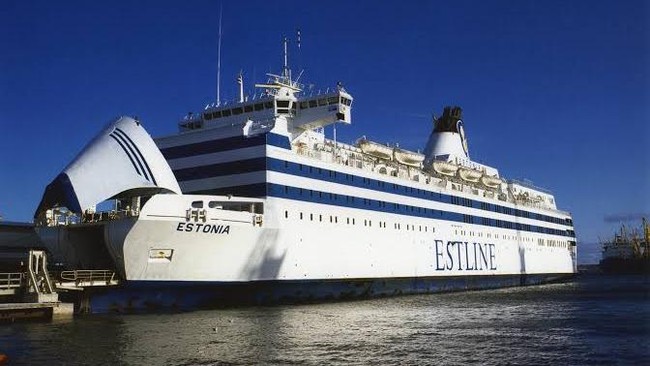
A ship door that suddenly detached became the beginning of one of Europe’s deadliest maritime tragedies. Seawater immediately rushed into the vessel, causing it to list and ultimately sink within minutes.
The ship was the MS Estonia, which sank in the Baltic Sea on 28 September 1994, exactly 32 years ago today. Of the 989 people on board, 852 perished in the tragedy.
On that day, the MS Estonia was sailing across the Baltic Sea from Tallinn, Estonia, towards Stockholm, Sweden, carrying 989 passengers. The sea was experiencing stormy conditions, causing the ship to sway under the impact of waves and wind. However, the passengers had no inkling that the journey would end in tragedy.
According to passenger testimonies on the Estonianworld website, at approximately 01:00 AM, all passengers heard a loud thud from the front of the ship. It appeared that the bow door, used for transporting vehicles, had suddenly detached. This allowed seawater to flood directly into the vehicle deck.
The water then spread across a vast area. The massive influx of water caused the ship to lose its balance. As the weight of the water continued to increase, the ship began to list rapidly.
As a result, the rapid onset of the event made it difficult for passengers to move towards exits and lifeboats. Staircases became almost vertical, while some evacuation routes became unusable. Approximately 40 minutes after the bow door detached, the MS Estonia finally sank in the Baltic Sea.
Records show that only 137 people survived, while 852 others died in the tragedy.
Citing a report from the Ministry of Transport and Communications, the primary cause of the bow door detaching was a combination of powerful wave impacts and a weakness in its locking mechanism. On that night, waves reached approximately 4–6 metres. The impact caused damage to the locking mechanism, eventually leading to the detachment of the bow door. Subsequently, a massive amount of seawater was able to enter the vehicle deck directly.
The influx of water into the vehicle deck is a serious issue for passenger ferries. Water can move freely across the deck surface, worsening the ship’s stability as it begins to list.
The MS Estonia tragedy subsequently prompted changes in safety standards for passenger ferries. Older vessels had to be modified to improve safety when facing damaged ship conditions.
Vehicle decks began to be partitioned to limit the spread of water, while hull structures were reinforced. The design and locking mechanisms of bow doors also received greater scrutiny to prevent similar occurrences.
The MS Estonia is ultimately remembered as more than just a ship that sank in the Baltic Sea. The tragedy that claimed 852 lives also serves as a vital lesson for the shipping industry regarding the fatal consequences of water entering the vehicle deck.
A single detached door was the beginning of the disaster. In less than one hour, a ship carrying nearly a thousand people ended up at the bottom of the sea.