
Ship Carrying Picnicking Employees Capsizes, 844 Perish
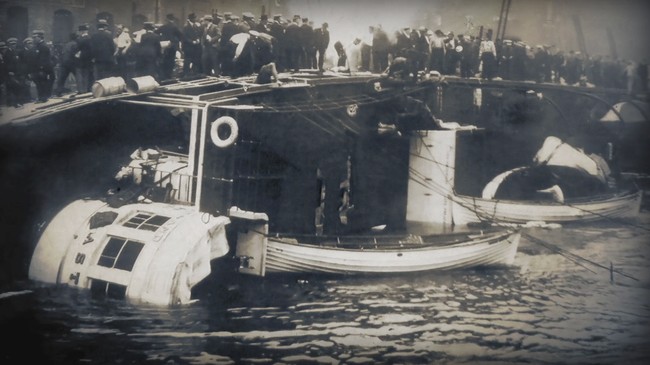
A picnic meant to be a moment of joy turned into a tragedy in mere minutes. Thousands of employees and their families, looking forward to a company outing, instead became victims of one of the deadliest maritime disasters in American history. A total of 844 people died after the SS Eastland capsized whilst still moored at the dock on 24 July 1915, exactly 111 years ago today. That morning, rain fell on Chicago. Despite the weather, enthusiasm was undimmed. Thousands of workers from the Western Electric Company and their families had gathered since dawn for the firm’s annual picnic. They were scheduled to sail across Lake Michigan to Michigan City, Indiana, a distance of 92 kilometres. The crowd was to be transported using five chartered vessels. One of them was the SS Eastland, which had a reputation as the fastest passenger ship on the Great Lakes. However, what people did not realise was that the Eastland harboured a serious, long-standing problem. According to Britannica, the ship had poor stability and had nearly capsized on several previous voyages. This is where the disaster began. At around 6:30 a.m. local time, passengers started boarding the vessel. Shortly afterwards, at 6:41 a.m., the Eastland began to list to starboard. The crew attempted to correct this by flooding ballast tanks to restore balance. The effort was temporarily successful, and the ship righted itself, but only for a moment. The Eastland then began to list again, this time to port. Despite this, boarding continued until the ship reached its capacity of 2,500 people. At this maximum load, the vessel rocked from side to side several times before suddenly losing stability and tilting more than 25 degrees. Water began pouring in through windows and doors that were now below the river’s surface. Consequently, in less than an hour after the first passenger boarded, the ship rolled completely onto its side. The rapidity of the event meant many passengers had no chance to save themselves. A reporter for the Chicago Herald, Harlan Babcock, described the scene, saying, ‘When the boat toppled, people on the upper deck were thrown off like ants brushed from a table.’ Some were trapped inside cabins, whilst others were crushed by furniture and parts of the ship’s structure. Many victims drowned in the river, which was actually very close to the dock. This resulted in a massive death toll. A total of 844 people died, and 70 per cent of them were young people under the age of 25. A federal investigation revealed the tragedy was triggered by a combination of factors, particularly modifications that made the SS Eastland top-heavy. Before the disaster, the ship had been fitted with additional lifeboats and rafts to comply with new US regulations requiring vessels to carry enough lifeboats for all passengers. Ironically, the addition of this safety equipment increased the load on the upper part of the ship, worsening the stability problems that the SS Eastland had from the outset. The situation was made worse by the large number of passengers boarding simultaneously that morning. To this day, the sinking of the SS Eastland is remembered as one of the deadliest maritime disasters in US history.