
Shenzhou-24 Mission to Conduct 90 Scientific Experiments in Orbit
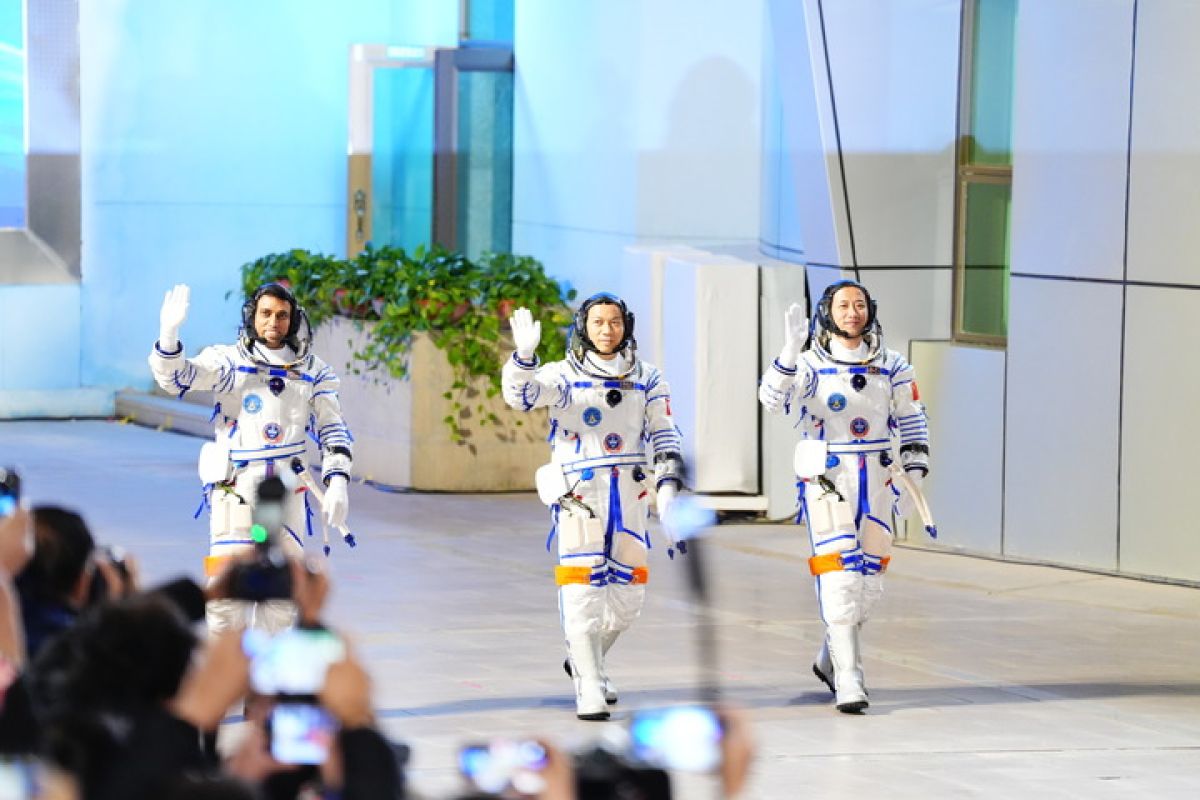
Jiuquan (ANTARA) – China’s Shenzhou-24 mission will mark a new milestone in space exploration, conducting 90 scientific experiments and technology tests aboard the space station.
The mission’s main objectives are to complete an in-orbit crew handover with the Shenzhou-23 crew, ensure the space station’s routine operations continue smoothly, carry out space science and applications, and undertake maintenance, public outreach activities and payload testing, CMSA spokesperson Zhang Jingbo said at a press conference.
The experiments and tests will cover space life sciences, space materials science, microgravity fluid physics and combustion science, fundamental physics, space medicine and new space technologies.
In space life sciences, researchers will develop vascular and multi-organ chips to investigate how the space environment affects key physiological processes, such as vascular ageing. The aim is to develop new strategies to prevent and treat age-related vascular diseases.
In space materials science, the mission will focus on the in-orbit preparation and performance control of ultra-high-temperature niobium-silicon intermetallic compounds and multi-component calcium-silicon bioactive glass. It will also conduct scientific studies of various materials, including single-crystal silicon and perovskites.
Experiments in microgravity fluid physics and combustion science will target high-efficiency space heat-exchange technologies and fire prevention and control. Examples include electric-field-coupled micro- and nanostructures to improve heat transfer through boiling in microgravity, and studies of interactions between clean gaseous fire-extinguishing agents and diffusion flames under varying pressure and oxygen levels.
In fundamental physics, the mission will explore new states of matter and physical laws through optical-lattice quantum simulation and research into new quantum states. It will also investigate key technologies for cold-atom interferometer-based inertial measurement in space.
In space medicine, under the human spaceflight research programme, the crew will conduct multi-omics research and studies of behaviour and brain function in space, while further verifying new health-maintenance technologies for astronauts and the general public.
In aerospace technology, the mission will carry out a series of important tests on a chemical-electric hybrid propulsion system using a new ionic-liquid propellant, as part of efforts to develop advanced spacecraft propulsion technology.
Asked about the value of long-term experiments aboard the Tiangong space station, Zhang said basic research requires scientists to be willing to work quietly and away from the spotlight for years, continually deepening research in their chosen fields.
By making use of microgravity, high vacuum, intense radiation and the high level of cleanliness in space—conditions that are difficult to replicate on Earth—and combining orbital work with ground-based research, scientists can uncover laws that are difficult to detect on Earth and pave the way for major discoveries and technological breakthroughs, he said.
Zhang cited one example from fundamental physics: the century-long effort to reach absolute zero. After 15 years of work, Chinese scientists pioneered the use of full optical-trap cooling technology on the ultracold atom rack aboard Tiangong, lowering a cloud of rubidium atoms to 9.7 picokelvins—about 14 orders of magnitude colder than room temperature—and keeping it observable for seven seconds.
The result was the coldest human-made matter ever recorded and set a new low-temperature record, opening up new possibilities for fundamental physics and related technologies.
“China will continue to use the space station as a national space laboratory to steadily advance space science, space applications and space technology, better serving scientific and technological progress and economic and social development,” Zhang said.
The Shenzhou-24 spacecraft, carrying Chinese astronauts Tang Hongbo and Wu Yi and Pakistani astronaut Muhammad Zeeshan Ali, was launched on Wednesday (25 November) at 08:18 Beijing time (07:18 WIB) from the Jiuquan Satellite Launch Centre in north-western China.
Zhang said the Shenzhou-24 mission would also include four China-Pakistan collaborative scientific projects in biotechnology and materials. As a Pakistani payload specialist, Zeeshan Ali will conduct an experiment involving photosynthetic cyanobacteria in orbit.
Source: jawawa.id (https://jawawa.id/newsitem/shenzhou-24-mission-to-conduct-90-scientific-experiments-in-orbit-1795632731)
Originally published by Antara (Indonesian) (https://www.antaranews.com/berita/5878979/misi-shenzhou-24-akan-lakukan-90-eksperimen-ilmiah-di-orbit), translated from Indonesian