
Sharia Economy Highly Prospective for Development in West Java
The development of Sharia economy and finance is becoming increasingly relevant amidst current economic dynamics. As the Central Bank, Bank Indonesia is committed to continuously supporting the development of Sharia economy and finance as a new source of economic growth.
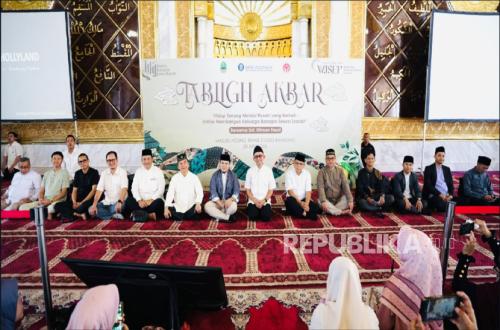
“The development of the Sharia economy aims not only to increase economic activity but also to present an economic system that is inclusive, equitable, and provides widespread benefits to society,” stated the Head of the Bank Indonesia Representative Office for West Java Province, Junanto Herdiawan, during the Tabligh Akbar event at the Trans Studio Bandung Mosque on Sunday (28/6/2026).
The strategic role of the Sharia economy is reflected in Indonesia’s vast potential. The contribution of the Halal Value Chain (HVC) sector to the national Gross Domestic Product (GDP) has reached 27.34 per cent (KEKSI, 2026). Global Muslim consumer spending across six main sectors has reached 2.6 trillion USD and is projected to surge to 3.56 trillion USD by 2029 (SGIE 2025/2026).
In West Java, the Sharia economy possesses very strong prospects due to the large Muslim population base and the growth of halal MSMEs, Muslim fashion, halal culinary, pesantren (Islamic boarding schools), and Muslim-friendly tourism. With this social, economic, and cultural capital, West Java has a significant opportunity to become one of the national epicentres for halal economic development. However, there remains substantial room for strengthening literacy, given that Indonesia’s Sharia economic and financial literacy level in 2025 stood at 50.18 per cent.
Junanto noted that in response to this condition, more massive and inclusive Sharia economic literacy education efforts are required to provide a sustainable multiplier effect for the community. Realising these efforts necessitates close collaboration between stakeholders, including the government, industry players, academics, and community leaders.
Consequently, the Bank Indonesia Representative Office for West Java Province organised an educational activity through a Tabligh Akbar titled “Living Peacefully through Blessed Sustenance: Efforts to Build a Happy Family according to Sharia.” This education is part of the Sunda Karsa Fest: West Java Creative Works - West Java Sharia Economic Festival (WJSEF) 2026, an annual agenda aimed at expanding the Sharia economy as part of a halal lifestyle and strengthening West Java’s role in supporting national Sharia economic progress.
In addition to the Tabligh Akbar, WJSEF 2026 also features various other Sharia economic education and experience activities, including the Sharia Economic Forum, Santri-preneur, and Moneytalk; various Sharia competitions such as Halal Chef, Modest Fashion, and the Sharia Economic Olympiad; Wakafee as a waqf post to support community welfare programmes; and showcases for Sharia MSMEs and Halal Beauty, alongside Sharia banking and financial services.
The theme of the Tabligh Akbar is particularly relevant as the Sharia economy originates from the aspect of life closest to the community: the family. In an increasingly dynamic era, every family desires a peaceful, harmonious, and prosperous life. In this context, it is vital for every family to ensure all economic activities remain within Sharia corridors, from methods of earning income to managing family finances and spending.
These values are the foundation of the Sharia economy. It is not merely about Sharia financial institutions or halal products, but about how economic activities are conducted while upholding principles of justice, public interest, transparency, and responsibility.
The enthusiasm of West Java residents towards the Sharia economy was reflected by the presence of approximately 3,000 congregants at the Tabligh Akbar, hailing from study groups, majelis taklim, and the general public in the Greater Bandung area. This presence demonstrates that the Sharia economy is no longer viewed as a concept distant from the people, but as a way of life that can be applied starting from the smallest unit: the family.
In his lecture, Ustadz Hilman Fauzi invited congregants to build happy families according to Sharia by striving to seek sustenance through halal means and avoiding the haram. He emphasised that sustenance should be understood not just in terms of quantity, but also in terms of blessings (barakah).
Ustadzt Hilman stressed the importance of building family awareness to avoid usury (riba), online loans, ‘paylater’ schemes, and dubious (syubhat) transactions, while strengthening family financial cooperation based on the principles of necessity, utility, and Maqashid Sharia.
Bank Indonesia will consistently expand Sharia economic and financial literacy, strengthen a robust and competitive halal ecosystem, encourage Sharia MSMEs to scale up, and establish the Sharia economy as a collective effort in building an “Extraordinary West Java.” This strengthening will serve as a tangible contribution from West Java in supporting the vision of Indonesia as a global halal industry hub.