
Sharia Economy Bill Enters Priority Legislation Programme: What Happens Next?
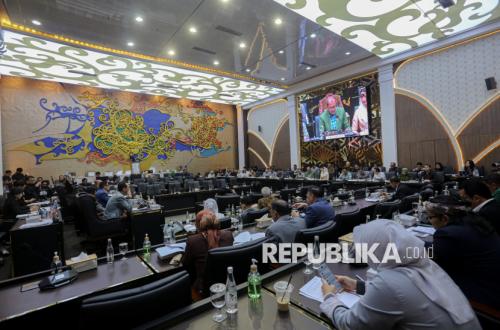
JAKARTA — Wednesday, 25 November 2026, was a long-awaited day for those working to advance the sharia economy. At a working meeting of the House of Representatives’ Legislation Body, the Government and the Regional Representative Council (DPD), 62 bills were agreed for inclusion in the 2027 Priority National Legislation Programme (Prolegnas). One was the Sharia Economy Bill, proposed by a member of the Prosperous Justice Party (PKS) faction. The news is cause for gratitude.
This is also a first. Throughout the 2020–2024 medium-term Prolegnas, the bill never made it onto an annual priority list. In 2021, it was reported to have been included among the priorities for 2022, but it did not appear on the list of 40 bills approved by the House plenary meeting on 7 December 2021. The bill was later included again in the 2025–2029 medium-term Prolegnas, but was absent from the 2025 and 2026 priority lists. Only now has it been agreed for the 2027 priorities.
That means we are entering uncharted territory. With the House and the Government having agreed to the bill, the question of whether it is needed has been answered. What remains is a more practical question: after its inclusion on the list, what must happen for it to reach the statute book?
I will try to answer using three legal thinkers familiar to lawyers. Kelsen helps explain why the route must be an Act. Radbruch helps assess what its content must safeguard. Friedman helps divide responsibility for who does what.
Kelsen: why it must be an Act
Hans Kelsen’s theory of the hierarchy of norms (Stufenbau) teaches that a lower-level norm derives its authority and validity from a higher-level one. We recognise this logic in the hierarchy of laws and regulations set out in Article 7(1) of Law No. 12/2011.
The good news is that the sharia economy has already advanced in the national planning framework. Law No. 59/2024 on the 2025–2045 National Long-Term Development Plan (RPJPN) incorporates it into the country’s development direction for the next two decades, including the strengthening of regulation, institutions, digital infrastructure and human resources. Five months later, Presidential Regulation No. 12/2025 on the 2025–2029 National Medium-Term Development Plan (RPJMN) placed it under the second National Priority, alongside food, energy and water self-sufficiency, as well as the digital, green and blue economies. The RPJMN must be observed by all government development actors.
The problem is that the RPJPN and RPJMN are planning documents. They set a direction, but are not designed to regulate powers, rights or relations between institutions. On the ground, sharia economy rules remain dispersed across more than a dozen sectoral laws, covering banking, capital markets, insurance, zakat, waqf and halal product assurance. Cross-sector coordination rests only on Presidential Regulation No. 28/2020 on the National Committee for Sharia Economy and Finance (KNEKS). In other words, the goal is written into law, but the vehicle for achieving it still relies on a presidential regulation.
A presidential regulation cannot harmonise Acts, because it sits one level below them. As long as coordination rests only on a presidential regulation, each ministry and authority will continue to give primary precedence to its own sectoral law. Only a norm at the level of an Act can organise the relationship between those laws. The Sharia Economy Bill would bridge the direction set out in the RPJPN and RPJMN and its implementation. That is the most fundamental reason the Prolegnas process must be completed.
Source: jawawa.id (https://jawawa.id/newsitem/sharia-economy-bill-enters-priority-legislation-programme-what-happens-next-1795891849)
Originally published by Republika (https://opini.republika.co.id/berita/tp7pbt451/ruu-ekonomi-syariah-masuk-prolegnas-prioritas-selanjutnya-apa), translated from Indonesian