
Shared Ownership of the Sun
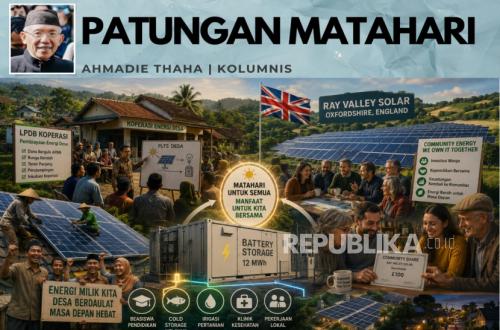
In a village in England, the sun has apparently been promoted. It is no longer just a celestial body that appears in the morning and goes home in the evening without saying goodbye. The sun has now become a ‘shared asset’. There are even residents who, perhaps while sipping warm tea on their terraces, might say, ‘I own a small share of today’s sunshine.’
It sounds like the dialogue of someone who has been sunbathing for too long. But that is exactly what is happening in Oxfordshire, a county in South East England, through the Ray Valley Solar project. There, thousands of solar panels generate electricity for around 7,000 homes.
The problem is, the sun sometimes works too diligently. During the day, electricity is so abundant that the grid cannot accommodate it all. As a result, that expensive clean energy is wasted, like leftover rice from a feast that guests did not finish.
Thus, a simple yet revolutionary idea was born: surplus daytime electricity is stored in a giant battery with a capacity of 12 MWh, then released again at night when electricity demand rises and energy prices are high.
The sun finally no longer works only the morning shift. It can ‘work overtime at night’ via the battery. A form of light packaging that might make poets envious, because it turns out sunlight can be put into a warehouse.
What is more interesting is not the battery itself. Technology can be bought. The difficult part is building a sense of ownership.
In Indonesia, the Revolving Fund Institution for Cooperatives (LPDB Koperasi) offers a very important and strategic scheme. The state provides revolving funds from the state budget (APBN), cooperatives obtain cheap financing with low interest rates and long tenors, even accompanied by mentoring and incubation. The goal is noble: to accelerate village electrification and boost the people’s economy.
The state is present as an initial driver so that villages do not continue to be spectators of energy development. In the Indonesian context, which still has frontier, outermost, and least developed regions (3T) with limited infrastructure, this approach makes sense and is even necessary.
But England is trying to step into a different space. There, the community is not merely a beneficiary of energy projects. They are invited to become its capital owners. Residents buy community shares starting from around £100. The public’s money is pooled to build the energy storage system.
When electricity is sold back at high prices, the profits do not entirely flow to large energy companies. A portion returns to the community in the form of dividends, social projects, energy efficiency programmes, and subsequent environmental investments.
Herein lies an interesting philosophical difference. The LPDB scheme is essentially the state helping the community build energy assets. The Ray Valley model, meanwhile, is the community collectively building their own energy assets. One relies on the fiscal strength of the state. The other relies on the strength of citizen participation. One is born from a logic of development. The other grows from a logic of ownership. One answers the question, ‘How does the village get electricity?’ The other begins to ask a further question, ‘Who owns that electricity?’ This second question turns out to be very decisive for the future.
For decades, electricity was understood as the business of large companies, large substations, large power plants, and large bills. The public merely needed to be customers who receive a piece of paper or a payment notification each month, with a feeling sometimes more tense than exam results.
But community energy projects in England are trying to reverse that logic. They call it the democratisation of energy. Citizens no longer just buy electricity. They co-own the generation, the batteries, and a share of the profits from the system.
In fact, the UK government is now preparing support of up to £1 billion to expand community energy projects like this across the country. The goal is not only to reduce carbon emissions but also to create wealth that continues to circulate within the local community.