
Shallot Farmers in Nganjuk Adopt Strategies to Face El Niño
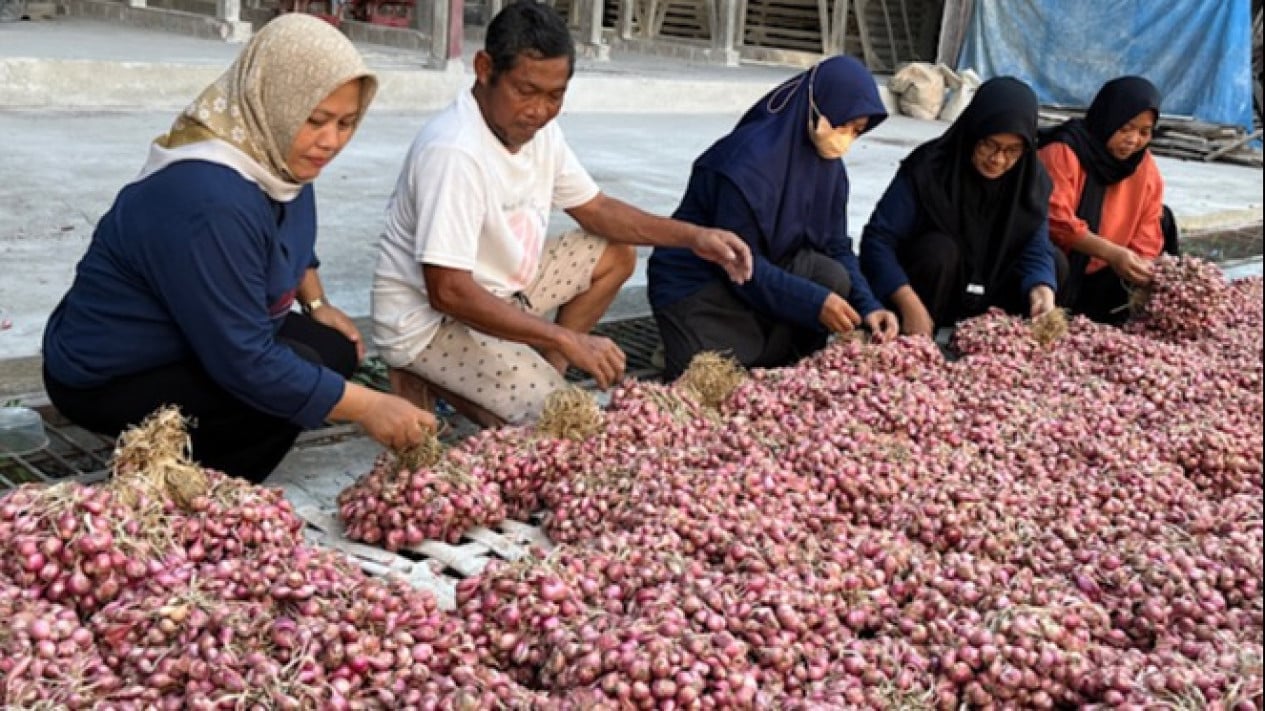
The threat of El Niño is being anticipated by shallot farmers in Nganjuk Regency, East Java. One of the steps taken is to ensure the availability of water remains secure during the dry season so that shallot production is not disrupted.
Pembina of Gapoktan Karya Abadi, Bambang Suparno, said that water needs are an important factor in shallot cultivation. According to him, shallot plants require a sufficient water supply, but not excessively.
“We have been assisted in building sump wells for cultivation water needs. Because shallots need water but do not want excess water. Now facing El Niño, water needs must be ensured to be safe,” said Bambang.
He explained that the farmer group in his area has built nearly 12 sump well points to support shallot cultivation. In addition, farmers are also starting to switch to using electricity for operating water pumps in the fields because fuel costs are getting higher.
According to Bambang, the Tajuk shallot variety remains the mainstay of Nganjuk farmers because it is considered to have high productivity and can adapt to both dry and rainy seasons.
“This variety’s advantage is that it is suitable for the dry season with productivity of 24 tonnes per hectare, even higher. In the rainy season, 12–17 tonnes per hectare. So it is strong in production limits in the dry season and also strong in the rainy season,” he said.
That variety is currently widely used by farmers in various regions in Indonesia, from South Sulawesi, Aceh, to Papua. In addition to its high productivity, the Tajuk variety is also considered to have good storage power, making it suitable for use as seeds.
Bambang said that shallot seeds are the main component in cultivation. Therefore, many farmers choose to store part of the harvest to be used as prospective seeds for the next season.
Currently, shallot seed prices are also rising along with increasing needs ahead of the planting period in Nganjuk, which is estimated to take place from June to July.
“As of today, seed prices are trending upwards. Today the price is already Rp56,000–Rp57,000 per kilogram. It is not impossible that when Nganjuk’s planting season comes in about a month, from early June to late June, it could rise again,” he said.
Source: jawawa.id (https://jawawa.id/newsitem/shallot-farmers-in-nganjuk-adopt-strategies-to-face-el-nino-1778687596)
Originally published by VIVA.co.id (https://www.viva.co.id/bisnis/1898538-petani-bawang-merah-di-nganjuk-pasang-strategi-hadapi-el-nino), translated from Indonesian