
Shallot farmers in Alahan Panjang utilise pest trap technology
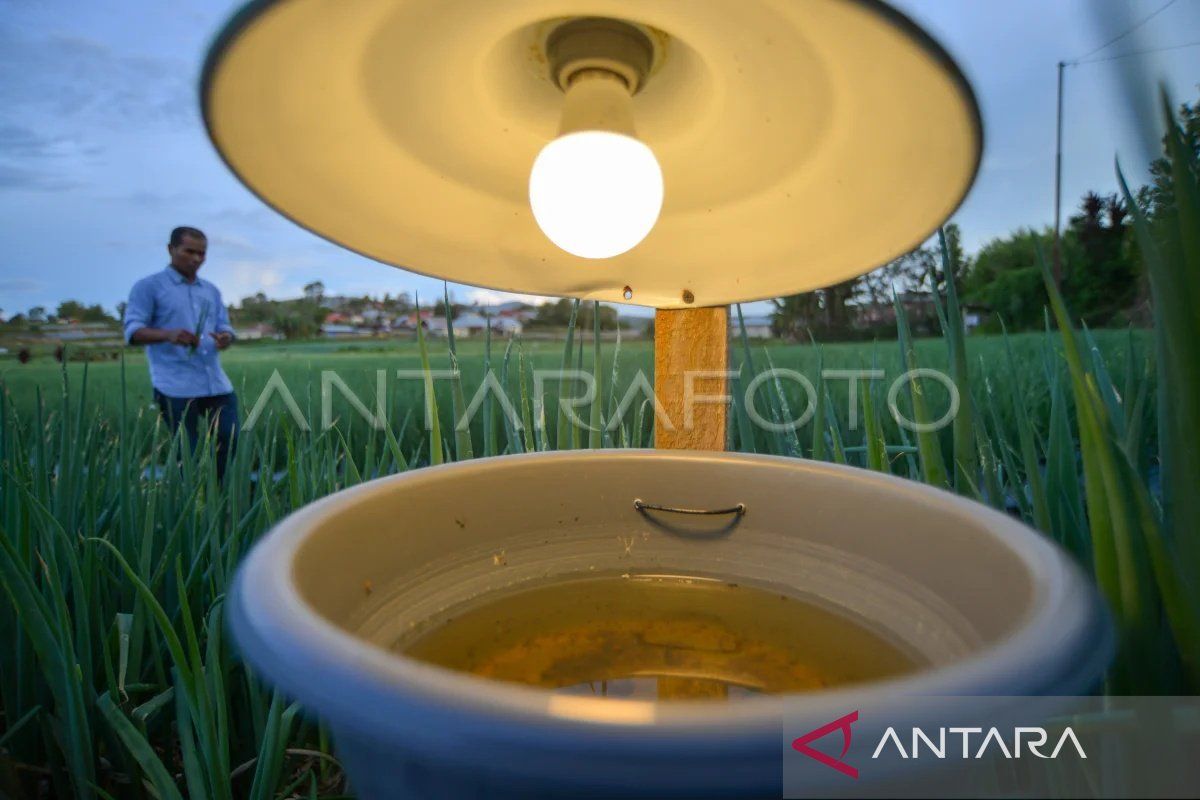
Shallot farmers in Alahan Panjang, Solok Regency, West Sumatra, are using pest trap technology as an effort to reduce attacks by plant pests while also cutting pesticide use in cultivation.
Head of the Solok Regency Agriculture Office Deslirizaldi in Solok on Wednesday appreciated the steps taken by farmers in Alahan Panjang who were able to utilise technology and electrical energy in developing shallot cultivation.
According to him, the innovation demonstrates farmers’ creativity in improving production efficiency while reducing pesticide use.
To anticipate water shortages, the central government through the Ministry of Agriculture has provided piped irrigation and pumping facilities to farmer groups. In 2026, Solok Regency received assistance of 18 units through the Medan Agricultural Centre.
The Solok Regency Agriculture Office also continues to propose additional irrigation assistance in 2027, including additional budget in 2026 for the construction of piping networks based on proposals from farmer groups to support the productivity of shallots and other horticultural commodities.
In addition, one shallot farmer in Alahan Panjang, Amri Ismail, said the use of the technology is one solution for controlling pests that attack shallot plants on his farmland.
He said that besides facing pest attack problems, farmers also need an irrigation system capable of supporting crop needs, especially by utilising water sources available around the land.
“For irrigation, we utilise water sources from around the lake. The water is pumped using electrical power and then channelled to the land with a sprinkler system,” he said.
The use of electricity is carried out through the electrifying agriculture programme from PT PLN (Persero), an innovation in the use of electrical energy to support activities in the agriculture, fisheries, plantation and livestock sectors.
With the support of the programme, Amri installed a pipe network on his farmland so that water from the edge of the lake can be pumped and distributed to water the shallot plants more effectively.
Not only for irrigation, the available electricity is also used to develop a pest trap system or light trap. Dozens of light points are installed in the planting area to attract pests that are active at night.
Under each lamp, a container filled with water is provided to trap pests attracted to the light source. This method helps farmers reduce pest populations without having to continuously rely on insecticide spraying.
According to him, the application of light traps can reduce insecticide use by around 50 percent or even more compared to before. This condition also has an impact on reducing production costs that farmers must incur.
He added that reducing insecticide use is also expected to produce agricultural products that are safer for consumption because exposure to chemicals can be suppressed.
Although the initial investment in building the lighting network is quite large, the cost is considered to be offset through savings on insecticide purchases and relatively efficient electricity use.