
'Seyegan Fire House' Remains Mysterious; UGM Discovers Cracks, BPBD Installs CCTV
The cause of repeated fires in a residence in Kasuran Mriyan X, Margomudyo, Seyegan, Sleman, remains unidentified. Research teams from various universities and institutions are continuing their efforts to solve the mystery.
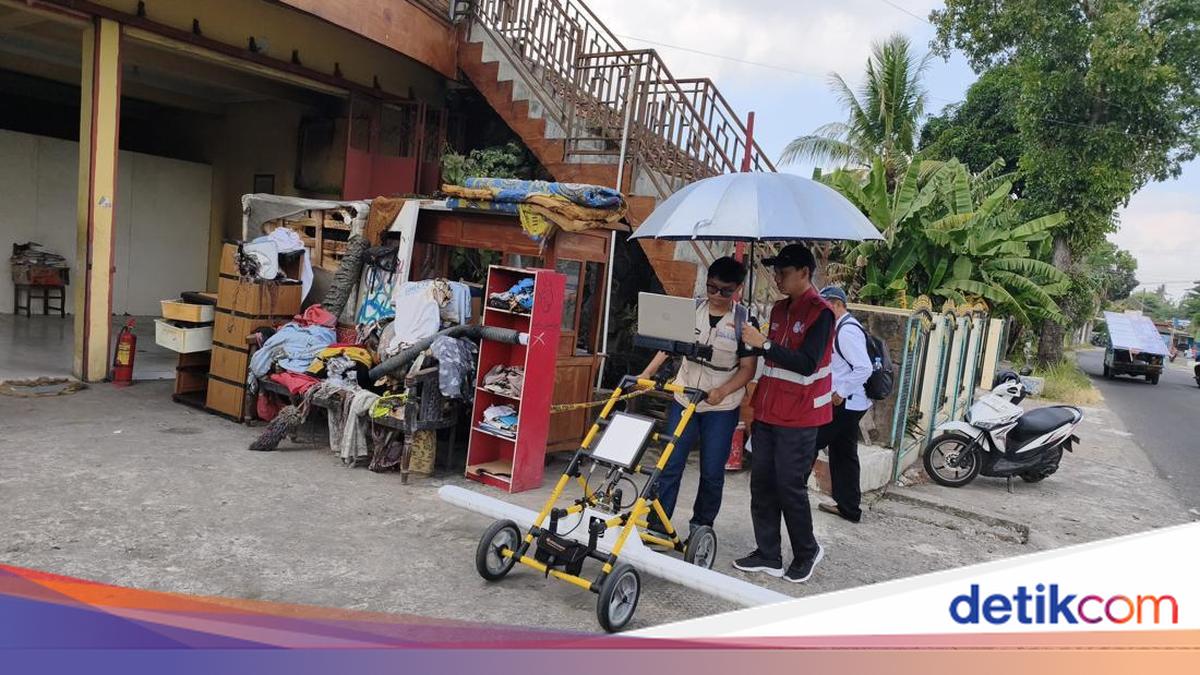
Recently, a UGM team conducted underground mapping at Mutfiana’s house using ground-penetrating radar. Saptono from the Laboratory of Exploratory Geophysics, Department of Geological Engineering, FT UGM, explained that the tool was used to detect potential pathways for gas escaping to the surface. “The purpose is to see what lies beneath the surface, whether it be buried objects, soil layers, or cracks, which can be detected with this device,” Saptono told reporters at the site on Monday (8/6/2026).
The research team inspected several areas where fires had appeared. Preliminary results revealed several underground cracks at a depth of approximately 20 metres, suspected to be gas exit points. However, this remains raw data that requires further processing. “For now, it is still preliminary; we have only had a brief look without further processing, but there appears to be a connection between the fire points and the cracks visible underground at a depth of about 15-20 metres,” he explained.
This finding will be followed up with geoelectrical mapping to reach deeper soil or rock layers, allowing for the detection of cracks in rock formations and identifying any silt layers beneath the house. The team plans to concentrate their survey around the house area.
Due to the unresolved phenomenon, researchers from the National Research and Innovation Agency (BRIN) have also intervened. Hari Soekarno, a researcher from the Limnology and Water Resources Research Centre, conducted an initial observation while coordinating with UGM, UPN, and other agencies. “Following our visit, we will hold research discussions to review what has been done and subsequently complement the findings,” said Hari.
He noted that previous research, particularly by the UGM team, suggested phosphine gas from poultry waste as a potential trigger. However, after inspecting the waste installation at the house, he expressed doubt. “Looking at the waste installation, even if phosphine gas were formed, I believe it would have already been released into the atmosphere,” he stated. Consequently, BRIN will take gas samples from the rooms that frequently experience fires to analyse whether the trigger is hydrogen, methane, or another gas, despite the challenge of very low concentrations.
Meanwhile, the initial process leading to the fires in Mutfiana’s house remains a mystery. Therefore, the Sleman Regional Disaster Management Agency (BPBD) has installed two CCTV cameras in the front and middle rooms of the house. “Our intention is to see the origin of the fire. No one has witnessed the actual process of the fire appearing in these various spots,” said the Head of BPBD Sleman, Bambang Kuntoro. He hopes the CCTV footage will assist academic researchers and provide additional evidence to strengthen their conclusions.