
Seven Days of Fighting Forest Fires in North Penajam Paser, Water Sources Become Major Issue
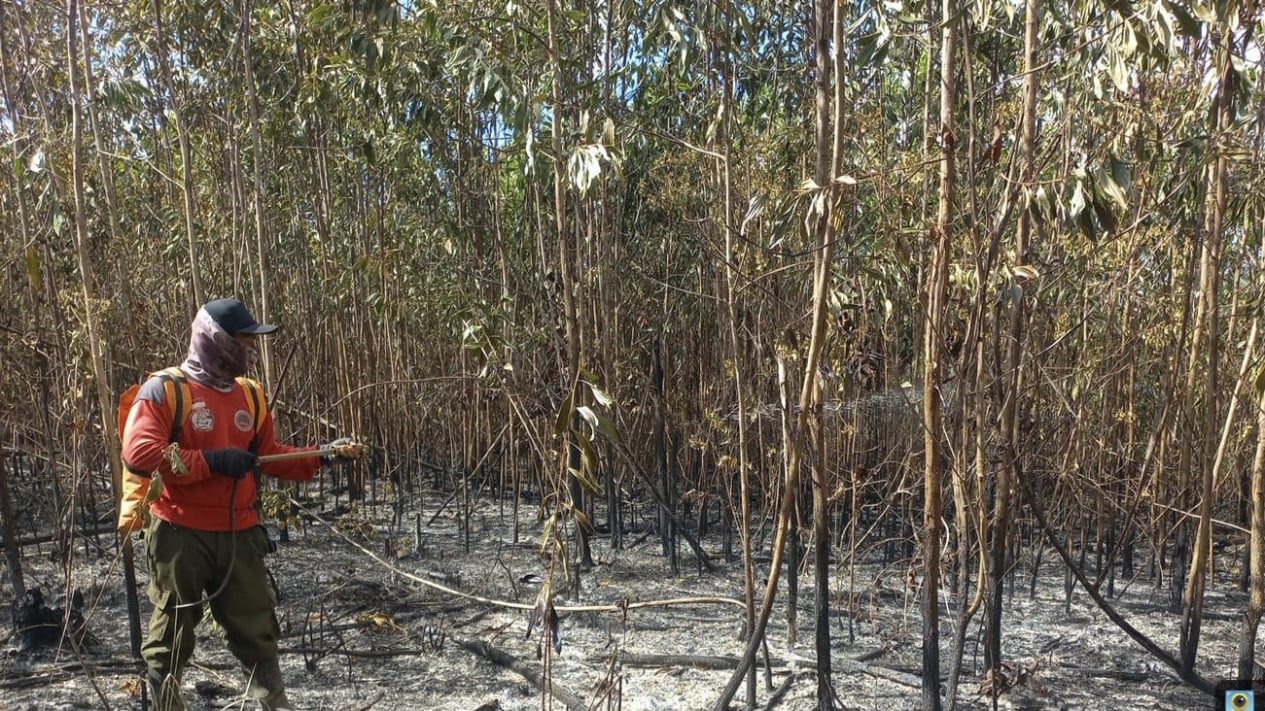
The forest and land fires (karhutla) in the peatland area of RT 1lag, Petung Village, Penajam District, North Penajam Paser (PPU), East Kalimantan, have not yet fully subsided.
Entering the seventh day, joint teams are still struggling with both firefighting and cooling operations. These efforts were intensified after aerial monitoring via drones detected several smoke points in the peatland, raising concerns that new fire hotspots could emerge.
Nurlaila, the Head of the PPU Regency BPBD (Regional Disaster Management Agency), stated that officers must still pursue smoke points located in hard-to-reach areas. “Handling is ongoing because aerial monitoring shows several peat smoke points that have the potential to reignite,” Nurlaila said in Penajam on Sunday (4/10/26).
Terrain and water access have become the primary obstacles in managing the fires. The smoke points are located quite far from water sources, forcing officers to extend hoses across approximately 25 to 30 connections to reach the burning area. Additionally, five to six hose connections must be used to fill flexible tanks, making the extinguishing process more time-consuming and labour-intensive.
On the seventh day, the joint team operated seven nozzles, consisting of four from the BPBD, one from the Department of Agriculture, and two from Manggala Agni. The total area of land burnt in the region has reached 36.88 hectares.
The operation also involves personnel from the Satpol PP (Public Order Agency) and the Samapta Directorate of the PPU Police. In total, 75 personnel have been deployed, including 30 from BPBD, 15 from the Department of Agriculture, five from Manggala Agni, 12 from Satpol PP, and 13 from the PPU Police.
“Extinguishing and cooling are being carried out entirely using portable and slip-on engines, utilising the water sources still available at the location,” she added.
However, the water supply around the site is also becoming a problem. Secondary channels that officers previously relied on have now dried up. As a result, the firefighting teams must now rely on primary channels to meet the water requirements for the extinguishing and cooling processes.
“Furthermore, PT KMS is also supporting the handling efforts by stationing large-capacity portable engines at the border of the fire area,” Nurlaila added.