
Seven Days After NTT Earthquake, Casualty Toll Continues to Rise
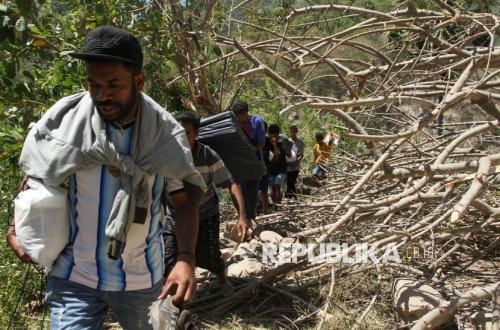
The National Disaster Management Agency (BNPB) has recorded that the number of casualties from the M 7.7 earthquake in Flores, East Nusa Tenggara, on Saturday (15/8/2026) continues to rise seven days after the disaster. Not only have fatalities increased, but the number of injured and displaced people has also grown.
Acting Head of the BNPB Disaster Data, Information and Communication Centre, Berton SP Panjaitan, said the death toll from the earthquake had reached 83 people as of Friday (21/8/2026) at 16.00 WIB. The figure increased by eight compared with previous data.
“The details are that the deaths were caused by indirect impacts of the earthquake, with two in Manggarai Regency, two in East Manggarai Regency, three in Nagekeo Regency, and one in Ngada Regency,” he said during an online press conference on Friday afternoon.
In addition, the number of injured also increased by 79 compared with previous data. The total number of injured is now reported at 986 people.
Berton said the number of displaced people from the earthquake also increased by 18,050 on the day. This means there are currently a total of 110,785 people still displaced due to the earthquake.
Regarding damage data, he said there are currently 44,946 housing units affected. Of that number, 17,176 units were reported heavily damaged, 9,758 units moderately damaged, and 18,013 units lightly damaged.
“Posts in each regency will continue to update damage data with damage level categories. Damaged houses based on their damage level will be determined by name and address of the affected residents,” Berton said.
Aftershocks Still Occurring
Berton added that aftershocks are still being felt shaking the Flores region seven days after the main earthquake. Based on data from the Meteorology, Climatology and Geophysics Agency (BMKG) up to Friday, there have been 4,258 aftershocks, with the largest magnitude M 6.2 and the smallest M 1.1.
“Meanwhile, the aftershocks that could be felt by residents numbered 118,” he said.
Separately, BMKG Director of Earthquakes and Tsunamis, Wijayanto, predicted that the aftershock sequence will continue for the next three to four weeks. He assessed that the early phase of the aftershock sequence still shows a complex temporal pattern and has not yet simplified.
According to him, aftershock activity in the first few days was still relatively high and has not shown a significant decay pattern. “The number of earthquakes per 24 hours was recorded at 704 events on the first day, increasing to 746 on the second day, then ranging from 668, 649, and 627 events on the third to fifth days, but rising again to 802 events on the sixth day,” he said in a statement on Friday.
Based on BMKG monitoring results, the aftershock sequence caused several significant tremors of intensity IV-VI MMI that were strongly felt by local residents. BMKG recorded strong shaking events on 19 August 2026 at 23.17 WIB with magnitude M 5.6, and 20 August 2026 at 05.45 WIB with magnitude M 5.8. Furthermore, a significant earthquake struck again on 20 August 2026 at 09.47 WIB with magnitude M 5.8, which triggered subsequent damage to affected building structures and bridges and caused landslides at several points.
Relocation results show that aftershocks did not spread homogeneously, but instead formed several separate clusters. The main cluster is located around the source zone of the M 7.7 earthquake north of Nagekeo and extends along the Flores Back-arc Thrust. Meanwhile, other aftershock clusters emerged in the western part of the main source zone, specifically north of Manggarai Regency.
Daily seismicity data shows the focus of activity continues to move dynamically over time. On the first to fourth days after the main earthquake, earthquakes spread evenly across all clusters from east to west.
However, on the fifth and sixth days, seismic activity shifted and concentrated its strength in the western cluster. Meanwhile, the eastern cluster began to gradually reduce its activity intensity.
He stated that BMKG will continue to operate a 24-hour real-time monitoring system. BMKG officers continuously analyse the quantity of events, magnitude, distribution of earthquake sources, direction of activity movement, and characteristics of earthquake sources to provide accurate and timely information to the public and relevant agencies.
“To ensure information transparency, BMKG publishes updates on aftershock activity data regularly twice a day, at 05.00 WIB and 17.00 WIB,” he said.
Source: jawawa.id (https://jawawa.id/newsitem/seven-days-after-ntt-earthquake-casualty-toll-continues-to-rise-1787309644)
Originally published by Republika (https://news.republika.co.id/berita/tk470v393/tujuh-hari-pascagempa-ntt-korban-masih-terus-bertambah), translated from Indonesian