
Serving in 3T Regions and Minority Areas Becomes a Challenge for Ulama Cadre Development
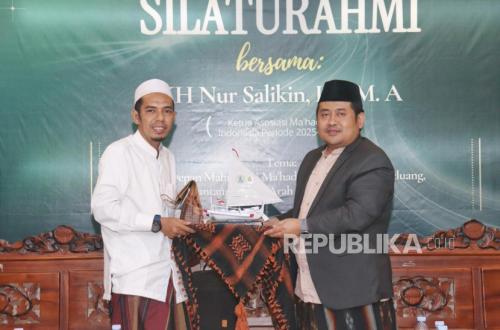
The need for ulama (religious scholars) willing to serve in Muslim minority areas and the outermost, frontier, and least developed (3T) regions is considered increasingly vital to expand access to Islamic education. Consequently, a cadre formation model that prepares graduates to serve in these areas is seen as a tangible contribution from pesantren (Islamic boarding schools) to society.
The General Chairman of the Indonesian Ma’had Aly Association (AMALI), KH. Nur Salikin, expressed his appreciation for the commitment of Ma’had Aly Lathifiyah, which directs the service of its students to Muslim minority regions and 3T areas in West Sulawesi. This appreciation was shared during the AMALI gathering at Ma’had Aly Lathifiyah, Parappe, on Sunday (28/06/2026).
According to Nur Salikin, as Ma’had Aly institutions continue to develop across various regions, each institution possesses a unique service specialty. Ma’had Aly Lathifiyah, he noted, has chosen to focus on preparing religious scholar cadres to be present in areas that still require the strengthening of religious education.
“I see the strength of Ma’had Aly Lathifiyah not only in its teaching of the ‘kitab kuning’ (classical Islamic texts), but in its orientation towards service. They are preparing religious scholar cadres who are ready to serve in Muslim minority areas and 3T regions. This is the true face of pesantren service,” said Nur Salikin.
He stated that students are not only equipped with the ability to read and understand classical texts but are also prepared to become preachers and educators capable of presenting an Islam that is moderate, friendly, and brings peace to society.
The service areas include several regions in the Mamasa Regency, where the Muslim community exists as a minority, as well as the outermost island areas of West Sulawesi, including Kalukaluna Island and surrounding islands that still face limited access to religious education.
According to him, the challenges of preaching in minority areas differ from those in regions that already possess a strong pesantren ecosystem.
“Preaching in minority areas requires more than just knowledge. It requires patience, exemplary character, the ability to build dialogue, and noble morals. Therefore, the religious scholar cadres born from pesantren must act as social glue and present Islam as a blessing for all of society,” he said.
Nur Salikin added that as a pesantren-based higher education institution, Ma’had Aly Lathifiyah uses the mastery of classical texts as the primary foundation of learning, integrated with character building so that graduates are prepared to serve within a pluralistic society.
He assessed that this educational model aligns with the efforts of ulama cadre formation being continuously encouraged by AMALI.
“Today, the nation needs scholars who do not only teach in classrooms or preach from pulpits. The nation needs scholars who are willing to be present in areas with minimal Islamic education services, accompanying the community, teaching classical texts, and simultaneously strengthening the moderate and ‘wasathiyah’ (middle-way) values of Ahlussunnah wal Jamaah,” he said.
Nur Salikin expressed his hope that the service provided by Ma’had Aly Lathifiyah could serve as an example for other Ma’had Aly institutions to expand their contributions to regions that still require Islamic education services.
“The strength of a pesantren is not measured by the grandeur of its buildings, but by the extent to which its alumni are present to bring benefits. When graduates are willing to teach in remote areas, outermost islands, and minority regions, that is when the pesantren is building a civilisation,” he concluded.
Source: jawawa.id (https://jawawa.id/newsitem/serving-in-3t-regions-and-minority-areas-becomes-a-challenge-for-ulama-cadre-development-1782726806)
Originally published by Republika (https://khazanah.republika.co.id/berita/thdycj522/pengabdian-di-daerah-3t-dan-wilayah-minoritas-jadi-tantangan-kaderisasi-ulama), translated from Indonesian