
September, a Horror Month for the IDX Composite: 7 Declines in 10 Years as Foreign Capital Flees
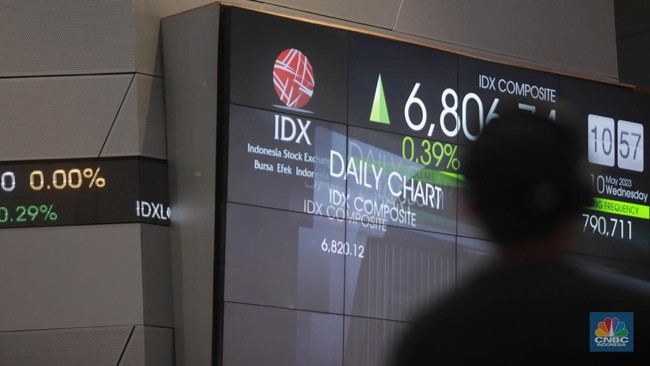
The Indonesia Stock Exchange (IDX) enters September 202ting with a challenging outlook. In addition to facing an unfavourable historical track record for the month of September, the Indonesian stock market remains overshadowed by selling pressure from foreign investors in the regular market.
The IDX closed August 2026 at 6,525.48, before immediately rising 1.14% to 6,564.51 during trading on Tuesday (1/9/2026). While the early month strength provided a positive signal, it was insufficient to guarantee that the index has escaped the risk of consolidation.
Data from the last 10 years shows that the IDX has only strengthened in three September periods and weakened in the other seven. The average September return was recorded at minus 0.88%, while the median return stood at minus 0.55%. This pattern demonstrates a seasonal tendency towards weakness, often referred to as the ‘September effect’.
September remains a vulnerable month for the IDX. Although historical patterns do not always repeat, the frequency of declines reaching seven out of 10 years suggests that investors must anticipate higher volatility. The best performance occurred in September 2025 when the IDX rose by 2.94%. Gains were also recorded in 2021 by 2.22% and in 2017 by 0.63%. Conversely, the worst period occurred in September 2020, when the index plummeted by 7.03% amidst pandemic uncertainty.
Outside of the extreme 2020 period, pressure in September generally occurred on a more limited scale. The median return of minus 0.55% indicates that typical September weakness is not always massive, but the directional tendency remains negative.
Foreign funds are also more likely to exit. In the last 10 September periods, foreign investors recorded net selling seven times and only booked net buying in three periods. The average September foreign flow stood at a net sell of approximately Rp1.37 trillion. The largest foreign outflow occurred in September 2020 with a net sell of Rp15.59 trillion. Significant selling also took place in 2017 at Rp11.20 trillion and 2019 at Rp7.23 trillion.
Meanwhile, the largest foreign inflow occurred in September 2024 with a net buy of approximately Rp25.02 trillion. Despite the massive foreign fund inflow, the IDX still fell by 1.86% during that period. The opposite occurred in September 2025, where the IDX managed to rise 2.94% even though foreign investors recorded a net sell of Rp3.80 trillion. These two periods demonstrate that foreign flow is not the sole determinant of market direction.
The strength of domestic investors, Rupiah movements, global sentiment, and the distribution of foreign transactions across specific stocks also influence the IDX. Foreign net buying does not automatically lift the index if the purchases are concentrated or occur through the negotiated market.
Signals from foreign transactions in August remain mixed. Based on reference data, foreign investors recorded a net sell of Rp3.44 trillion in the regular market during August. However, when all market types are calculated, foreign investors actually recorded a net buy of Rp1.19 trillion. This discrepancy occurs because the total market includes regular, negotiated, and cash markets. Net selling in the regular market is more relevant for reading price pressure, as this market is the primary venue for stock price formation.
Meanwhile, the net buy across all markets was likely supported by special transactions in the negotiated market. Therefore, that figure cannot yet be considered a sign that foreign investors have returned to widespread accumulation. A more positive signal will only form if the foreign flow in the regular market also consistently reverses into a net buy. Nevertheless, a shift from aggressive selling to thinner net selling can help improve sentiment.
The IDX still has opportunities to reach 6,800. Although September has a poor historical record, seasonal patterns cannot be used as a certainty that the IDX will weaken again. Support from domestic investors and reduced intensity of foreign selling can help the index hold steady.
In a bear case, the IDX is expected to close September at the 6,300 level. This scenario could occur if foreign selling pressure continues, the Rupiah weakens, and global sentiment encourages investors to reduce holdings in risky assets. Concentrated selling in banking and large-cap stocks could exert deeper pressure on the index.
In a base case, the IDX is projected to reach 6,800. This is the primary view because the market does not require large foreign inflows to move upwards. A decrease in the intensity of regular net selling, a relatively stable Rupiah, and buying by domestic investors could serve as positive catalysts.
In a bull case, the IDX has the potential to reach 7,000. This target requires the foreign flow in the regular market to turn into a net buy, a strengthening Rupiah, and increased investor interest in emerging market assets. Foreign buying also needs to be distributed evenly across major stocks rather than occurring solely through negotiated transactions.
Considering the history of September, the initial position of the index, and the condition of foreign flows, the 6,800 level is the primary scenario for the IDX at the end of September 2026. This is particularly relevant given the MSCI catalyst, which could provide further announcements regarding the potential removal of the FIF and NOS freeze, thereby increasing foreign inflows into the Indonesian capital market during the next rebalancing in November 2026.
Indonesia also appears set to maintain its position in Emerging Markets, given the exchange transparency reforms which have been rated highly by several parties and investors interviewed.
Source: jawawa.id (https://jawawa.id/newsitem/september-a-horror-month-for-the-idx-composite-7-declines-in-10-years-as-foreign-capital-flees-1788314318)
Originally published by CNBC Indonesia (https://www.cnbcindonesia.com/research/20260901141050-128-764033/september-bulan-horor-ihsg-7-kali-tumbang-dalam-10-tahun-asing-kabur), translated from Indonesian