
Separation of Civil-Military Justice Challenged in Constitutional Court Over Restitution Hurdles
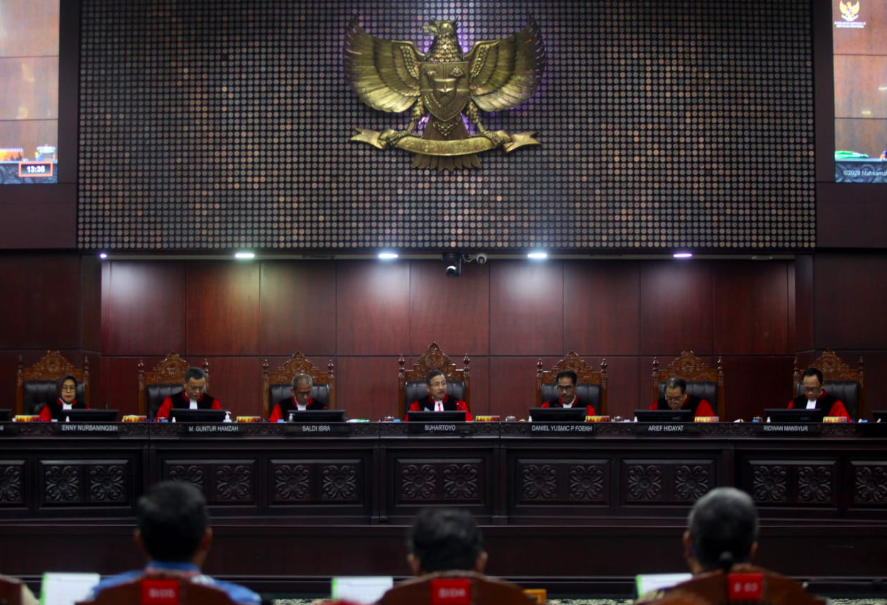
The family of a murder victim involving both civilian and military perpetrators is challenging provisions in Law Number 20 of 2025 concerning the Criminal Procedure Code (KUHAP) at the Constitutional Court (MK). Petitioners Puspita Aulia, Andina Oktariani, and Rizka Restiani argue that the separation of judicial processes for civilian and military defendants has hindered their pursuit of justice, including the fulfilment of restitution rights for victims. Through their legal counsel, Kurniawan, the petitioners are contesting the constitutionality of Article 170 paragraph (1) of the KUHAP, specifically the phrase “examined and tried by a court within the general judicial environment”. They contend this provision creates legal uncertainty when a criminal act is committed jointly by civilian and military perpetrators. During the hearing, Kurniawan explained that the separation of judicial processes severs the connection between defendants allegedly involved in a single criminal act during the evidentiary process. Consequently, the victim’s family faces difficulties in fighting for their rights, including claiming restitution from defendants processed through the military judiciary. “The loss of constitutional rights is specific and actual. The petitioners witnessed an effort to eliminate the element of planning in the murder case of Petitioner I’s husband after hearing the military prosecutor’s demands against the defendant with a military background,” Kurniawan stated while reading the main points of the petition at the MK Building on Wednesday. According to him, this situation arises because military perpetrators are subject to the military justice system under Law Number 31 of 1997 concerning Military Justice, while civilian perpetrators are processed through the general court. The petitioners also assessed that the trial process in the military court does not provide sufficient space to reveal the connection between civilian and military defendants in the same case. One indication they highlighted was the rejection of a request from the civilian defendant to provide testimony during a trial held at the Military Court II-08 Jakarta. On this basis, the petitioners requested that the MK declare the phrase “examined and tried by a court within the general judicial environment” unconstitutional and conditionally not legally binding as long as it is not interpreted as “must be examined and tried by a court within the general judicial environment”. They hope this change in interpretation can provide legal certainty in handling cases jointly involving civilian and military perpetrators. During the session, the panel of constitutional justices provided several notes on the petition. Constitutional Justice Adies Kadir assessed that the petitioners needed to strengthen their argumentation regarding legal certainty and explain in more detail the link between the tested norm and the constitutional issue they alleged. “This is requesting an interpretation. For the posita and petitum to be aligned, it needs to be explained whether the phrase sufficiently guarantees legal certainty. This is not merely a matter of adding the word ‘mandatory’, but relates to legal needs in the practice of connection trials,” Adies said. He emphasised that the Court needs a stronger explanation regarding the urgency of changing the meaning of the norm being tested. Meanwhile, Constitutional Justice Liliek P. Adi highlighted the case used as the basis for the petition because it had not yet attained permanent legal force. According to Liliek, this condition renders the case experienced by the petitioners insufficiently robust to serve as a concrete example for judicial review. “So existing or legally binding rulings for this connection trial need to be added,” Liliek stated. He suggested the petitioners include previous rulings that have permanent legal force to strengthen their constitutional arguments. Echoing this, Deputy Chief Justice of the MK Saldi Isra asked the petitioners to explain the causal link between the norm being tested and the constitutional loss they experienced. According to Saldi, the description of the norm’s conflict with the constitution was still not clearly depicted in the submitted petition. “In the reasons for the petition, there is no conflict with the constitution yet. So please convey it, because that is what will be assessed for conflict. Otherwise, we cannot enter the substance of the petition,” Saldi said. In their petition, the petitioners explained that Puspita Aulia is the wife of the late Mohammad Ilham Pradipta, a former Branch Head of PT Bank Rakyat Indonesia (Persero) Tbk who became a victim of kidnapping and murder in August 2025. According to the petitioners, the deceased was abducted by a group consisting of civilian and military elements in the Pasar Rebo area, East Jakarta, on 20 August 2025. A day later, the victim was found dead in Kampung Karangsambung, Nagasari Village, Bekasi Regency.