
Separating the 2029 Elections
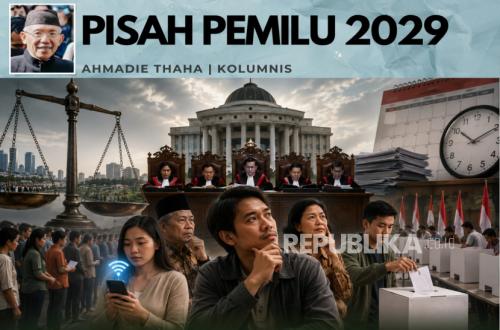
In the past, people thought a thousand times before taking a matter worth a few thousand rupiah to court. The image of the court was terrifying: expensive costs, wasted time, complicated procedures, and a building full of people in suits with thick files. Now the situation has changed completely. The people even bring the matter of remaining internet quota to the Constitutional Court (MK). This phenomenon is not happening because the people suddenly enjoy litigation. There is a more interesting reason: the people are beginning to understand that the constitution is not merely a thick book read aloud during state ceremonies.
Especially for major matters, for example regarding elections. So on 12 August 2026, although rejecting petition Number 256/PUU-XXIV/2026, the MK again affirmed that the DPR and the government must complete all legal regulations for the 2029 Election before the election stages begin. In its legal considerations, the MK judges emphasised that there is no other choice but to complete the revision of the law as a mandatory consequence of MK Decision Number 135/PUU-XXII/2024. This is a major matter, because what is at stake is legal certainty about how the people will exercise their right to vote in 2029.
Interestingly, a matter of that magnitude sits within the same landscape as cases that appear far simpler. The lawsuit over remaining internet quota serves as an interesting illustration. A citizen went to the MK because he could not accept that his remaining internet quota was forfeited when the period of that small package ended. From this trivial internet quota case, we are immediately confronted with a far more massive problem: the design of the 2029 Election. If remaining internet quota alone can trigger a lawsuit in the name of constitutional rights, what more the procedures for more than 270 million citizens in choosing their representatives and leaders.
It began with Decision Number 135/PUU-XXII/2024. The MK completely overhauled the election system starting from 2029. The MK separated national elections — the election of the President/Vice President, DPR, and DPD — from regional elections — the election of DPRD and regional heads. At the earliest two years or at the latest two and a half years after the inauguration of the President and members of the DPR/DPD, regional elections will be held.
This step has a very strong fundamental reason. The 2024 Election proved how heavy it is to hold voting with five types of ballot papers at once in a single day. The KPU assessed that separating the schedule can reduce the workload of field officers, prevent casualties due to exhaustion, and improve the overall quality of election administration.
So, this change is not merely a matter of shifting the calendar from February to November or changing the five-year interval to two years. This decision determines the quality of our democracy. All this time, when the people had to choose the President, DPR, DPD, DPRD, Governor, Regent, and Mayor all at once in a dense period, voters were forced to digest too many candidate names. Democracy turned into a political buffet party. All the dishes were piled on the table, but voters did not have time to taste them one by one.
Separating the elections gives voters room to assess the performance of the central government first before they make their choices at the regional level. The MK argued that the two to two-and-a-half-year gap is an ideal evaluation period for the public to assess the performance of the national government.
However, a decision of this magnitude automatically creates new complications. The old system had already set the terms of office for regional officials based on simultaneous elections. When the election calendar shifts, the terms of office of DPRD members and regional heads are also affected. Which officials must have their terms extended? Until when do those terms apply? When exactly will regional elections be held? How will the requirements for regional head candidacy change if the distance from the legislative election changes?
This mounting homework cannot be resolved simply with the sentence ‘it will be regulated later in the law’. The problem is that the implementing law itself has not yet been finalised. In August 2025, the MK had reprimanded the DPR and the government for not yet following up on Decision 135. In case Number 124/PUU-XXIII/2025, the MK declared the petitioner’s request inadmissible because the lawmakers had not yet formulated the follow-up articles.