
Senior Economist Shares 5 Ways to Achieve 8% Growth for Indonesia's Economy
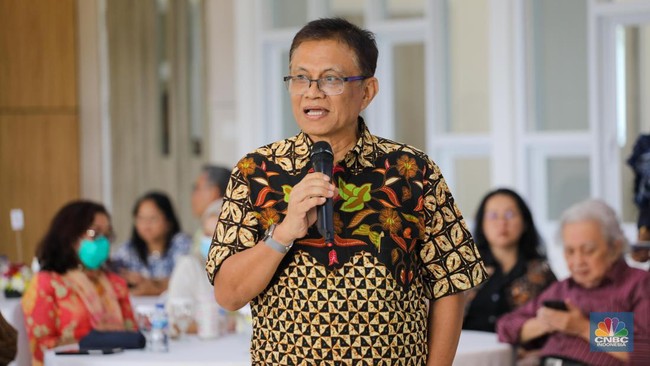
Jakarta, CNBC Indonesia - The government targets 8% growth for the Indonesian economy in 2029. This target has been set in the 2025-2029 National Medium-Term Development Plan (RPJMN).
However, the government’s projection for Indonesia’s economic growth in 2026 remains below the roadmap established to achieve that growth target.
The basic macroeconomic assumptions of the 2026 State Revenue and Expenditure Budget (APBN) target Indonesia’s economic growth this year at 5.4%. That figure is below the RPJMN’s 6.3%.
Moreover, during its course, Indonesia’s economy faces numerous challenges, primarily from external factors that impact internal conditions.
Early in 2026, war between Iran, the United States, and Israel erupts, significantly contributing to global uncertainty. World oil prices surge sharply, breaching US$100 per barrel due to the closure of the Strait of Hormuz, through which 20% of the world’s oil tankers pass.
The ripple effects of the war alter the global economic outlook. The International Monetary Fund (IMF), for instance, projects global inflation in 2026 at 4.4%, higher than 2025’s 4.1%.
High inflation prompts most central banks worldwide to maintain their high interest rates, ushering in a renewed era of “higher for longer,” leading to expectations that many countries will proceed cautiously with economic expansion.
Meanwhile, the global economy is also forecasted to slow in the same year, to 3.1% from 2025’s 3.4%, according to IMF projections.
So, what steps must the government take to ensure 8% economic growth remains a certainty?
Didik J. Rachbini, economist from INDEF and Rector of Paramadina University, states that bridging the gap between government economic projections and the RPJMN requires productivity enhancements.
“The gap towards the target cannot be closed solely through fiscal expansion but requires structural productivity improvements,” he said, quoted on Thursday (23/4/2026).
However, to boost that productivity, Didik notes that Indonesia faces another challenge: high logistics costs at 14.3% of GDP, with the government’s target to reduce this to 8% by 2045.
Didik explains there are three drivers to enhance productivity and propel economic growth to meet future targets.
The first is investment in digital infrastructure, which directly impacts growth, not merely as a supporting effect. According to Didik, digitalisation has now become a new growth multiplier.
“Every 10% increase in broadband penetration drives GDP growth by 1.21 percentage points in advanced economies and 1.38 percentage points in developing countries. This means digital is not just an enabler but a direct driver of economic productivity,” Didik clarified.
Additionally, improvements in mobile broadband can boost labour productivity. Enhancements in access quality and speed correlate with a productivity increase of about 0.2 percentage points. Expanding data centre capacity is also necessary to promote digital services trade, with potential growth of up to 1.6 percentage points.
The second driver is policies on priority sector infrastructure. Three sectors require focus in these priority policies: renewable energy, mass transportation, and ports and sea tolls.
“These sectors have strong backward and forward linkages, as well as significant impacts on productivity and economic growth. They serve as the main levers in closing the growth gap towards the national target,” Didik explained.
According to him, energy infrastructure can drive industrial productivity through more reliable, efficient, and sustainable energy availability. Mass transportation infrastructure is essential to reduce economic costs from congestion and improve workforce mobility efficiency in urban areas.
Meanwhile, sea toll and port policies can enhance logistics efficiency, strengthen export competitiveness, and accelerate integration into global supply chains.
“As the world’s largest maritime nation with a poor Logistics Performance Index (LPI), developing ports and sea tolls can improve logistics efficiency, bolster export competitiveness, and speed up integration into global supply chains. This has not been realised over the past decade,” he added.
The final driver is green economic policies, which have become a primary condition for global competitiveness, thus influencing the risk of losing access to global markets.
“The global shift in investments towards low-carbon sectors presents a strategic opportunity for Indonesia to drive sustainable growth,” he said.
Didik provides five policy recommendations in the infrastructure acceleration strategy to boost economic growth.
First, efficient investment by lowering the Incremental Capital Output Ratio (ICOR) through prioritising ready and high-impact projects.
Second, strengthening connectivity to reduce logistics costs and promote industrial downstreaming. Third, developing digital infrastructure to create the highest productivity multipliers across sectors.
Fourth, financing reforms, where the APBN acts as a catalyst and public-private partnerships as investment accelerators. Fifth, bolstering green infrastructure to enhance global competitiveness and meet ESG standards.
Source: jawawa.id (https://jawawa.id/newsitem/senior-economist-shares-5-ways-to-achieve-8-growth-for-indonesias-economy-1776916405)
Originally published by CNBC Indonesia (https://www.cnbcindonesia.com/news/20260423081758-4-729083/ekonom-senior-bagikan-5-cara-agar-ekonomi-ri-tumbuh-8), translated from Indonesian