
Senator Graal: End Extractive Investment, Focus on Sustainable Investment
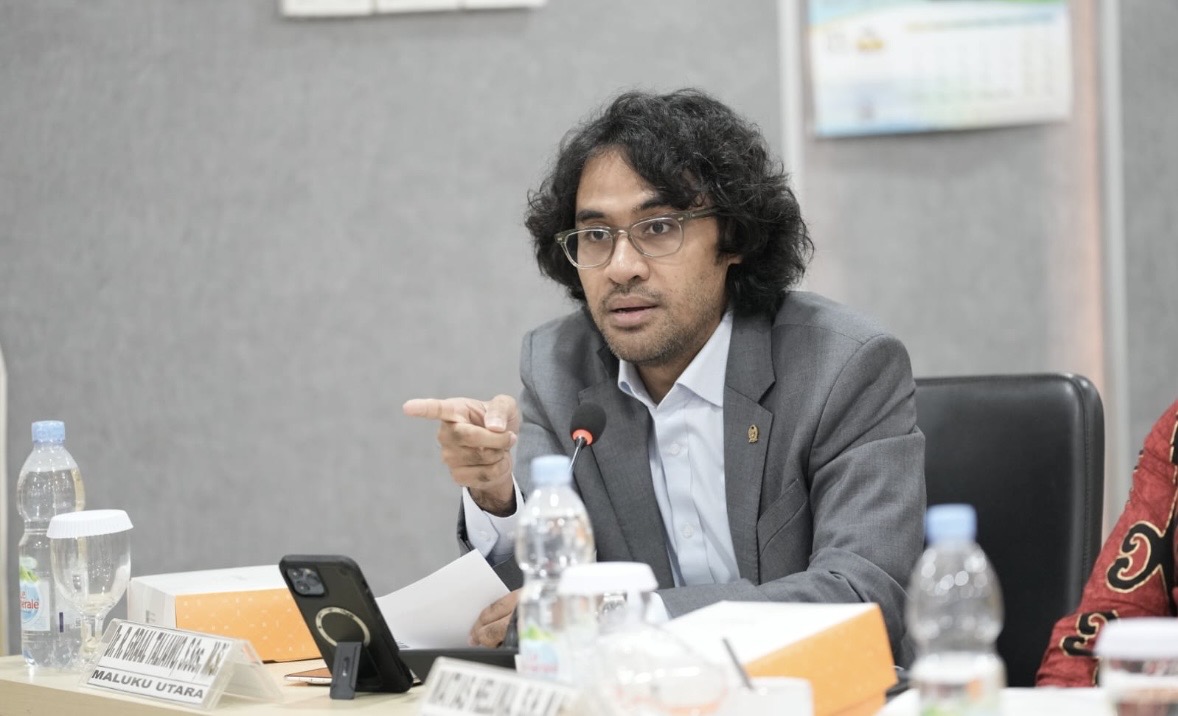
Senator R. Graal Taliawo, representing North Maluku in the Regional Representative Council (DPD RI), delivered a sharp critique to the Ministry of Investment and Downstreaming/BKPM and the Ministry of Energy and Mineral Resources (ESDM) during separate meetings on 9 June 2026 at the DPD RI Building in Jakarta. “There is no point in exaggerating North Maluku’s high economic growth to us. It is not the bank accounts of ordinary people that are ringing. We still witness economic inequality before our very eyes,” he stated.
He pointed to a development paradox in Indonesia. “Indonesia promotes sustainable investment. Yet on the other hand, the reality is that more investment is digging into the earth, including in North Maluku,” Senator Graal said. The member of DPD RI Committee II assessed that the investment structure developing in North Maluku remains heavily dominated by the extractive sector based on mining and mineral processing.
North Maluku’s economic growth is high, but it is not the community that feels the economic benefits. Borrowing a phrase used by Dr. Graal, “Our economic growth is brutal. It is the highest among other provinces, reaching over 30 percent. But the people are still struggling and finding it difficult to pay their children’s university tuition fees due to limited incomes. This certainly deserves criticism.”
The highest contributing sector to economic growth is the extractive industry: mining and its downstream processing. “With simple logic, we already know whose bank accounts are ringing. It is definitely the investors, not the community. This is what is scientifically termed non-inclusive economic growth. It only benefits a handful of parties, not evenly spread to the people in the region,” he explained seriously.
For Dr. Graal, this is a critical issue and certainly unfair for the people of North Maluku. The community sees real environmental damage before their eyes, compounded by having to experience significant economic inequality.
North Maluku is currently bearing a fatal ecological burden, worsened by a land crisis for livelihoods. “Our land area is around 3 million hectares. Nearly 655,000 hectares are already allocated for mining. Meanwhile, sustainable food land is only about 6,000 hectares. Eventually, we might end up eating nickel and gold,” asserted the man born in Wayaua, Bacan.
It is an open secret that investment in North Maluku is dominated by mining. By 2025, there were a total of 113 Mining Business Permits (IUP) in North Maluku, issued by both regional and central governments. “Of that total, currently only about 10 percent are operating in North Maluku. That alone has already devastated the environment in North Maluku. It is unimaginable if all IUPs become active and produce,” he added.
Dr. Graal is also anxious and baffled by the previous issuance of IUPs. “On Taliabu Island, almost the entire island is within a Mining Business Permit Area (WIUP). Mangoli Island and Gebe Island share the same fate. One village area in Woi Village, South Halmahera Regency, is already within the WIUP of a gold mining company. There is community life there,” he stated firmly.
According to him, we must not only talk about investment figures and economic growth. We must also look at the impact on the environment, the living space of communities, and the sustainability of regional development.
The political ideas activist also voiced community corrections regarding the Community Empowerment Programme (PPM). “Residents around the mining ring complain because mining companies are not transparent and do not involve them in the PPM. They are the ones affected, yet there is no empowerment for them. This is certainly wrong,” he said.
Law No. 2 of 2025 clearly regulates in Article 108 that IUP and Special Mining Business Permit (IUPK) holders are obliged to prepare community development and empowerment programmes consisting of, among others: b. Involvement of local communities and indigenous peoples residing in the Mining Area (WP) in mining activities.
Another criticism is that the state needs to be present in the land acquisition process. When an IUP is granted, the state must ensure that land acquisition negotiations between the community and the company are conducted fairly and in accordance with existing legal rules. Intimidating behaviour towards the community is not justified. It is important that no party feels sacrificed, displaced, or disadvantaged. The state must no longer wash its hands and shirk responsibility.
He also pushed for energy equity and highlighted that many villages in North Maluku still lack electricity. There are still around 62 villages in North Maluku, including Kulo Village in Central Halmahera, that remain completely without electricity. This is certainly an important note for the Ministry of Energy and Mineral Resources, which runs the Village Electricity programme.
During the meeting, Dr. Graal firmly requested that the central government stop issuing new IUPs in North Maluku. “Every visit to villages, communities around the mining ring always convey a message: ‘We do not want our environment to be destroyed because of mining activities. We do not need all of that. We are content with what exists in our living environment. The abundance of fish, as well as plantation and agricultural produce,’” he said.
He then asked the ESDM Ministry to evaluate IUPs that are currently producing and those that exist but are not operating. Mining companies must comply with regulations, including in the implementation of Environmental Impact Assessments (AMDAL) and PPM. On the other hand, many mining companies in North Maluku are still not operating at all. They do not dare to because the community is waiting with machetes. If there are companies whose IUPs have no mineral resources, the ESDM Ministry can reduce the IUP area so that the community can manage the land.
To BKPM, Dr. Graal requested an orientation towards developing a green and blue economy in North Maluku. North Maluku has great potential to become a centre for green and blue economy development.