
Sempurna's Story and the Threat of Forest Fires to Bornean Orangutans
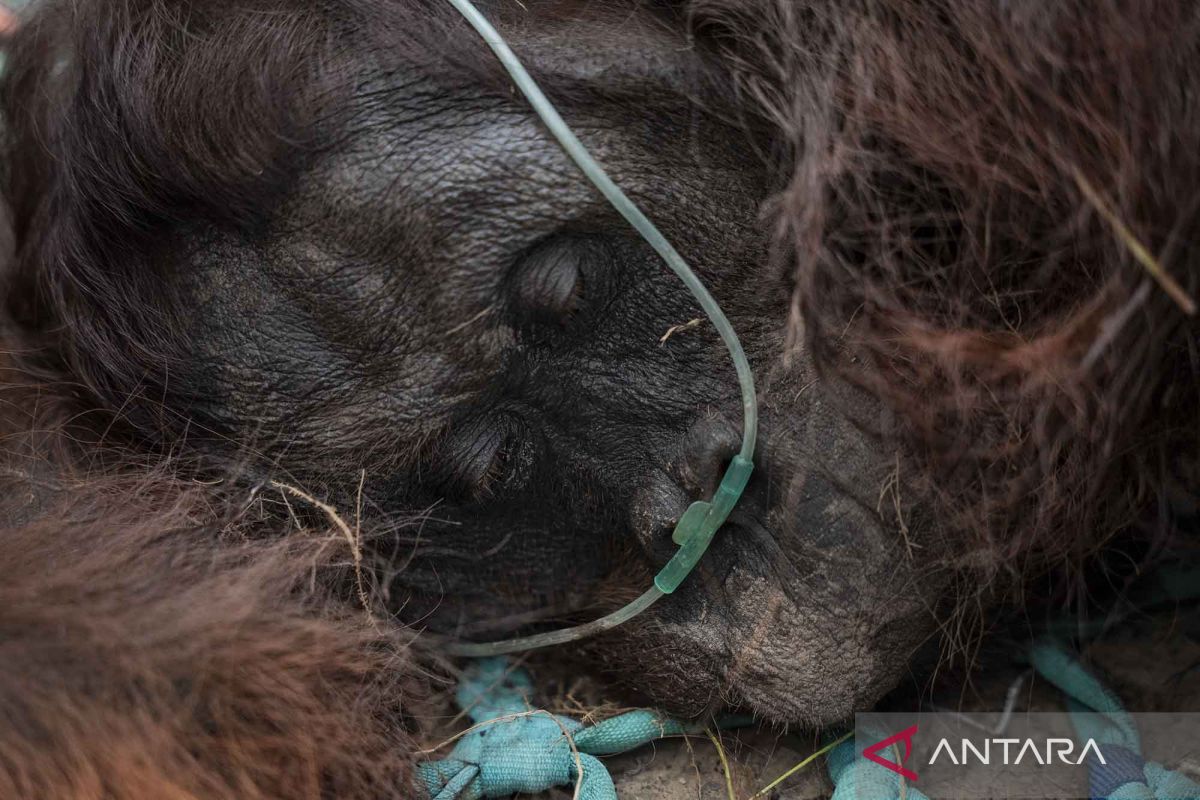
Jakarta (ANTARA) - A distressing story has emerged from Ketapang Regency, West Kalimantan. An adult male Bornean orangutan named Sempurna was found in a very weak condition and suffering from breathing difficulties at an oil palm plantation in Sempurna Hamlet, Kuala Satong Village, Matan Hilir Utara Subdistrict, on Sunday (30/8).
The West Kalimantan Natural Resources Conservation Centre (BKSDA) team, together with the International Animal Rescue Indonesia Foundation (YIARI), carried out an evacuation. Sempurna received oxygen therapy and fluids before being taken to the YIARI rehabilitation centre. However, his condition continued to deteriorate until he was declared dead on the same day.
The results of a post-mortem examination carried out on 1 September showed pathological changes in several organs, particularly the lungs, heart and kidneys. The lungs displayed a condition suspected to be linked to smoke exposure, causing oxygen deprivation or acute hypoxia. This condition is believed to have also disrupted cardiovascular function, contributing to Sempurna’s death.
Sempurna’s case is a stark illustration that forest and land fires are not merely a matter of smoke disrupting human activities. For wildlife such as orangutans, fires can mean the loss of their homes and food sources, as well as a direct threat to their safety.
The Bornean orangutan, or Pongo pygmaeus, is one of the species most dependent on the existence of forests. Trees are where they search for food, rest, move from one location to another, and raise their young.
When a forest burns, the damage does not end once the flames are extinguished. Vegetation that serves as a food source can disappear, wildlife movement routes are severed, and areas that previously provided shelter become unsafe territory.
Such situations have in fact occurred several times in Kalimantan. In August 2026, for example, BKSDA West Kalimantan evacuated orangutans from residents’ plantation areas in Ketapang due to the threat of forest fires. Previously, a mother orangutan named Mama Yuni and her two offspring were also evacuated after fires threatened their habitat and cut off their movement routes.
In other words, when forests burn, orangutans face multiple layers of problems. They must avoid fire and smoke while simultaneously searching for a new place to survive.
To date, attention on forest and land fires has often focused on the flames and the extent of land burned. Yet the smoke produced is also a major problem for wildlife.
Sempurna is the most immediate example. The orangutan was not reported to have suffered severe burns, but was found struggling to breathe after being caught in the midst of fire conditions. The examination after his death showed damage to the lungs suspected to be linked to smoke exposure.
For animals living in forest areas, thick smoke can reduce air quality and impair the respiratory system. In fires that rage for days, wildlife also has limited options for finding a place with cleaner air.
Therefore, saving orangutans from forest fires does not always mean moving them away from the flames. Rescue teams must also pay attention to the animals’ health condition resulting from smoke exposure, dehydration, food shortages, and stress during the evacuation process.
Orangutans emerging from the forest are not deliberately approaching humans. In many cases, they are driven to search for food sources and shelter after their habitat has been disturbed.
Plantations are among the places they may visit, as they provide trees or fruit that can be used as a food source. However, the presence of orangutans in plantation areas can also cause concern among local communities.
This is where the rescue process becomes important. Handling that is rushed or carried out without expertise can endanger both the animals and humans.
Sempurna’s case also demonstrates the importance of public reports. BKSDA West Kalimantan stated that reports from residents are a crucial part of efforts to rescue wildlife that is sick, injured, or affected by forest fires.
Similar threats are also occurring in other parts of Kalimantan.
In East Kalimantan, for example, BKSDA together with the Jejak Pulang Foundation evacuated 11 orangutans on 1 September 2026 from the Jejak Pulang Forest School area in Samboja, Kutai Kartanegara Regency. The step was taken after fires moved increasingly close to the Samboja special-purpose forest area (KHDTK) and smoke began to impair visibility.
Unlike Sempurna, who was found in a critical condition, the 11 orangutans evacuated in Samboja were declared healthy and safe from the effects of smoke exposure after examination.
The two events show two sides of the threat posed by forest fires. On one hand, there are animals that can still be saved through swift evacuation. On the other, there are animals like Sempurna whose condition was already too poor to be saved.
Sempurna’s story is ultimately not just about one orangutan that died as a result of a deteriorating environment. The event serves as a reminder that the safety of wildlife is closely tied to the condition of the forests where they live.
Orangutans cannot simply move to a new habitat when forests burn. They need areas with trees, food, and sufficient space to live. As habitats become increasingly fragmented and then struck by fire, their options for survival grow ever fewer.
Wildlife rescue efforts during forest fires remain important. However, fire prevention and habitat protection are equally vital steps.
For rescuing a single orangutan after it leaves the forest may be something a rescue team can accomplish. But ensuring the forest remains a safe place for orangutans requires far longer-term work.
Sempurna is indeed gone. But his story shows that when Kalimantan’s forests burn, what is lost is not only the trees. Behind the smoke and scorched land lies a home for wildlife that is also under threat.
And for the Bornean orangutan, losing a home can be the beginning of a far greater problem.