
Sempurna and the Sentinel Species We Ignore
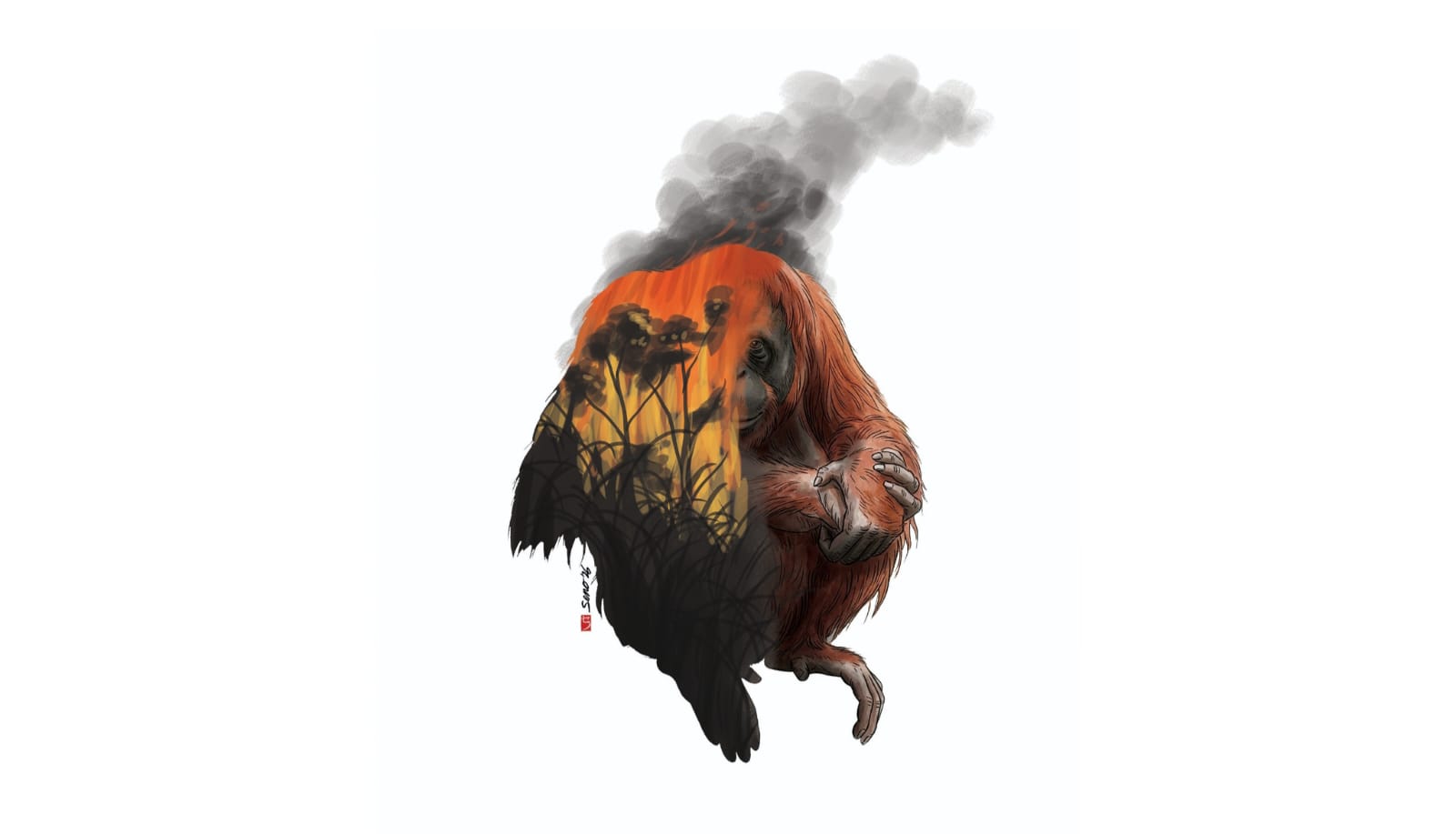
The death of an orangutan named Sempurna in a local palm oil plantation in Laman Satong Village, Ketapang, West Kalimantan, should not be read merely as seasonal conservation mourning. Found in a weakened state and receiving emergency oxygen, the necropsy results pointed to lung dysfunction caused by smoke exposure. This event is a biological signal that we have failed to read as an alarm, rather than just a heartbreaking news item about wildlife that is quickly forgotten once the news cycle passes.
To date, the discourse on managing forest and land fires in Kalimantan has revolved almost entirely around anthropocentric calculations: how many hectares of land burned, how many millions of humans were exposed to respiratory infections (ISPA), and how many schools were closed. The lives of non-human beings lost in the same shroud of smoke are treated as ecological footnotes rather than equivalent epidemiological data. In environmental health science, Sempurna’s death is precisely what is known as a ‘sentinel species’ phenomenon—an early biological signal of a real threat that is also eroding human health in the same region.
SENTINEL SPECIES THAT ARE IGNORED
The concept of a sentinel species is not new in environmental science. It refers to organisms that, due to their physiological proximity or ecological position, show symptoms of environmental poisoning more quickly and clearly than humans, much like the canaries once carried by coal miners to detect toxic gases before humans could sense them.
Orangutans, with lung structures and respiratory systems that are evolutionarily very close to humans, are nearly perfect sentinel candidates for air pollution caused by forest fires. When an adult orangutan, which lives daily in the forest canopy, must be evacuated in critical condition due to the air it breathes, it serves as empirical evidence that the air quality in the area has exceeded the threshold tolerable by the respiratory systems of large mammals—a threshold that should serve as an early warning for humans living nearby.
Ironically, our public health system is not designed to listen to such signals. Data on wildlife deaths and evacuations are managed separately by conservation agencies and national park authorities, while human respiratory infection data is managed by the Ministry of Health. The two are almost never brought together in a single analytical framework, even though both are symptoms of the exact same source of pollution.
GAP IN EMERGENCY PROTOCOLS
This gap is not merely an administrative issue, but a structural flaw in our disaster response architecture. When thousands of joint personnel, water-bombing helicopters, and weather modification fleets are deployed to extinguish hotspots, emergency evacuation protocols for wildlife trapped in the middle of smoke clouds have almost no place in the national disaster command structure.
Conservation organisations, such as orangutan rehabilitation centres, operate with much more limited resources. They often only reach animals when they are already in critical condition, as seen in Sempurna’s case, because there is no early warning mechanism linking air quality monitoring with the range of protected species populations. Technically, the hotspot distribution data and smoke dispersion models already possessed by BNPB and BMKG could easily be overlaid with the habitat maps of orangutans that conservation agencies have mapped for years.
EMBRACING THE ONE HEALTH FRAMEWORK
The most relevant framework to bridge this gap is the ‘One Health’ approach, a paradigm that explicitly recognises that human health, animal health, and ecosystem health are a single, inseparable unit. This approach has been adopted globally to handle cross-species threats such as zoonosis, but it has almost never been integrated into the architecture of forest fire management in Indonesia.
Integrating One Health into forest fire management means three concrete steps. First, data on the death and evacuation of protected animals must be included as an official indicator in the national air quality early warning system, alongside human respiratory infection data. Second, the habitats of protected animals, such as orangutan ranges, must receive priority in the mapping of weather modification zones and peatland canal blocking, rather than being treated as residual areas outside firefighting priorities. Third, conservation agencies must be given official access to the national disaster emergency command chain, rather than operating alone with whatever limited resources they possess, as occurred in Sempurna’s case.
The death of an orangutan in a Ketapang palm oil plantation will not change any policy if we continue to treat it as an isolated conservation incident. However, if we are willing to read that death for what it truly is—a biological signal from the same ecological system we breathe—then Sempurna could become a turning point for building a forest fire response architecture that truly unites human and non-human health within a single, cohesive framework, rather than two parallel worlds that only meet in news of tragedy.