
Semesta Network: Creative agencies are no longer just about content production
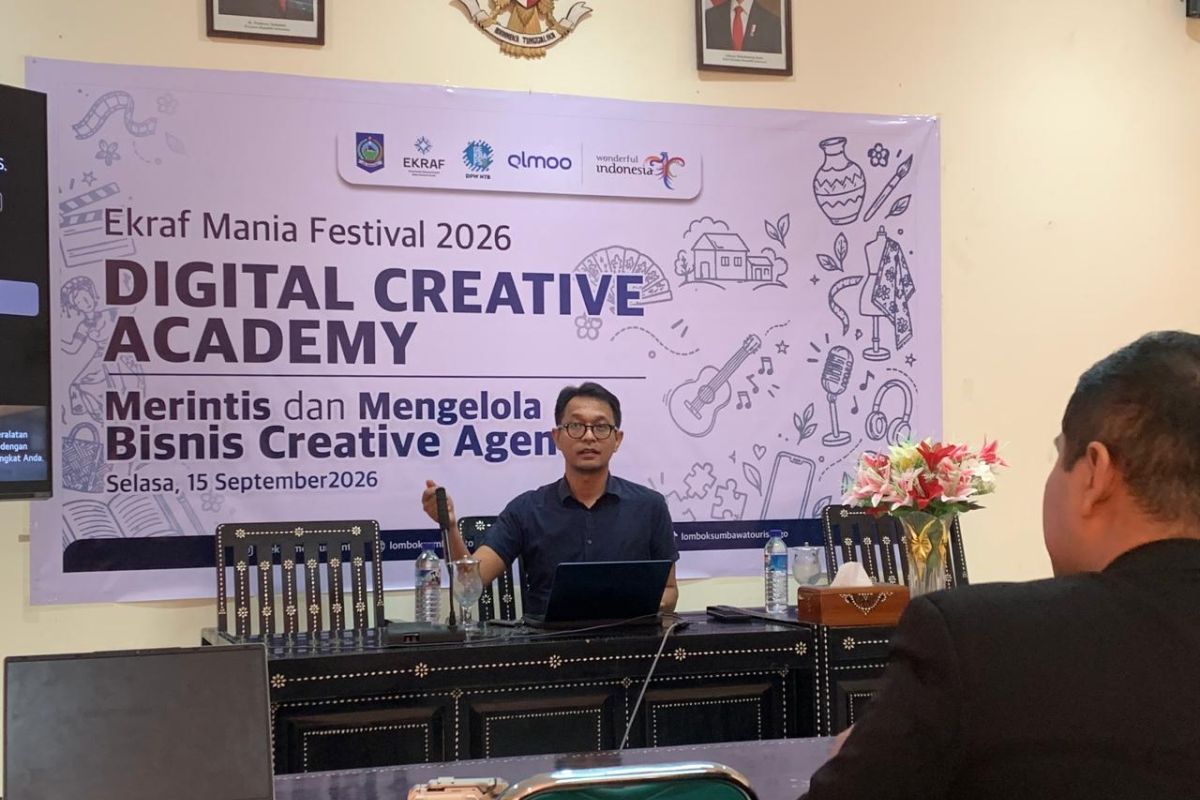
Mataram, NTB (ANTARA) — Semesta Network director M Hafidullah has said the creative agency business now has an increasingly broad scope and is no longer limited to producing content or managing social media campaigns.
“If anyone today thinks that a creative agency only makes content, does social media activations, runs campaigns and so on, then creative agencies today have gone beyond all of that,” Hafidullah said while speaking at an event organised by the NTB Tourism and Creative Economy Office in Mataram, NTB, on Tuesday.
He explained that creative agencies are one part of the creative industry ecosystem, which has a very large and diverse market.
According to him, within the agency ecosystem there are various clusters, including advertising agencies, creative agencies, digital agencies and media agencies, each with different functions and business opportunities.
“If everyone becomes an agency, you all end up competing with each other. If I may offer guidance, take on your respective roles,” he said.
Hafidullah, who started his business in 2002, said his business journey shows that opportunities in the creative industry continue to grow alongside changes in technology and consumer behaviour.
He began in software development before entering the world of digital advertising.
Over time, Semesta Network built a number of interconnected business lines within the creative ecosystem.
One of these is its digital agency, which Hafidullah said can now be developed into several focus areas, including services for government.
He also highlighted the enormous business potential of media within the advertising ecosystem.
Based on his experience handling corporate clients, communication and advertising budgets are not spent entirely on advertising production; a large portion is also allocated to media.
“The biggest business actually belongs to those who own the media,” he said.
According to him, the existence of media is also closely tied to data and research for measuring communication effectiveness.
For that reason, his company developed a research firm focused on digital transformation.
Beyond creative agencies, Hafidullah said the creative industry ecosystem can also be developed through intellectual property (IP) businesses, business incubators and technology companies.
The IP business, he said, is now one of the growing models in the creative industry because creative products can be developed into various commercial forms.
“What is sold could become a product. That falls into the IP category,” he said.
He also encouraged creative economy players in NTB not to focus on just one type of business.
In his view, dividing roles within the ecosystem can instead create collaboration and expand the market.
Hafidullah assessed that opportunities in NTB’s creative industry are wide open because the creative economy ecosystem has a large and continuously growing market.
He noted that the creative economy now encompasses 21 subsectors, with the emergence of new types of ventures such as content creators and automotive modification.
“When we talk about the creative ecosystem, the market will never run out. The market is enormous,” he said.
On that occasion, Hafidullah also shared Semesta Network’s experience handling a number of major clients, including PT Pertamina, BSI and the Ministry of Public Works and Housing (PUPR).
He cited the management of the PUPR Ministry’s digital communications, which included creative content featuring Minister of Public Works and Housing Basuki Hadimuljono.
According to him, creative content that appears spontaneous on social media still fundamentally requires strategy, concept, production and planned communication management.
Hafidullah hopes this experience can inspire creative economy players in NTB to see business opportunities more broadly and build collaborations according to their respective expertise.
“You all must be able to do the same,” he said.