
Semarang City BPBD Trains People with Disabilities in Disaster Mitigation
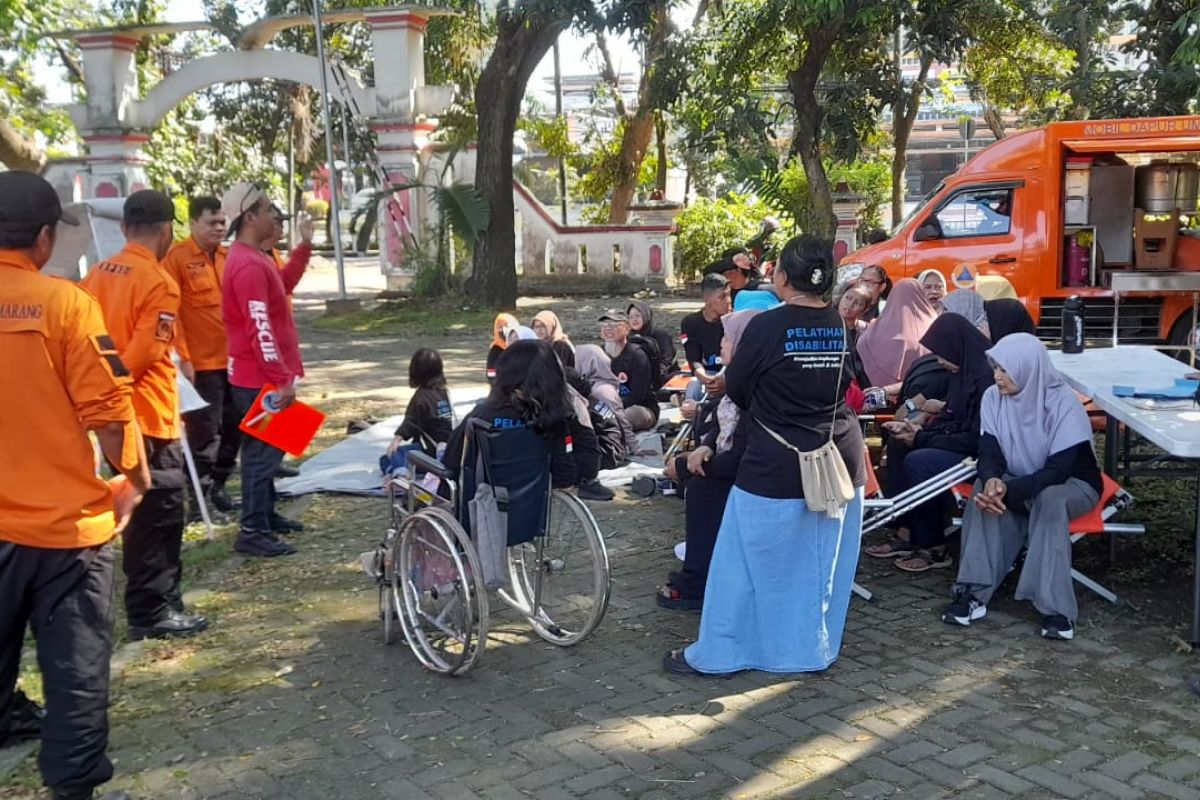
Semarang (ANTARA) - The Semarang City Regional Disaster Management Agency (BPBD), together with the Semarang City Inclusion Service (LINKK Semar), held training on disaster mitigation and preparedness for people with disabilities.
The Head of BPBD Semarang City, Endro Pudyo Martantono, in Semarang on Thursday, explained that mitigation and preparedness are topics that every member of society must understand, especially people with disabilities.
“People with disabilities, in facing disasters, should at least be able to save themselves independently before assistance arrives to help and rescue them,” he said.
Moreover, given the topography of Semarang City, which often experiences natural disasters such as floods and landslides, these must be addressed wisely with anticipatory actions.
Therefore, he said, in addition to providing materials, a disaster simulation was also conducted involving the operational section of BPBD and people with disabilities.
In the simulation, detailed explanations were given on what needs to be prepared and done when a disaster occurs.
The Chair of LINKK Semar, Fita, explained that the organisation is a collaborative platform established to create an inclusive, equitable, and just disaster management system for all layers of society, particularly people with disabilities.
Meanwhile, the Chair of the Disaster Study and Management Division of LINKK Semar, Wishnu Pratomo, elaborated on disasters, mitigation, and preparedness for people with disabilities by understanding disaster signs and what needs to be done independently.
The explanations were provided for each possible disaster in the area and its handling according to various types of disabilities.
In the disaster simulation, participants were divided into four groups acting as victims, evacuation and shelter teams, data and information centre, and public kitchen.
After briefing and explanations of each role and task, the participants began the disaster simulation, including the rescue of people with physical and visual disabilities, as it requires knowledge of the challenges in handling them.
In the simulation, participants appeared serious in carrying out their roles and tasks; after the victims were rescued and evacuated, the data and information centre team conducted data collection.
Meanwhile, the public kitchen team prepared food to be distributed to the evacuation tents, both as a simulation and as lunch for the event, so that all participants and facilitators could experience the disaster situation.
The activity is planned to be held periodically so that people with disabilities will be more prepared to face disasters, especially to minimise fatalities.