
Seizing Export and Investment Opportunities After the IEU-CEPA Agreement
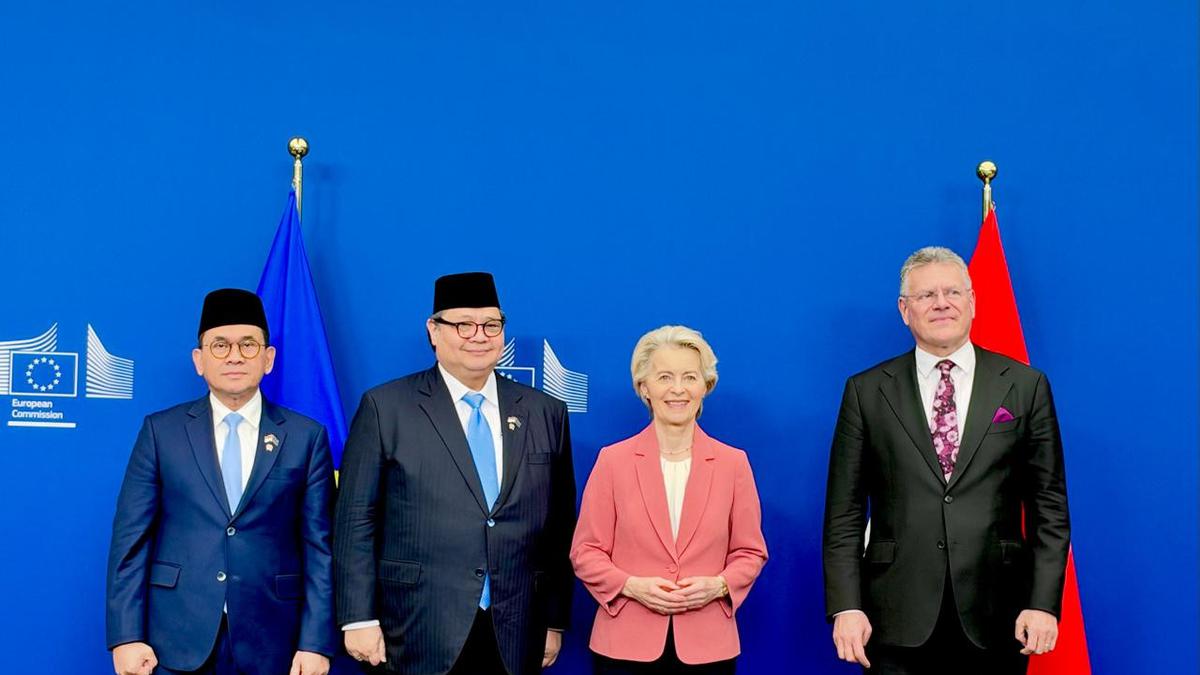
Indonesia’s economic relationship with the European Union has entered a new phase following the signing of the Indonesia-European Union Comprehensive Economic Partnership Agreement (IEU-CEPA) and the Investment Protection Agreement (IPA) on Saturday, 21 November 2026. The agreements are expected to support Indonesia’s economic growth, particularly by expanding access for Indonesian exports to the EU market.
The IEU-CEPA documents were signed in Brussels, Belgium, by Coordinating Minister for Economic Affairs Airlangga Hartarto and Trade Minister Budi Santoso. The EU was represented by its Commissioner for Trade, Maroš Šefčovič.
Budi said the signing marked an important milestone in Indonesia-EU economic relations, following more than a decade and 19 rounds of negotiations. It brought the long negotiating process to a close.
“After a long journey spanning a decade and at least 19 rounds of negotiations, Indonesia and the EU have finally signed the IEU-CEPA in Brussels. This signing marks an important milestone in the economic relations between the two sides and is one of Indonesia’s trade diplomacy achievements under President Prabowo Subianto,” Budi said in an official statement on Sunday, 22 November 2026.
A historic milestone for 1.01 billion people in the EU and Indonesia
Airlangga said the signing was historic and would benefit around 1.01 billion people in the EU and Indonesia. He hoped the agreements would be implemented promptly after ratification in both jurisdictions.
“This signing is historic, particularly for the 730 million people across the 27-member EU and Indonesia’s 280 million people,” he said.
“We will now work to ensure that implementation of both agreements, the IEU-CEPA and the IPA, produces tangible outcomes through cooperation between businesses in the EU and Indonesia, while also opening up opportunities,” Airlangga added.
European Commission President Ursula von der Leyen said a partnership based on rules and trust would strengthen resilience. European companies, she said, were well positioned in some of the world’s fastest-growing markets.
“At the same time, they also show that Europe is a reliable partner of choice,” she said on Saturday, 21 November 2026.
She said the IEU-CEPA represented a long-term relationship and a partnership between the world’s largest single market and Southeast Asia’s largest economy.
“Together, we represent a market of 730 million people. This agreement delivers tangible benefits for people in Indonesia and the EU. It will support economic growth and create quality jobs on both sides, for farmers, manufacturers and small businesses alike,” she said.
What benefits will Indonesia gain from the agreement?
Benefits for Indonesia
Wider access to the European market
The Indonesia-EU partnership will widen access for Indonesia’s leading products and create opportunities to attract investment into the country. “The IEU-CEPA opens the gateway for our national flagship products to the European market while attracting quality investment into Indonesia’s strategic sectors,” Airlangga said after the signing on Saturday, 21 November 2026.
Indonesian products to benefit from duty-free access
Budi said the IEU-CEPA would support Indonesia’s economic growth, particularly by expanding access for exports to the EU. A total of 90.4% of EU tariff lines will be reduced immediately to 0% when the agreement enters into force. These include palm oil and some of its derivatives, rubber and rubber products, footwear, textiles and textile products, among others.
Tariffs on a further 7.92% of tariff lines will be phased out over three to 15 years, bringing the total coverage to 98.35% of tariff lines.
“More than 98% of EU tariff lines will provide preferential market access for Indonesia’s leading exports, such as palm oil and its derivatives, footwear, textiles, fishery products, rubber, furniture and various other manufactured goods,” he said.
Businesses could save Rp17 trillion
Airlangga estimated that implementation of the IEU-CEPA could generate savings of around Rp15 trillion to Rp17 trillion by removing tariffs on Indonesian export commodities.
He said products including palm oil, cocoa and coffee would receive 0% tariffs on entry to the EU, contributing to the savings.
“On tariff savings, we will see how it works, but a simple estimate would put the savings at around Rp15–17 trillion,” Airlangga said at an online press conference on Saturday, 21 November 2026.
He said many of Indonesia’s leading products would be exempt from EU import duties.
“Some of Indonesia’s leading products, such as palm oil, garments, textiles, footwear, coffee, cocoa and rubber, will receive 0% import duties. Some others, including furniture, automotive components and fishery products, will receive similar tariffs,” Airlangga said.
He described the tariff reductions as an opportunity to expand markets for Indonesia’s leading products, adding that they were expected to increase trade volumes.
Higher CPO export quotas
Airlangga said quotas for exports of crude palm oil (CPO) and palm oil free from export duties could rise after the IEU-CEPA is implemented. The increases will be phased in.
“The duty-free export quotas for CPO and palm oil are 1.9 million tonnes and 140,000 tonnes respectively, and these quotas will rise gradually to their highest levels in the ninth year,” Airlangga said at a virtual press conference on Saturday, 21 November 2026.
Cooperation across a range of sectors
The IEU-CEPA covers more than tariff reductions. Its scope includes trade in goods and services, investment, intellectual property, government procurement, competition and sustainable development. Budi said he hoped these commitments would encourage investment, strengthen domestic industry, create jobs and improve Indonesia’s competitiveness in global markets.
“The IEU-CEPA is the most modern and comprehensive trade agreement we have, and sets a new benchmark in the breadth and depth of trade commitments and economic cooperation. It opens up opportunities for EU cooperation in Indonesian manufacturing, automotive, renewable energy and digital economy sectors. Stronger legal certainty and transparency are also expected to create a more stable and predictable business climate,” he said.
He also emphasised that the agreement had been designed to be inclusive, so that businesses of different sizes and across different sectors could benefit, including micro, small and medium-sized enterprises (MSMEs) and young entrepreneurs.
Access for MSMEs and a rise in exports
Simpler paperwork for MSMEs
Airlangga said the IEU-CEPA would make it easier for MSMEs to export their products, including by simplifying export documentation.
“Indonesian MSMEs can use a declaration of origin themselves, or a certificate of origin, to speed up export documentation. They can also use the MSME website and a tariff database organised by HS code under the IEU-CEPA,” he said.
Exports targeted to rise by 50%
Budi set a target for Indonesian exports to the EU to increase by as much as 50% over the next five years.
To achieve this, the government projects average annual export growth of US$3.8 billion to US$5.7 billion over the next five years. Businesses are being encouraged to take advantage of the trade facilitation provided by the agreement.
“We have targets for what we want to achieve after the IEU-CEPA comes into force. We expect exports to rise by US$3.8 billion to US$5.7 billion a year, on average, over the next five years. In other words, we hope exports will increase by 50% within five years,” Budi said at an IEU-CEPA trade agreement briefing at the Trade Ministry in Jakarta on Tuesday, 24 November 2026.
Set to take effect on 1 January 2027
Budi said the Indonesian government was accelerating ratification of the Indonesia-EU trade agreement. It aims to complete the process by the end of December 2026 at the latest, so the agreement can enter into force on 1 January 2027.
“We have to push to complete ratification by the first [of January], or at least by the end of December, because it has to be up and running on 1 January,” the Trade Minister said in Jakarta on Tuesday, 24 November 2026.
The acceleration is intended to prevent a gap between the expiry of the Generalised Scheme of Preferences (GSP) and the start of the IEU-CEPA. The GSP facility, which has benefited some Indonesian exports to the EU, expires on 31 December 2026.
“Why? Because our GSP ends on 31 December. We must not have a gap between the GSP and the CEPA. That is what we are working towards, and we have agreed that the EU is doing the same; it has promised to finish by mid-December,” he said.
The government has prepared the administrative requirements needed to speed up ratification. Indonesia is also coordinating with the EU, which aims to complete its own ratification by mid-December 2026.
“We ask for your support so that we can complete this ratification in a short time. We have prepared everything; we hope the procedures can be expedited,” he said.
Budi said swift ratification was important to ensure Indonesian businesses could make use of the trade facilities under the agreement as soon as possible.
Exporters urged to use 11 trade representatives
Budi has outlined several strategies to boost Indonesian exports to Europe and make the most of the IEU-CEPA. One priority is to make better use of Indonesia’s trade representatives across the EU. Indonesia currently has seven trade attachés and four Indonesia Trade Promotion Centres (ITPCs) in the region.
The network can help Indonesian businesses find prospective buyers, explore partnerships and expand the marketing of their products in Europe.
“We have 44 overseas representatives in 33 countries. How many are in the EU? There are seven trade attachés and four ITPCs,” Budi said on Tuesday, 24 November 2026.
He urged Indonesian exporters to contact the trade representatives for support in entering the European market, particularly after the two sides signed the IEU-CEPA.
“Do not hesitate to contact our ITPCs and trade attachés to arrange business matching,” he said.
The Trade Ministry also offers online business matchmaking through the InaExport portal. The service is intended to help domestic businesses connect directly with prospective partners in various countries.
Businesses call for straightforward implementing rules
Apindo chair Shinta Kamdani said the IEU-CEPA could broaden Indonesia’s economic partnerships and strengthen business certainty. The agreement was also expected to create opportunities for more sustainable growth in trade and investment.
“For the business community, this achievement is strategically significant because it provides a stronger foundation for expanding market access, increasing investment and strengthening industrial partnerships between Indonesia and the EU,” Shinta said in a statement on Monday, 23 November 2026.
Although the agreement promises substantial benefits, businesses are waiting for ratification by the EU and Indonesian parliaments. In the meantime, Shinta said, the government should prepare implementing regulations, administrative systems and customs procedures.
“We hope implementation of the IEU-CEPA can be as simple and smooth as possible, without administrative barriers or adjustment costs that could have been avoided,” she said.
Shinta said the priority was no longer simply to celebrate an agreement on paper, but to ensure that all its commitments translated into practical benefits for businesses.
Source: jawawa.id (https://jawawa.id/newsitem/seizing-export-and-investment-opportunities-after-the-ieu-cepa-agreement-1795600281)
Originally published by liputan6.com (https://www.liputan6.com/bisnis/read/8341880/menangkap-peluang-ekspor-hingga-investasi-usai-kesepakatan-ieu-cepa), translated from Indonesian