
Seeking Input on One Data Bill, House Legislation Body and Bappenas Visit China
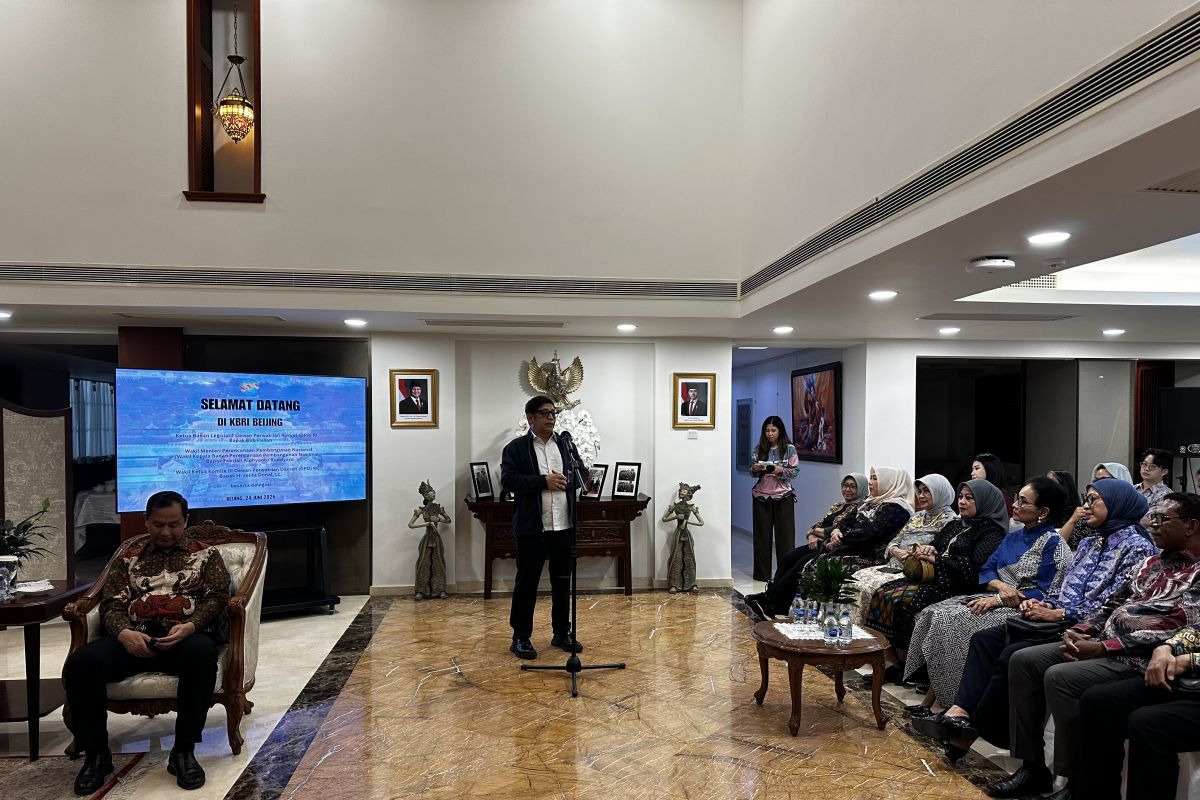
Beijing - A delegation from the House of Representatives’ Legislation Body (Baleg DPR) and the Ministry of National Development Planning (Bappenas) visited China to seek input on the drafting of the One Data Indonesia Bill (RUU SDI). “Our visit is at the invitation of Bappenas because of the drafting of the One Data Indonesia Bill. We are learning from experience because our data is patchy. As a result, we do not have valid data even though the data is right before our eyes,” said Bob Hasan, Chair of the House Legislation Body from the Gerindra Party faction, at the Indonesian Embassy in Beijing on Wednesday. Discussion of the One Data Indonesia Bill has currently reached Chapter XIII concerning dispute resolution. Previously, the House Working Committee (Panja) had discussed various materials, ranging from public participation, supervision, evaluation and accountability, to funding and the provision of incentives. The discussions also covered mechanisms for data sharing between agencies, interoperability, and data access and transfer. “China has already envisioned things far into the future. This can be a lesson for our conditions and how we can become a civilised nation with high values,” Bob added. Meanwhile, Deputy Minister for National Development Planning/Deputy Head of Bappenas Febrian Alphyanto Ruddyard stated that the One Data Indonesia Bill is a House initiative. “The initiative is not from the government but from the House Legislation Body. This is a new chapter in Indonesia’s history because with this One Data Bill, we will have One Data Indonesia. Since the Youth Pledge, we finally have another ‘one’—one data,” Febrian said. Febrian noted that the bill is crucial because Indonesia has too much data but lacks uniformity and a platform for sharing. “The Ministry of Social Affairs has its own data for social assistance, and the Directorate General of Population and Civil Registration at the Ministry of Home Affairs also has its own data, and they are not synchronised. That is the problem,” Febrian added. Therefore, creating a single platform that unifies various data from different ministries to formulate precise policies is Bappenas’s task. “Almost 60 percent of our data is inaccurate and does not match field conditions. China has a highly advanced system, so we want to learn because the problem is not the substance but the ecosystem,” Febrian explained. He noted that in many societal incidents, a one-data ecosystem is absent. “Many countries start with the ecosystem first, then the programme. We want to start that now,” Febrian added. Currently, One Data Indonesia is regulated through Presidential Regulation Number 39 of 2019, enacted on 17 June 2019. Under this regulation, One Data Indonesia is defined as a government data governance policy to produce accurate, up-to-date, integrated, and accountable data that is easily accessible and shareable between central and regional agencies through compliance with data standards, metadata, data interoperability, and the use of reference codes and master data. Through this regulation, Bappenas is mandated to set standards only at the macro (aggregate) level, manage government data governance, and oversee data governance for central, provincial, and district/city governments. The regulation aims to govern the data management produced by central and regional agencies to support development planning, implementation, evaluation, and control. The proposed One Data Indonesia Bill is expected to ensure that every policy and every rupiah of the state budget is based on single, up-to-date, and accountable data for more targeted and measurable development. Besides learning about the one-data ecosystem from partners in China, the delegation also visited the China International Supply Chain Expo (CISCE) in Beijing and Beijing University of Chinese Medicine, Febrian said. “We wanted to know how to make traditional medicine part of a national health system. It turns out there are many ecosystems we lack, such as education, research with standards recognised by modern medicine, promotion, and regulations to support the development of traditional medicine, including in insurance systems,” Febrian revealed. The delegation also included members of Committee III of the Regional Representative Council, led by Deputy Chair Jelita Donal, who held discussions with the Indonesian Ambassador to China and Mongolia, Djauhari Oratmangun, and Indonesian citizens in Beijing.