
Security and Development Must Go Hand in Hand to Achieve Peace in Papua
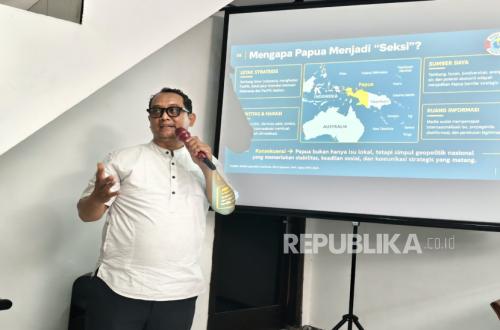
The Executive Director of Merah Pusaka Stratejik Indonesia (MPSI), Noor Azhari, believes that efforts to achieve peace in Papua require an approach that integrates security and development aspects. According to Noor, these two aspects should not be treated as separate agendas. Security is necessary to protect the community and ensure the rule of law, while development serves as a vital instrument to provide public services, improve welfare, and build public trust in the state.
This was stated by Noor during a public discussion titled “Why Does the Papua Conflict Escalation Always Heat Up?”, organised by the Merah Pusaka Stratejik Indonesia Foundation (MPSI) in East Jakarta on Friday (2/10/2026). “Peace in Papua is only possible if security, public services, social justice, and respect for local communities proceed together,” Noor said in his statement.
Noor noted that the issues in Papua cannot be viewed merely as security disturbances. The ongoing conflict is also related to the protection of civilians, the continuity of basic services, public trust, and the future of development in the Papua region. Based on MPSI’s 2026 research, more than 240 incidents of violence were recorded between 2019 and September 2026 across various areas in Papua. MPSI identified several patterns of violence, including intimidation, displacement, physical violence, disruptions to basic services, and disinformation.
The impact, according to Noor, is not limited to casualties and injuries. Violence also disrupts schools, health facilities, economic activities, logistics distribution, and the social life of the community. “Armed violence does not only result in casualties, but also severs schools, healthcare, markets, logistics, and social relations,” he added.
Noor Azhari assessed that the success of building peace in Papua cannot be measured solely by a reduction in armed clashes. According to him, other indicators include the extent to which the community feels safe again, the functioning of basic services, and the growth of trust in the state. “The measure of success is not just the decrease in armed contact, but the recovery of a sense of security, basic services, and citizen trust.”
Noor believes the state still plays a crucial role in ensuring security and law enforcement. However, the security approach must work alongside the protection of civilians, accountability, and sensitivity to the social and cultural conditions of local communities. On the other hand, development must continue to ensure that the community receives tangible benefits from the state’s presence.
Education, health, connectivity, food, clean water, and the strengthening of the local economy, according to Noor, are essential parts of the effort to build human security while strengthening the foundation of peace. “Development cannot proceed amidst fear; security will not be sustainable without public services that are felt by the citizens,” he said.
Noor also emphasised the importance of involving local actors in building peace in Papua. Traditional leaders, churches, village heads, women, youth, local governments, educators, healthcare workers, academics, and civil society are considered to have strategic roles in detecting potential conflicts and strengthening trust at the community level.
Noor urged that the handling of the Papua conflict gradually shift from a responsive pattern towards preventive protection. These steps include mapping vulnerable areas, early detection, integrated responses, recovery for affected communities, and sustainable trust-building. Noor stated that such an approach requires cross-sector coordination between central and regional governments, security forces, indigenous communities, religious leaders, academics, and civil society.
“The resolution of the Papua conflict cannot be sectoral. It must become an ecosystem that is safe, just, trusted, and provides benefits to the citizens,” he asserted. He emphasised that Papua should not merely be viewed as a conflict zone. Papua is a living space for its people, a customary space, a space for development, and an important part of Indonesia’s future. “Building peace in Papua means ensuring that civilians are no longer victims, but rather the centre of security, development, and reconciliation,” concluded Noor.