
Seaweed Associations Discuss International Cooperation in Quanzhou
Seaweed has long been a vital source of food, livelihoods and economic opportunities for many coastal communities.
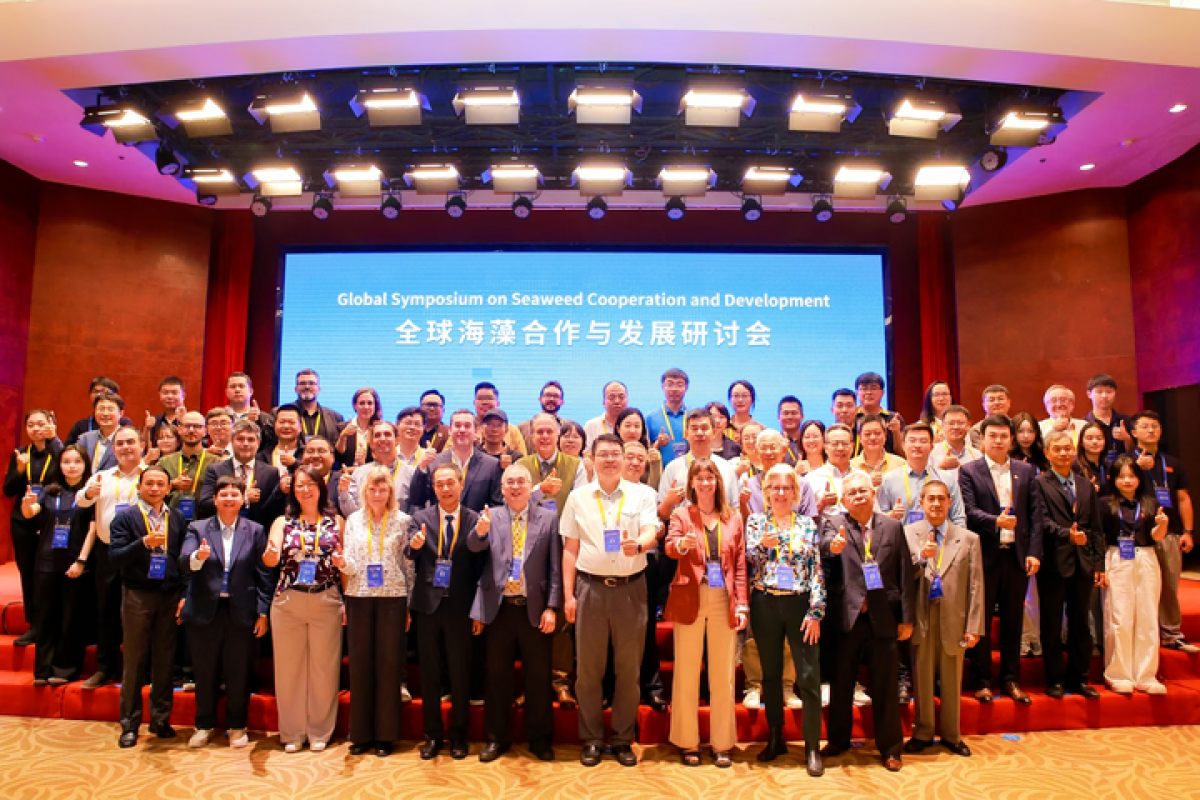
The Global Symposium on Seaweed Cooperation and Development was held in Quanzhou, Fujian Province, China, from 26 to 28 October 2026.
More than 80 representatives of research institutions, industry associations and businesses from China, Indonesia, the Philippines, Malaysia, Chile and other countries gathered in the southeastern Chinese port city to discuss how to turn seaweed into a truly global industry.
Liu Tao, vice-chairman of the China Algae Industry Association and head of the symposium, said global seaweed production exceeds 30 million tonnes in fresh weight each year, accounting for more than half of total global marine aquaculture output.
“Seaweed is not merely food, animal feed and a raw material for biological extraction. It also has value in marine carbon absorption, increasing the incomes of coastal fishers and revitalising rural areas,” Liu said, according to Xinhua.
Yuan Xinhua, deputy director of the Fisheries and Aquaculture Division at the Food and Agriculture Organization (FAO), said in a video address that amid serious global challenges such as food security and climate change, seaweed’s value has moved far beyond its traditional uses, supporting a more sustainable and resilient development pathway.
Liu said that as global seaweed farming, trade and consumption continue to grow, the industry faces shared challenges, including coordinated regional development, expansion into emerging markets and responses to global climate change. He said stronger international cooperation and knowledge-sharing were urgently needed.
At the symposium, experts released “100 Questions and Answers on China’s Seaweed Industry: Lessons for the World”, a systematic review of the industry’s current state, practical experience and challenges.
“We hope to turn China’s experience into lessons for the world, while also bringing international demand into the high-quality development of China’s seaweed industry,” Liu said.
On the sidelines of the event, China’s Xiamen University and Indonesia’s University of Mataram signed a memorandum of understanding to promote scientific and technological cooperation in marine studies, talent development and exchanges between young scientists.
In a report titled “Seaweed Industry Upstream and Downstream Development in Indonesia in Conjunction with the Global Seaweed Initiative”, Muhammad Safari Azis, chairman of the Indonesian Seaweed Association, said Indonesia had abundant seaweed resources.
Azis said Indonesia’s waters, in a tropical coastal country, are home to more than 1,000 macroalgae species, providing distinctive conditions for aquatic food production.
He said Indonesia’s seaweed industry stood out because it was developing cultivation upstream and processing downstream at the same time, rather than relying solely on processing. Indonesia has built around 60 seaweed-processing plants, producing alkali-treated, semi-refined and refined carrageenan, as well as bioplastic products.
Around six of the plants were built by Chinese investors.
“Indonesia is shifting from exporting raw materials to domestic processing,” Azis said.
Through the global initiative, Indonesia also hopes to better manage its production system, secure stable supplies and address price volatility and market-management challenges. At the same time, the main markets for Indonesian seaweed products remain concentrated, and the industry needs to diversify its markets and expand processing capacity.
In his report, Alfredo Pedrosa III, president of the Seaweed Industry Association of the Philippines, introduced the “ASEAN Seaweed Club”, which has 11 member countries. Indonesia and the Philippines are represented by industry players, while the other members are represented by government agencies responsible for fisheries and aquatic resources.
ASEAN countries will strengthen the resilience and sustainability of the seaweed industry through coordinated cooperation, Pedrosa said. He welcomed the participation of Chinese companies and research institutions in developing the ASEAN seaweed value chain and jointly addressing challenges such as fluctuations in raw-material prices.
Source: jawawa.id (https://jawawa.id/newsitem/seaweed-associations-discuss-international-cooperation-in-quanzhou-1793343177)
Originally published by Antara (Indonesian) (https://www.antaranews.com/berita/5821195/asosiasi-rumput-laut-bahas-kerja-sama-internasional-di-quanzhou), translated from Indonesian