
Searching for a Stone, Finding a Tooth — Turns Out to Be a 10,000-Year-Old Treasure
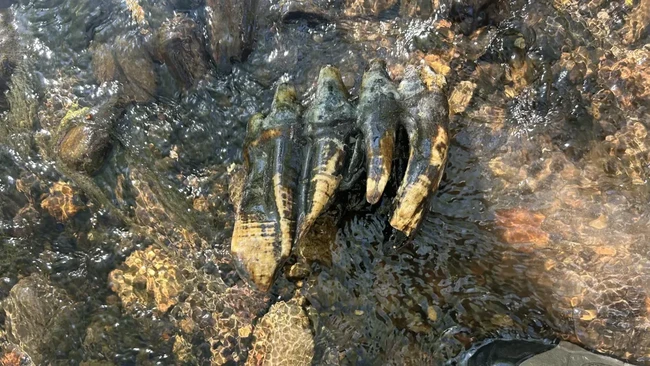
A researcher examining a small stream in California, United States, initially thought the hard object she had found was merely an oddly shaped stone. However, after inspection by experts, it turned out to be an exceptionally well-preserved fossilised tooth of a prehistoric animal, more than 10,000 years old. The discovery has been called one of the most beautiful fossil finds ever made in the region, according to a report by ABC News on Tuesday (15/9/2026).
The discovery took place on the stream bed in the San Mateo area of California. At the time, a researcher named Brigid Lynch was conducting field surveys for a nature conservation project. She spotted what appeared to be a strange stone, but upon closer inspection, the object had the distinctive shape and arrangement of a prehistoric animal’s tooth.
The object turned out to be a molar from a Pacific Mastodon that lived during the last Ice Age. The tooth was large, perfectly intact, and its colour remained so vivid that it looked as though it had only just fallen from the animal’s mouth thousands of years ago.
“This is the most complete and most beautiful Mastodon tooth I have ever seen in my life,” said palaeontologist Wayne Thompson with admiration. “When I saw it, the hairs on my neck stood up.”
Mastodons were giant mammals that lived on Earth from roughly 2.5 million years ago until around 11,700 years ago. They resembled the better-known prehistoric animal, the Woolly Mammoth, but were a different species. Mastodon teeth were shaped like rounded ridges, used for crushing twigs and foliage, whereas Mammoth teeth were flat, like a grinding stone, for grinding grass.
The Pacific Mastodon itself is a different type from the more widely known American Mastodon. Its teeth were more slender, its leg bones thicker, and its tusks differently shaped. The animal once roamed the coastal regions of California, Oregon, and as far south as northern Mexico.
The remarkable fossil tooth has now been handed over to Stanford University for further research. Researchers plan to carry out carbon dating to determine the tooth’s exact age, as well as create three-dimensional scans so its shape can be studied and shared without handling the original fossil.
Researchers also noted that fossil finds like this are extremely valuable. From the tooth, scientists can determine what the prehistoric animal ate, what the climate was like at the time, and how environmental change affected prehistoric life. That knowledge can then be used to understand what may happen to animals and their habitats in the future.
In other words, beneath what appeared to be an ordinary riverbed lay a story of nature buried for tens of thousands of years. What was initially dismissed as a common stone turned out to be the trace of a giant that once walked on the very ground upon which we now stand.