
Sea Cucumbers Act as Seabed Cleaners and Heroes: The Secret Revealed
The world’s coral reefs are under increasing pressure. Rising sea temperatures and ocean acidification are making marine environments increasingly unfavourable for coral survival.
The problem does not end there. Pollution is driving algal growth that can inhibit coral development, while overfishing reduces the various species that play a role in maintaining reef ecosystem balance.
While much attention has previously focused on the loss of algae-eating fish or predators that control coral-eating organisms, recent research shows that another inhabitant of the seabed plays an equally important role: the sea cucumber.
Quoting The Economist, Cody Clements and Mark Hay from the Georgia Institute of Emology found that the presence of sea cucumbers can help create water conditions that better support the growth of several types of coral.
The Seabed ‘Cleaner’
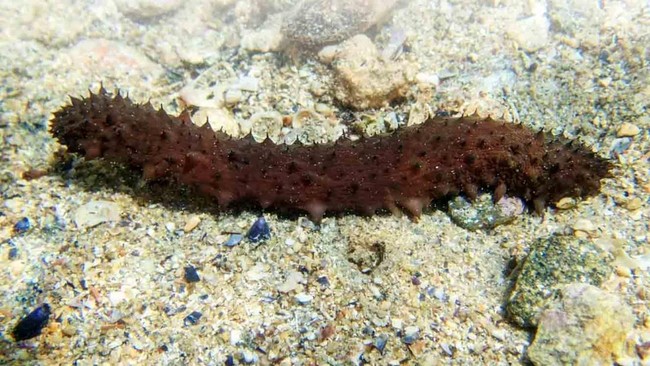
Sea cucumbers are relatives of sea urchins and starfish. These soft-bodied, cylindrical animals live by consuming seabed sediment, digesting the organic material within, and then excreting processed sand.
This seemingly simple activity performs a crucial ecological function. The FAO notes that sea cucumbers play a role in nutrient recycling and maintaining the health of sediments across various marine habitats.
Laboratory experiments also show that sea cucumbers can alter the chemistry of the surrounding seawater. These animals produce ammonia and carbonate ions, which have the potential to benefit corals.
Ammonia contains nitrogen that can be utilised by the symbiotic algae living within coral-forming animals. These algae, in turn, provide most of the nutrients required by their hosts.
Meanwhile, carbonate ions help reduce acidity levels in the surrounding environment. In theory, the combination of both creates more favourable conditions for coral growth.
Corals Can Grow 41% Faster
To test this theory, experiments were conducted in the waters of Mo’orea, French Polynesia.
In the initial trial, researchers placed corals in 20 cages around a reef. Two black sea cucumbers were placed in half of the cages, while the remaining cages were left without them.
After 38 days, no significant difference in coral growth was observed.
Researchers then repeated the experiment using 24 cages, increasing the number of sea cucumbers to four per treatment cage. The results changed significantly. Two out of the three coral species tested grew faster when living with sea cucumbers. The growth of one species increased by approximately 17%, while Acropora pulchra, an endangered branching coral, grew about 41% faster.
These findings strengthen the indication that the loss of sea cucumbers from an ecosystem does not merely mean the reduction of one marine species, but can also impact other organisms that depend on healthy seabed conditions.
Previous research from the Georgia Tech team also found another function. When sea cucumbers were removed from the reef environment, tissue death in Acropora pulchra increased more than threefold, and the risk of entire colony death surged by up to 15 times. Researchers suspect sea cucumbers help clean sediments of microorganisms that can trigger coral diseases.
Despite their role in the marine ecosystem, sea cucumbers continue to face fishing pressure. FAO data shows global sea cucumber catches reached approximately 39,000 tonnes in 2024, down from 42,000 tonnes in 2022 and 2023.
While this figure is much smaller than the catch of major marine commodities, which can reach hundreds of thousands to millions of tonnes per year, the pressure on sea cucumbers remains a concern because several species grow relatively slowly and play a vital role in the health of seabed ecosystems.
Indonesia Has a Major Stake
These findings are highly relevant to Indonesia. Sea cucumbers are not only part of the coastal ecosystem but are also an economically valuable fishery commodity that has long been traded.
A 2024 Fisheries Research study noted that at least 55 species of sea cucumbers have been confirmed for commercial harvest in Indonesia. Research on 4,553 individuals across 2t3 locations from western to eastern Indonesia also found that the majority of observed sea cucumbers were relatively small, indicating high fishing pressure.
This pressure is critical to monitor because sea cucumbers inhabit habitats such as intertidal zones, seagrass meadows, and coral reefs. A study in Frontiers in Marine Science examining coral reef ecosystems on Java Island also found several economically valuable sea cucumber species whose international trade is regulated through CITES.
On the other hand, demand for sea cucumbers remains steady. Data from the Ministry of Marine Affairs and Fisheries (KKP) for 2026 indicates that sea cucumbers remain one of Indonesia’s fishery commodities exported to China. Overall, Indonesian fishery exports to China in 2025 reached approximately 479,000 tonnes, valued at US$1.2 billion.
This situation highlights the unique position of the sea cucumber. On one hand, these marine animals hold economic value for the fisheries sector. On the other, their presence supports sediment health, nutrient cycles, and coral reef ecosystems.
Consequently, the sustainable management of sea cucumbers is not only about maintaining commodity stocks but also about preserving biodiversity and the resilience of coastal ecosystems amidst the pressures of climate change and human activity.
Source: jawawa.id (https://jawawa.id/newsitem/sea-cucumbers-act-as-seabed-cleaners-and-heroes-the-secret-revealed-1789725406)
Originally published by CNBC Indonesia (https://www.cnbcindonesia.com/research/20260918102951-128-768937/teripang-jadi-petugas-kebersihan-pahlawan-dasar-laut-ini-rahasianya), translated from Indonesian