
Scientists Uncover Terrifying Truth: Humans Live in a Cannibal Galaxy
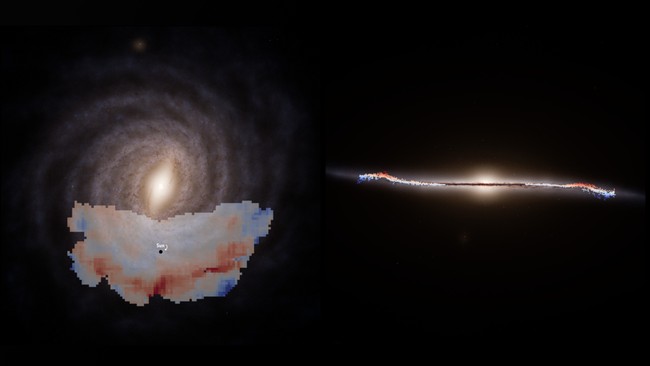
Jakarta, CNBC Indonesia - For billions of years, the Milky Way has been growing, partly by ‘devouring’ smaller galaxies. NASA records the Milky Way spans 100,000 light-years and contains between 100 billion and 400 billion stars. Over 12 billion years, it has continued to grow by merging with numerous dwarf galaxies.
Recent findings provide evidence that the ancient dwarf galaxy Loki merged with the Milky Way approximately 10 billion years ago. Astronomers have identified stellar remnants possibly belonging to this galaxy.
A study published in the Monthly Notices of the Royal Astronomical Society reveals astronomers focused on metal-poor star clusters near the galactic disc to find evidence of consumed galaxies and determine the Milky Way’s history and evolution.
The search for very-metal-poor (VMP) stars focused on ancient stars in the galactic halo — a large, spherical, diffuse cloud surrounding the disc. Astronomers believe merger evidence lies within the Milky Way’s inner regions.
Lead author Dr. Federico Sestito, a postdoctoral researcher at the Astrophysics Research Centre at the University of Hertfordshire and his team identified 20 metal-poor stars using observations from the European Space Agency’s Gaia telescope.
They also employed high-resolution spectrographs on the Canada-France-Hawaii Telescope near Maunakea summit in Hawaii to observe these stars.
However, the research team struggled to determine the stars’ exact ages, though their chemical composition suggests they are over 10 billion years old.
Located approximately 7,000 light-years from our solar system, the study found all stars share similar chemical compositions, indicating they originated from the same dwarf galaxy.
Of the 20 stars identified, 11 are in prograde orbits, moving in the same direction as the galactic disc, while the rest move retrograde.
‘If the Loki scenario is correct, the merged system could produce stars moving either in the same or opposite direction,’ said Sestito, quoted from CNN International on Sunday, 24 May 2026.
He noted this event likely occurred when the Milky Way was younger and its gravitational pull weaker than today.
‘Cosmological simulations indicate this happened around 3-4 billion years after the Big Bang,’ he added.