
Scientists Study Thunderquakes, Findings Reveal New Facts—Could They Trigger Tsunamis?
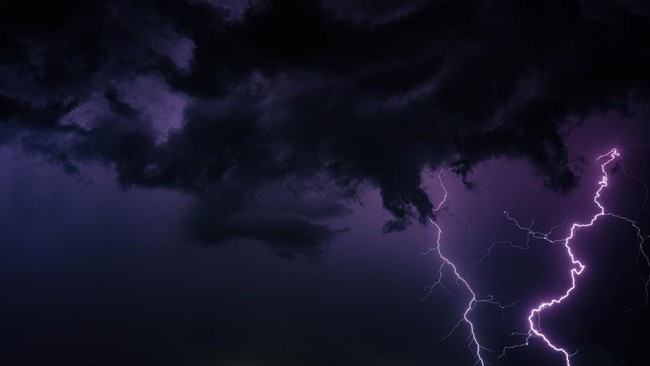
Scientists have studied a phenomenon called ‘thunderquakes’—small ground vibrations triggered by pressure waves from the sound of thunder striking the earth with great force. The research findings show that this phenomenon can be used to map subsurface geological conditions to a depth of around 100 metres.
According to sciencenews.org, the research was conducted by Penn State University geophysicist Tieyuan Zhu together with a number of researchers. They analysed seismic signals captured by fibre-optic cables beneath the University Park campus area over two and a half years.
During the research period, the team detected more than 450 thunderquakes. The signals were then processed into a picture of the geological conditions near the ground surface beneath the campus.
As a result, the researchers found a number of weak zones that had not previously been detected in the limestone layer. These zones have the potential to become locations for the formation of sinkholes in the future.
Penn State is located in an area with karst topography that is full of caves and limestone fractures. The findings from the thunderquakes were then confirmed using data from boreholes and indications of ground surface deformation detected via satellite.
The thunderquake phenomenon works when acoustic pressure waves from thunder propagate through the air. Some of the wave energy can transfer to the ground and produce very small movements.
These vibrations cannot be felt by humans. However, fibre-optic cables have sufficiently high sensitivity to detect them.
Fibre-optic cables stretch slightly when they receive vibrations. This change affects the travel time of light within the cable, producing a signal that can be analysed as an indication of ground movement.
This technology utilises existing fibre-optic cable networks used for telecommunications. In the State College area of Pennsylvania, the cable stretches about 4 kilometres and is buried about one metre underground.
Some of these cables are not always used for communication traffic. These cables, known as ‘dark fibre’, can then be used as seismic sensors without the need to build new networks.
Experiments using fibre-optic networks to detect seismic waves caused by thunder actually began at Penn State in 2019. The research at that time proved that the cables were capable of capturing vibrations produced by thunder.
In the latest research, the scientists found that thunderquake signals can not only be detected, but also used to create a picture of subsurface geological conditions down to around 100 metres.
According to Zhu and his colleagues, this method has the potential to be a cheaper and easier alternative to seismic surveys. This is because a single thunderstorm can produce strong signals covering an area of up to tens of square kilometres.
The method is considered highly potential for application in urban areas that already have fibre-optic cable networks. Thus, researchers do not need to build new sensor infrastructure to conduct underground surveys.
So, can these ‘thunderquakes’ trigger a tsunami?
The research does not show that thunderquakes can cause tsunamis. The vibrations produced by thunder are ground movements on a very small scale and are instead used by scientists as signals to map subsurface conditions.
This means that the term ‘thunderquake’ in this research does not refer to a large earthquake like those that can trigger tsunamis. The phenomenon is more accurately understood as small seismic waves that appear when energy from thunder is transferred to the ground.
The researchers even see the possibility of using thunderquakes beyond Earth. Zhu said the method could theoretically be used for seismic surveys on other worlds, including Titan, Saturn’s moon known to have giant storms of long duration.
The research on the use of seismic waves generated by thunderstorms was published in the journal Science Advances on 21 August 2026. The study was titled ‘Subsurface mapping of the Earth using seismic waves generated by thunderstorms’.
Zhu and D.J. Stensrud’s 2019 research on ground movement caused by thunder using a distributed acoustic sensing network based on fibre optics was previously published in the Journal of Geophysical Research: Atmospheres.