
Scientists Confirm World's Cutest Octopus Species
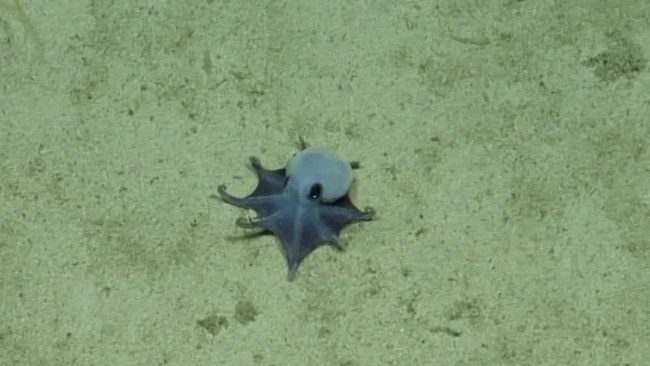
JAKARTA, CNBC Indonesia — The underwater world has once again delivered a stunning surprise for scientists. At a depth of nearly 1,800 metres around the Galapagos Islands, researchers from the Charles Darwin Foundation discovered a new octopus species that is exceptionally unique due to its golf-ball size, bright blue colour, and previously unrecorded physical characteristics. The discovery has been published in the journal Zootaxa.
When first captured by a remotely operated vehicle (ROV) camera, the tiny creature immediately drew attention. ‘It’s so tiny! It’s blue!’ exclaimed one researcher excitedly while viewing footage sent directly from the ocean floor.
Janet Voight, a cephalopod expert and curator at the Field Museum of Natural History in the United States, tasked with identifying the creature, immediately recognised it as a special discovery. ‘As soon as I saw it, I knew this was something extraordinary,’ Voight said. She initially identified the new species from photographs, and her confidence grew after receiving the preserved specimen. ‘When the package arrived, I was amazed. The creature is stunning,’ she added.
The new species has been scientifically named Microeledone galapagensis. Its uniqueness lies not only in its tiny size but also in the bright blue colour on its back — one of the rarest colours found in nature. Intriguingly, its underside is a deep purple, creating a distinctive pattern.
According to Voight, this colour pattern serves a survival function beyond mere aesthetics. ‘We suspect the colour pattern helps protect it. If the octopus captures prey that emits light, the light could attract other predators. The octopus then covers the prey with its dark underbelly to remain safe,’ she explained.
Other distinguishing physical features include short, stout arms with a single row of suckers. This morphology differs from most known octopus species. Its back skin is also exceptionally smooth, a key differentiator from similar species.
The most surprising aspect for scientists is the creature’s taxonomic position. Genetically and morphologically, it belongs to the Megaleledonidae family — a group of octopuses typically much larger and found in the Southern Ocean surrounding Antarctica.
Another intriguing fact is that its closest relatives, which share a similar appearance, live off the coast of Uruguay — in a different ocean and on the opposite side of South America. This sheds new light on the dispersal and evolution of deep-sea octopuses.
With only one specimen found, researchers opted against dissecting it to study its internal structure. Instead, they used CT scanning technology to capture thousands of X-ray images, which were then compiled into a complete 3D model. This method allows them to examine internal organs without damaging the valuable specimen.
‘Nothing is more extraordinary than studying something no one has ever seen before,’ said Stephanie Smith, head of the museum’s X-ray laboratory.
The creature was first discovered around Darwin Island in 2015, but years of research and scientific verification were required before it was officially announced in May 2026.
The discovery also underscores how vast and largely unexplored the deep ocean remains. ‘If you combined all the land on Earth, it would not cover the area of the Pacific Ocean,’ Voight said.