
Scientific Study Reveals the Origins of the Black Stone
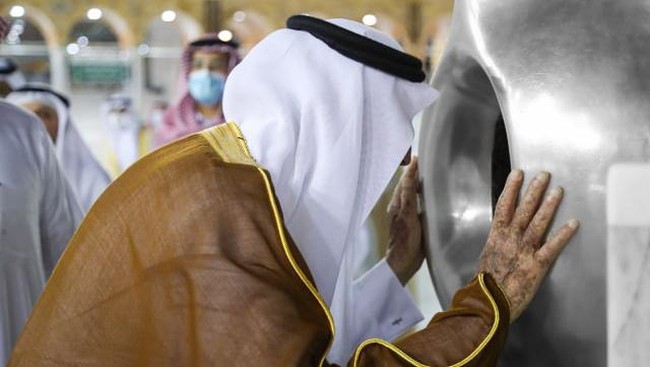
Jakarta, CNBC Indonesia — As the 2026 Hajj season approaches, attention is once again drawn to one of the most sacred sites in the Masjidil Haram, namely the Hajar Aswad. This black stone, located at a corner of the Kaaba, serves as a spiritual magnet for millions of pilgrims visiting the holy land.
The Hajar Aswad has long been revered by Muslims as a historical relic rich in religious meaning. However, its existence has also attracted the attention of scientists who seek to study it through a scientific approach.
Research is being conducted to trace the origins of the Hajar Aswad, which still sparks various speculations. Some believe that the stone originates from natural materials on Earth, while other theories suggest that it may have come from outer space.
Several researchers even note similarities between the Hajar Aswad and meteorites, both in terms of their presumed material structure and the stories surrounding the origin of the stone.
This conclusion is based on the story that the rock came from heaven. Furthermore, historical evidence suggests the presence of meteorite traces near the Kaaba, where the Hajar Aswad is located.
In addition, E. Thomsen in his 1980 study, “New Light on the Origin of the Holy Black Stone of the Ka’ba,” stated that a researcher named Harry St John Philby discovered a meteorite impact crater in Al-Hadidah in 1932, which was later called Wabar.
The crater was then measured and reported to be more than 100 meters in size, with some fragments found around the crater and in the desert.
The fragments are made of molten sand and silica mixed with nickel. Thomsen said that this mixture would display a white color on its inner layer, while the outer part is covered with a black crust.
The black color in the rock comes from the element nickel, which is formed as a result of explosions of nickel and iron (ferrum) in outer space.
Thomsen also believes that the characteristics of these fragments are similar to the description of the Hajar Aswad. The white color previously mentioned on the stone may come from the inner part of this chemical mixture.
This white layer does not last long, so it is eventually covered by a black layer on the outside. In the end, all that can be seen is a black stone.
In history, the Hajar Aswad is said to have been initially white and then turned black because it absorbed human sins.
Meanwhile, the white spots visible on the Hajar Aswad are thought to be remnants of glass and sandstone.
“This meteorite may be the same stone as the Hajar Aswad,” Thomsen wrote.
Another study also attempts to reveal the age of the stone. It is mentioned that its age corresponds to the period known by the ancient Arab community, and it is possible that the stone was brought to Mecca through Oman.
However, the theory that the Hajar Aswad is a meteorite also has several weaknesses. Among them, meteorites generally do not float, rarely break into small fragments, and are not easily resistant to erosion under certain conditions.