
School Surrounded by Water, Boats Become Main Transport for SDN Pantai Bahagia 02 Students
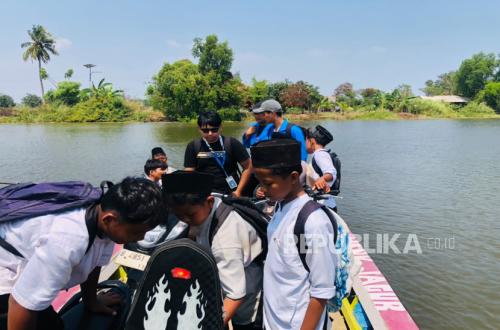
For some students, the journey to school may only require a vehicle or walking along an existing road. However, for children living in Muara Bendera, Pantai Bahagia Village, Bekasi Regency, boats are part of their daily routine for travelling to and from school. This situation was observed first-hand by students from Bina Sarana Informatika University (UBSI) during the BSI Explore 2026 programme in Pantai Bahagia Village. While in the area, the students not only carried out educational programmes but also saw how geographical conditions and limited infrastructure affect community activities, including children’s access to school.
Sinta, mentor of Team 13 of BSI Explore 2026 in Pantai Bahagia Village, said the infrastructure conditions in this area are very different from urban areas. A number of roads are still difficult for vehicles to pass, so residents rely more on boats for mobility. “The roads are still quite difficult for cars and even motorbikes to enter. Besides that, people here mostly use boats because the roads are still not good,” Sinta said in a press release received on Friday (21/8/2026).
This condition is also felt by children attending SDN Pantai Bahagia 02. Sinta said students living in Muara Bendera use boats to go to and from school because the area where they live is largely surrounded by water. “What is concerning is that for the children at SDN Pantai Bahagia 02, they still use boats every day to go to and from school,” she said.
According to Sinta, there are two pick-up times for students from school. Students in grades 1 and 2 are picked up at around 10.00 WIB, while students in grades 3 to 6 are picked up at around 12.30 WIB. Muara Bendera is still part of Pantai Bahagia Village. However, the geographical character of the area makes land access very limited. Sinta said the area is now dominated by water, while some residents’ houses are built on stilts and residents own boats to support their daily activities.
“There, the roads are completely cut off, there is no land road at all. It is already full of water, and the houses are stilt houses. So each resident also has their own boat,” she said. She added that around 80 per cent of children living in Muara Bendera attend SDN Pantai Bahagia 02. Therefore, the existence of a pick-up boat is very important for the mobility of students from that area.
Sinta explained that the government had previously provided a boat to support children’s access. However, after problems arose with the use of that boat, the village government then took the initiative to provide a boat through community agreement and mutual cooperation. “This is an agreement, ‘it is fine, let us build a gotong royong boat’ for the children. This boat is specifically for children living in Muara Bendera,” she explained.
At the village level, the students brought a mangrove planting programme and education on coastal ecosystems. The programme was chosen because Pantai Bahagia faces environmental problems such as abrasion and tidal flooding. “Here it is indeed coastal, the areas must be protected from abrasion. The problems are abrasion and tidal flooding. So there is still a great lack of mangrove planting, so we decided to bring a mangrove planting programme and introduction to mangrove education,” Sinta said.
To support these activities, the students received information and assistance from the Secretary of Pantai Bahagia Village, Ahmad Qurtubi. Sinta said the area also already has mangrove seedling cultivation that can support the implementation of the programme. Behind the access and infrastructure problems, Sinta sees that Pantai Bahagia has potential that has not been fully developed. The existence of mangrove areas and lutung (langurs) are two things that she believes could be developed as environment-based tourist attractions.
“If the roads here were good, this could also become a good tourist destination, especially the mangroves. There are lutung in the mangroves, so it could become a tourist attraction,” she said. BSI Explore 2026 ultimately brought students to see Pantai Bahagia from a broader perspective. On one side, there are children who must cross the water to attend school; on the other side, there are mangroves and lutung habitats that hold environmental and tourism potential.