
Scenes of Beef Traders After Government Raises Cattle Reference Price
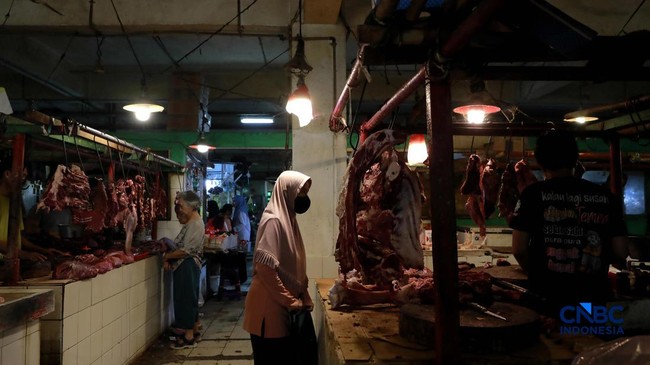
The increase in the reference price for live cattle is beginning to be felt at the trader level. A beef seller is seen serving a buyer at Cijantung Market, East Jakarta, on Thursday (23/4/2026), amid the rising trend in the price of this commodity.
The government, through Coordinating Minister for Food Zulkifli Hasan or Zulhas, has officially raised the Reference Sales Price (HAP) for live cattle weight by Rp1,000 to Rp59,000 per kilogram (kg).
Based on observations by CNBC Indonesia at Cijantung Market, beef prices at the trader level are still in the range of Rp130,000–Rp140,000 per kg. One trader, Riski, sells beef for Rp140,000 per kg.
“For clean beef, we sell it for Rp140,000 per kilo; the price after Eid al-Fitr hasn’t even dropped yet,” said Arif to CNBC Indonesia.
On the upstream side, a local cattle farmer in Jakarta, Latif, revealed that the current live cattle price has reached Rp60,000 to Rp75,000 per kg. He even predicts that the price could rise to Rp85,000 per kg this year.
“Ahead of Eid al-Adha, we plan to increase it by about 30 percent to around Rp85,000 per kilo of whole weight,” Latif told CNBC Indonesia.
According to Latif, the price increase is triggered by the limited supply of male cattle. This condition forces the use of female cattle that are actually suitable for consumption, but it risks disrupting production sustainability.
In addition to supply factors, the price rise is also influenced by increasing distribution costs due to fuel inflation. The threat of foot-and-mouth disease also looms over the live cattle trade.
Nevertheless, Latif assesses that the rise in live cattle prices has not yet had a significant impact on retail beef prices in the market, which remain in the range of Rp130,000–Rp140,000 per kg.
He added that global dynamics also play a role, particularly the conflict in the Middle East, which affects the import supply chain for live cattle.
Meanwhile, Zulhas emphasised that the government is endeavouring to curb price increases at the consumer level to maintain people’s purchasing power.
Previously, the Indonesian Ministry of Agriculture (Kementan) had warned of the potential for rising imported cattle prices that could pressure traders, especially in the Jabodetabek region.
This is driven by increases in exchange rates, insurance costs, and handling charges (cost, insurance, and freight/CIF), which push up cattle prices upon arrival in Indonesia.