
SBM ITB, PMSM Indonesia, and APRESI Discuss the Future of Talent, Technology, and the Workplace
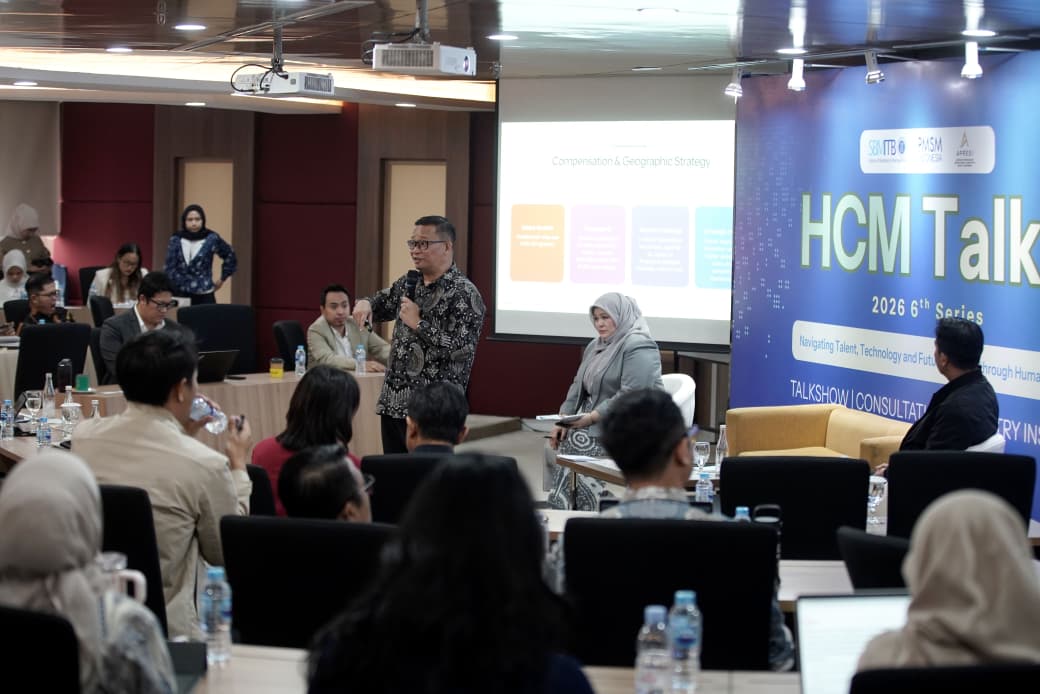
The Bandung Institute of Technology’s School of Business and Management (SBM ITB), in collaboration with the Indonesian Human Resource Management Association (PMSM) and the Indonesian Association of Recruitment and Executive Search Companies (APRESI), held the 6th HCM Talks Series titled “Navigating Talent, Technology and Future of Work through Human Capital”. The forum served as a platform for collaboration between academics, practitioners, and professional associations to discuss the various challenges and opportunities in human resource management amidst increasingly rapid changes in the world of work.
Donald Crestofel Lantu, Deputy Dean for Resources at SBM ITB, underscored the importance of collaboration between universities, industry, and professional associations in building Indonesia’s talent ecosystem. He stated that SBM ITB plays a role in producing talent through education, APRESI acts as a bridge to labour market needs, whilst PMSM serves as a forum for practitioners to develop human resources across various organisations. “Never eliminate the human factor. Use technology as a support and continue to be a lifelong learner capable of navigating change with clear values and purpose,” he asserted.
Echoing this sentiment, Dudi Arisandi, Chairman of PMSM Indonesia and Chief People Officer of Tiket.com, added that PMSM is committed to building a Human Capital ecosystem through pentahelix collaboration between the education sector, industry, and professional associations. “As an organisation that has been established for over 46 years, PMSM continues to encourage Indonesian talent development through various competency development programmes and professional networks,” he said.
Ricky Mulani, Chairman of APRESI and CEO of Recruit Asia, highlighted the crucial role of the recruitment industry in bridging organisational needs with the right talent. He noted that although technology continues to evolve, understanding a candidate’s character, potential, and suitability for an organisation’s culture still requires a human touch that cannot be fully replaced by technology.
During the keynote speech session, Henndy Ginting, Chair of the SBM ITB Senate and Chair of the People and Knowledge Management Interest Group at SBM ITB, explained that the current world of work is facing three main dynamics: the acceleration of digitalisation and artificial intelligence, changing workforce expectations, and the transformation of the Human Capital function from an administrative role to a strategic organisational partner. According to Henndy, the future of work is not about replacing humans with technology, but about how humans and technology can complement each other. To face this complexity, organisations require leaders who can integrate personal, social, business, organisational, and global capacities through the concept of Omni-Leadership.
The discussion continued in three panel sessions addressing the Indonesian talent market, the future of work, and the utilisation of Human Capital technology in organisational transformation. In the first session, “Indonesia Talent Market 2026: From Hiring to Strategic Talent Management in a Competitive Market”, Yudo Anggoro, Director of the Center for Policy and Public Management at SBM ITB, reminded attendees that talent management cannot be separated from the national economic condition. “The economic slowdown, the weakening middle class, and the challenges facing the manufacturing sector have a direct impact on the dynamics of Indonesia’s labour market,” he noted.
From the recruitment industry perspective, Bagus Hendrayono, Founder & Managing Director of Talent Hunts Indonesia and General Treasurer & Head of Learning Development at APRESI, highlighted the skills gap phenomenon as a primary challenge. Although Indonesia’s workforce is very large, many companies still struggle to find talent with competencies that match business needs. “Our biggest problem is not the quantity of talent. The challenge is whether the skills possessed by candidates genuinely match the company’s requirements,” he explained.
The second session explored the theme “Future of Work: Redesigning Work, Workforce, and Workplace”. Muhammad Yorga Permana, Assistant Professor at SBM ITB, stated that the development of AI presents opportunities as well as new challenges for organisations. AI can increase productivity but also raises questions about the future of jobs, leadership models, and workforce competency needs. Complementing this perspective, Agustina Samara, Chief of Human Resources & Corporate Services at PT Asuransi Jiwa Sequis Life and Treasury of PMSM Indonesia, stressed that the future of work is no longer solely about technology, but also about the human capacity to remain relevant and adapt. “The future of work is no longer just about technology, but about how we as humans have relevance and a growth mindset to face change,” Agustina stated.
In the third session, “Human Capital Technology: Leveraging HR Tech for Organizational Transformation”, the speakers discussed how technology can be utilised to improve the quality of human resource management without eliminating the human aspect of the process. Achmad Ghazali, Associate Professor at SBM ITB, emphasised that technology should not only be used for administrative efficiency but also to improve the quality of data-driven decision-making. Meanwhile, Fajar Hendarman, Assistant Professor at SBM ITB, highlighted the importance of a digital mindset and continuous learning capabilities as the foundation of digital transformation. The discussion was further enriched by the Executive Vice President of Human Capital Strategy & Talent Management at PT Bank Rakyat Indonesia (Persero) Tbk.