
Saving from an Early Age, Planting the Future
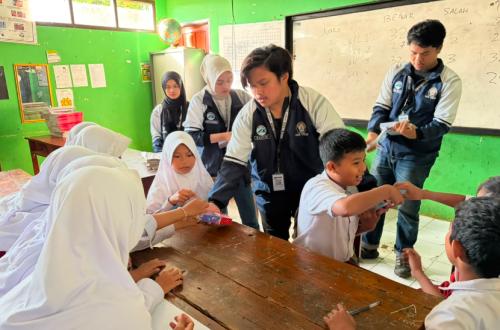
There are small habits whose impact is only felt long after a person grows up. Saving is one of them. It seems simple: setting aside some pocket money, resisting the urge to buy something, and putting it into a money box. Yet behind that simple act lies profound lessons in discipline, patience, prioritisation, and self-control.
This awareness is what students from Universitas Diponegoro’s Community Service Programme (KKN) Team II sought to instil through the CERDAS programme at SDN Juragan, Kandeman District, Batang Regency. The programme does not merely encourage children to put money into a money box, but introduces a more fundamental way of thinking: distinguishing between needs and wants.
In modern life, this ability is increasingly important. Children grow up in an environment saturated with consumer offers. Advertisements appear through television, mobile phones, social media, digital games, and social circles. The desire to buy something can arise even before a child understands the value of the money being spent.
For this reason, financial literacy should not wait until a person reaches productive age. Education about money needs to be introduced as soon as a child begins to understand that every choice has consequences. In this context, saving is not merely an economic activity. It is character training. When a child chooses to save their pocket money rather than spend it immediately, they are learning to delay gratification. When they begin to understand that buying a textbook is different from buying an unnecessary toy, they are learning to determine priorities. When they consistently set aside money day after day, they are practising discipline.
These lessons may not always be found in full within textbooks. That is why the approach taken by the Undip KKN students in Juragan Village is noteworthy. The financial literacy material was not delivered through heavy lectures, but through simple language, educational games, and money box decorating activities. Children were invited to identify which items are needs and which are merely wants. A concept that may sound simple to adults is actually a crucial foundation in financial management.
Many financial problems in adulthood originate not solely from low income, but also from an inability to manage priorities. A person may earn a sufficient income yet still face financial difficulties when all wants are treated as if they were needs. Therefore, getting children accustomed to recognising the difference between the two from an early age is a long-term educational investment.