
Savanna Fire Engulfs 1,956 Hectares of Mount Tambora National Park on Sumbawa Island
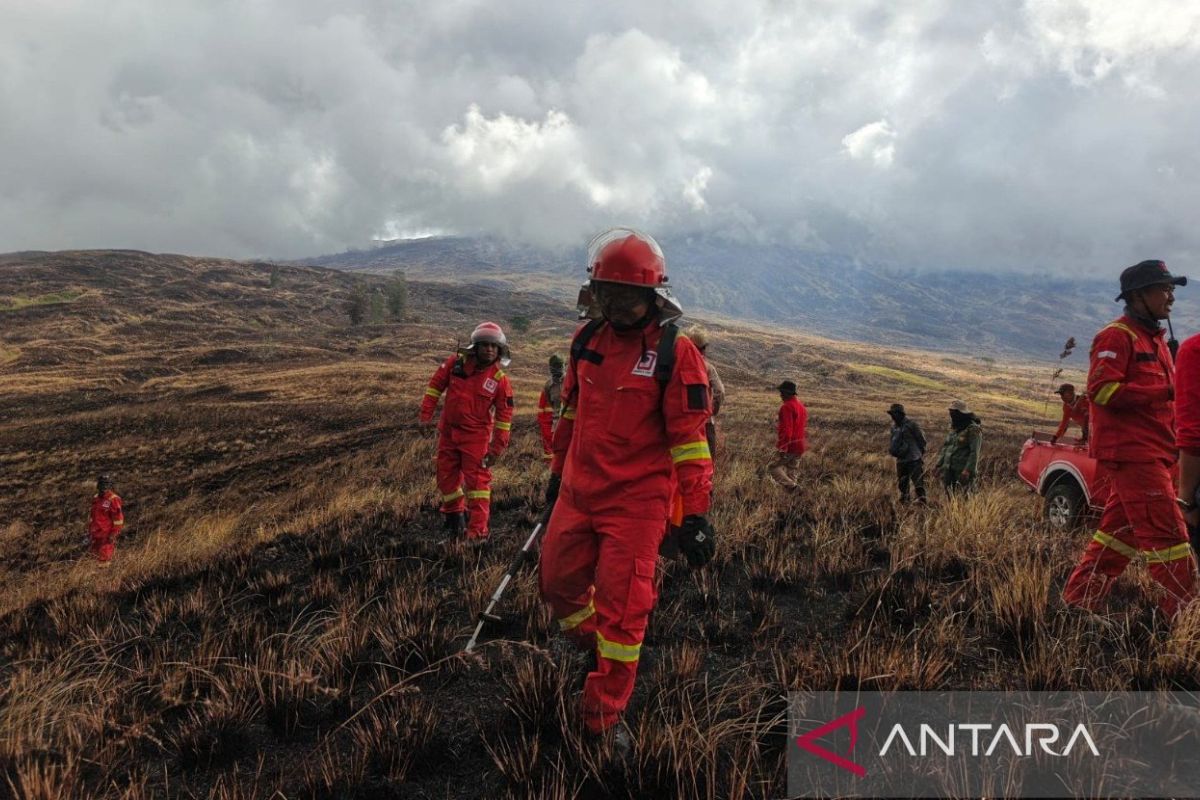
A fire has devastated around 1,956 hectares of savanna in Mount Tambora National Park on Sumbawa Island, West Nusa Tenggara. The Director General of Forestry Law Enforcement, Dwi Januanto Nugroho, stated that the fire was first detected on Sunday at 1.30 p.m. local time in the Piong Resort area.
‘When it ignited, conditions at the location were dry, the savanna vegetation was highly flammable, coupled with strong gusts of wind in the mountainous topography and limited water sources, causing the fire to spread quickly,’ he said in a written statement received in Mataram on Thursday.
He explained that the Jabalnusra Forest and Land Fire Control Centre, together with the Mount Tambora National Park Office, the Fire Care Community, and other related parties, are continuing to battle the flames in the Tambora savanna. Since the initial outbreak, the Mount Tambora National Park Office and the Fire Care Community have been carrying out early control efforts to limit the spread of the fire while continuously monitoring developments on the ground.
‘Based on hotspot monitoring and coordination between the Mount Tambora National Park Office and the Jabalnusra Forest and Land Fire Control Centre, the Ministry of Forestry has deployed one Manggala Agni team from Section Region III Mataram to strengthen the firefighting operation,’ he clarified. The personnel tasked with extinguishing the fire were dispatched from Mataram to Bima Regency and immediately joined the Mount Tambora National Park Office, the Fire Care Community, and other relevant elements to control the fire’s spread and protect areas that can still be saved.
Meanwhile, the Head of the Forest Fire Control Centre for the Java, Bali, and Nusa Tenggara Region, Bambang Setyo Antoko, said the firefighting operation is currently focused on suppressing the rate of the fire’s spread by adapting strategies to the terrain characteristics of Tambora. ‘The characteristics of the savanna in Tambora allow the fire to spread quickly, especially when wind conditions strengthen and water sources are limited. Therefore, the firefighting strategy is continuously adjusted to the developing conditions on the ground so that the spread of the fire can be controlled effectively,’ he said.
He noted that all involved elements are currently working in an integrated manner, prioritising personnel safety while protecting areas that can still be saved. He added that the Ministry of Forestry is urging local governments, regional authorities, area managers, tourism operators, and the community to increase vigilance during the dry season, avoid any activities that could potentially trigger forest fires, and immediately report any indications of fire so that handling can be carried out as early as possible.
Mount Tambora National Park is a nature conservation area spanning 71,645.64 hectares, designated by UNESCO as a World Biosphere Reserve. The area serves as a habitat for various wildlife, including the Yellow-crested Cockatoo, Red-headed Lorikeet, Rainbow Bee-eater, and Timor Deer. Beyond being a crucial bastion of biodiversity, Tambora is also a natural tourism destination that benefits the community through environmental services and the economic activities that grow around it.