
Saumlaki Residents Await Prosperity Promises from Masela Abadi LNG Project
At Omele Market in Saumlaki, the morning’s activity proceeded as usual. Fishing boats had just moored with fresh catches, while traders offered scad mackerel, tuna and various other marine produce to buyers.
Behind the bustle of the market, which has served as the economic heartbeat of the Tanimbar Islands community in Maluku Province for decades, lies hope that the Abadi Masela LNG project can finally bring the long-awaited change. Kuway, a local resident, is one such hopeful.
The retired civil servant, who now spends his days around town, views the giant gas project in the Arafura Sea as an opportunity to lift the community’s economy. However, according to him, the benefits will only truly be felt if local people are prepared to take part.
“If the Masela Block gets going, it means helping the community to improve the economy. What remains is how to prepare the human resources,” said Kuway when met by Republika at Omele Market in Saumlaki on Thursday (16/7).
He said improving the quality of human resources is the biggest challenge. Without a ready workforce, job opportunities risk being filled by workers from outside the region. “If the human resources are not up to it, the Masela Block will bring in people from outside,” he said.
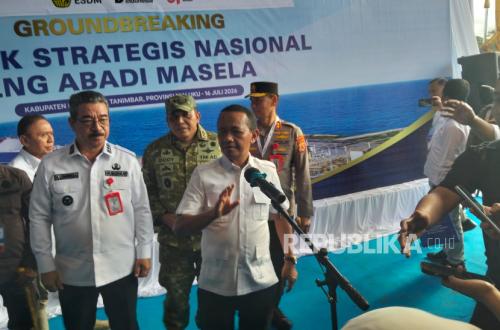
That hope emerged as the Indonesian government, together with SKK Migas and INPEX Masela Ltd, officially began physical construction of the Abadi Masela LNG National Strategic Project through a groundbreaking ceremony on Yamdena Island, Tanimbar Islands Regency, on Thursday (16/7). After 28 years since the Abadi gas reserves were discovered, the project has finally entered the construction phase.
President Prabowo Subianto, who attended the inauguration virtually from the State Palace, described the project as one of the determinants of Indonesia’s future energy security. With a production capacity of 9.5 million tonnes of LNG per year, the project is expected to strengthen the national energy supply while maintaining Indonesia’s position as one of the world’s LNG suppliers.
In addition to producing liquefied natural gas, the Abadi Field will also integrate Carbon Capture and Storage (CCS) technology, making it one of the first LNG projects in the world to operate carbon capture and storage simultaneously with gas production under a cost recovery scheme.
For Saumlaki residents, the nationally scaled project is seen not merely as an energy investment, but as an opportunity to improve the region’s economic condition, which is considered to have changed little since the Tanimbar Islands became their own regency in the early 2000s.
Kuway said the lives of ordinary people still face various challenges. According to him, employment outside the government sector remains limited, and most residents rely on farming or fishing for their livelihoods. “Farmers,” he replied curtly when asked about the community’s main occupation.
Local agricultural commodities, he said, are dominated by tuber crops. Meanwhile, some food needs, including certain vegetables and potatoes, still have to be brought in from outside the region.
These conditions make the prices of basic necessities relatively high. According to him, even global economic turmoil is quickly felt in the southernmost part of Maluku Province. “When America spikes high, it influences the world,” he said, referring to price increases felt by the community.
Amid these challenges, infrastructure development has indeed begun to appear in Saumlaki. One example is Omele Market, which now stands as a permanent building replacing the old traditional market that once burned down.
Kuway said the market’s construction added value because it attracts more people to come shopping. However, he admitted the community’s purchasing power has not fully recovered. “There is some added value because such a magnificent building attracts people to visit here,” he said.
Even so, he added, high prices have actually reduced consumer demand. “It is just that prices are too expensive. Consumer demand is low because prices have soared,” said Kuway.
For Kuway, this problem cannot be separated from the community’s overall economic condition. He said greater attention needs to be paid to ordinary people so that development is truly felt at the grassroots level.
Kuway said many traders at the market have to take their goods home because buyers are fewer than expected. Vegetables often do not last long before eventually spoiling.
Therefore, he hopes the Abadi LNG project will not only generate large investment but also create economic activity that can increase the community’s purchasing power. The government estimates the project will become one of the largest energy investments in Indonesia.
Source: jawawa.id (https://jawawa.id/newsitem/saumlaki-residents-await-prosperity-promises-from-masela-abadi-lng-project-1784440269)
Originally published by Republika (https://news.republika.co.id/berita/tieplo484/warga-saumlaki-menanti-janji-kemakmuran-dari-proyek-lng-abadi-masela), translated from Indonesian