
Saudi Oil Pipeline Bombed: Here Is the Impact on the World
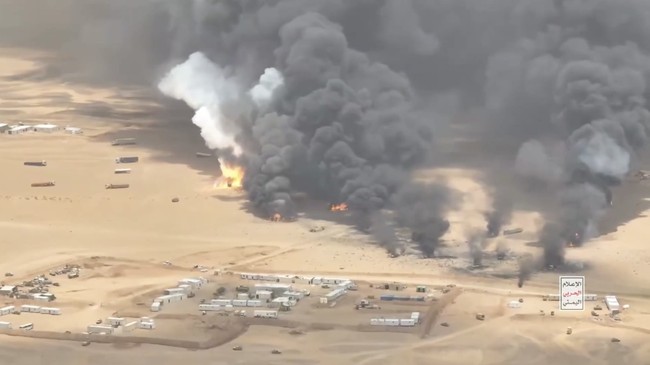
The fallback plan for the global oil market, already battered by more than six months of war between the United States and Iran, is now under threat of serious destruction.
Quoting CNN on Tuesday (15/9/2026), the Saudi Arabian government announced on Friday that it had been forced to shut down the East-West Pipeline following a barrage of drone attacks launched from within Iraqi territory. Local authorities stated that the deadly attack had resulted in a number of casualties and damage to facilities.
To date, no group has claimed responsibility. However, US President Donald Trump was quick to point the finger at Iran-backed proxy groups in Iraq as the masterminds behind the attack. In response to the accusation, the Iranian Foreign Ministry firmly denied it on Monday.
The forced closure carries fatal consequences. The East-West Pipeline, which stretches to the port of Yanbu on the Red Sea, is crucial for diverting millions of barrels of Saudi crude away from the conflict zone in the Persian Gulf.
According to a Capital Economics note published on Monday, the pipeline’s closure could cut up to 4% of total global oil supply. An operational halt that could last for weeks is seen as further strangling an already tense global oil market.
Houthi Grip and Price Surge
The threat of this crisis became a perfect nightmare after Houthi rebels in Yemen succeeded last week in seizing the port city of Mocha and Perim Island in the Bab al-Mandeb strait. This narrow waterway had previously served as an alternative route for Saudi oil exports when the Strait of Hormuz was blockaded.
The combination of the Houthi grip on the Red Sea and the closure of the Saudi pipeline has triggered fears that all of the region’s main oil escape valves will be sealed shut. As a result, crude oil futures rallied across the board in Monday’s trading. The global benchmark Brent surged more than 3% to US$108 (Rp 1,900,800) per barrel, while the US benchmark WTI rocketed to US$103 (Rp 1,812,800) per barrel.
“It would truly be a catastrophe if the East-West Pipeline cannot be quickly repaired and returned to operation. So far, that route is the most important route through which Saudi Arabia can divert its crude oil flows,” said Bob McNally, President and co-founder of Rapidan Energy Group.
Before it was destroyed by bombing, the resilience of the global oil market was greatly aided by the East-West Pipeline network, which could pump an average of around 6 million barrels of crude per day, nearly touching its peak capacity of 7 million barrels per day. Richard Bronze, co-founder of Energy Aspects, said the pipeline served a dual function: exporting crude oil and supplying refineries on Saudi Arabia’s west coast, whose output is then exported as refined products such as diesel.
“Traders are currently even more sensitive to disruptions in the refined products market because it is smaller in size and is also suffering because Ukrainian attacks on Russian refineries have reduced supply,” he explained.
The impact of this refining crisis has directly hit the US economy. Andy Lipow, President of Lipow Oil Associates, estimated that a prolonged pipeline closure could push US diesel prices, which last week had already broken through US$6 (Rp 105,600) per gallon, above US$6.50 (Rp 114,400) per gallon.
Stock Depletion Threat
The fate of oil supply now hinges on remaining stockpiles at the port. Johannes Rauball, Senior Crude Oil Analyst at Kpler, revealed that oil storage at Yanbu currently holds around 15 million barrels of crude oil.
“Based on average withdrawal rates, that gives roughly four days before the tanks run empty,” he said.
Meanwhile, Janiv Shah, Vice President of Commodity Markets at Rystad Energy, gave a slightly longer estimate for stock depletion, ranging between five and seven days.
Although Richard Bronze of Energy Aspects is optimistic that Saudi Arabia will be able to resume some flows through the pipeline whilst carrying out repairs, he warned that a prolonged total outage would carry deadly consequences.
“Sustained losses would turn this slow-burning crisis into a fast-spreading blaze,” he concluded.
Source: jawawa.id (https://jawawa.id/newsitem/saudi-oil-pipeline-bombed-here-is-the-impact-on-the-world-1789447873)
Originally published by CNBC Indonesia (https://www.cnbcindonesia.com/news/20260915080139-4-767900/pipa-minyak-arab-saudi-dibom-begini-dampaknya-bagi-dunia), translated from Indonesian