
Saudi Arabia’s Military Strength: What Is It Spending Rp1,100 Trillion On?
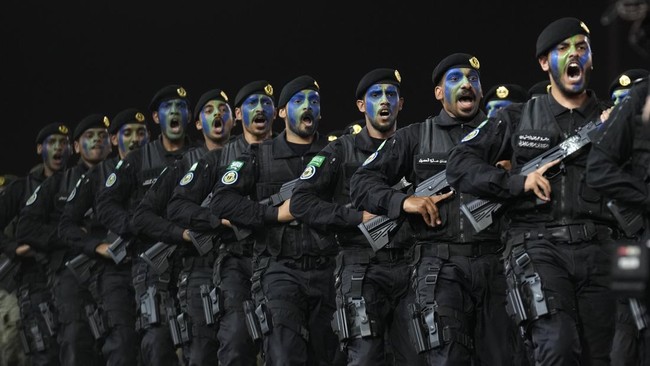
Jakarta, CNBC Indonesia – Saudi Arabia has once again come under attack from Houthi missiles and drones launched from Yemen. The attacks have targeted airports and oil facilities, escalating tensions across the Middle East.
Reuters reported that Houthi attacks disrupted flights in Saudi Arabia. King Khalid International Airport in Riyadh was forced to suspend operations after a deadly attack on Saturday (10 October 2026).
The situation has raised questions about the actual scale of Saudi Arabia’s military strength. The oil-rich country is known for its large defence budget and modern weapons.
According to Global Firepower (GFP) 2026 data, Saudi Arabia ranks 25th out of 145 countries, with a military strength index, or PowerIndex, of 0.4473.
GFP uses more than 60 factors to assess a country’s military strength, including troop numbers, weapons, defence spending and logistical capability. The lower the index, the greater a country’s conventional military strength under GFP’s calculations.
The United States ranks first, with an index of 0.0741, followed by Russia at 0.0791 and China at 0.0919.
Saudi Arabia’s position is notably below that of several Asian countries, including Indonesia, which ranks 13th, Israel in 15th place and Iran in 16th.
Below is a list of the world’s 25 strongest military powers according to GFP 2026.
Although it ranks only 25th overall, Saudi Arabia has a very large defence budget. GFP puts the country’s defence spending at US$63.99 billion, or about Rp1.142 trillion (US$1 = Rp17,855), making it the eighth-largest in the world.
That budget gives Saudi Arabia the means to buy and maintain a range of modern weapons, including fighter jets, tanks, warships and air-defence systems.
Saudi Arabia has around 247,000 active military personnel, as well as 150,000 paramilitary personnel or supporting armed forces. Combined, its active and paramilitary personnel total 397,000.
What, then, does Saudi Arabia’s arsenal look like on land, in the air and at sea?
Saudi Arabia’s Military Strength on Land, in the Air and at Sea
Saudi Arabia’s military is backed by thousands of combat vehicles, hundreds of military aircraft and dozens of warships. Its land forces include more than 1,000 main battle tanks, while its air force is among the largest in the world by aircraft numbers.
The following is a breakdown of Saudi Arabia’s military equipment, according to GFP 2026.
Saudi Arabia’s army is supported by thousands of military vehicles and heavy weapons. GFP records 1,085 main battle tanks, placing the country 21st globally in this category.
In addition, Saudi Arabia has 22,370 military vehicles, including armoured vehicles, personnel carriers and operational support vehicles.
The country also has 380 self-propelled artillery pieces, or guns mounted on vehicles that can move independently. Its arsenal includes a further 557 towed artillery pieces and 327 multiple-launch rocket systems (MLRS), which can fire volleys of rockets at ground targets.
Compared with its land and naval forces, Saudi Arabia’s number of military aircraft is one of its strengths. GFP records 917 military aircraft of various types, putting it 11th globally.
Of these, 283 are fighter jets, giving Saudi Arabia the world’s seventh-largest fleet in this category. The country also has 81 attack aircraft, 49 transport aircraft and 202 trainer aircraft.
Its helicopter fleet numbers 264, including 34 attack helicopters.
Another advantage is its fleet of 22 aerial refuelling aircraft, the second-largest in the world. These aircraft allow fighter jets to stay airborne longer and travel further without returning to base to refuel.
By contrast, Saudi Arabia has a relatively limited number of military vessels. GFP records 32 naval assets, placing the country 58th globally.
The fleet includes seven frigates and nine corvettes, used for a range of maritime defence and security operations. It also has nine patrol vessels and three mine countermeasure vessels.
However, GFP’s 2026 inventory lists no submarines, aircraft carriers or destroyers in Saudi Arabia’s fleet.
The navy nevertheless plays an important role because Saudi Arabia borders the Persian Gulf and the Red Sea. Both are vital international trade routes, particularly for shipments of oil and other energy commodities.
Why Can Houthi Attacks Still Penetrate Saudi Arabia’s Defences?
Saudi Arabia’s considerable military strength has not made the country completely immune to attacks by the Houthi group.
One reason is the difference in how the two sides fight. Saudi Arabia relies on a range of modern weapons, while the Houthis make extensive use of missiles and drones to strike targets from a distance. These weapons allow the Houthis to attack without confronting Saudi tanks or fighter jets directly on the battlefield.
To counter such threats, Saudi Arabia relies on radar and air-defence systems to detect, track and intercept missiles and drones before they reach their targets.
The Royal Saudi Air Defense Forces operate a range of weapons made in the United States and Europe. One of the best-known systems is the US-made Patriot, designed to counter various aerial threats, including ballistic and cruise missiles and aircraft.
Saudi Arabia has also operated its first Terminal High Altitude Area Defense (THAAD) unit since July 2025. The system is designed to intercept ballistic missiles during the final stage of their flight, including at high altitude.
According to the inventory compiled by Gladius Defense & Security, Saudi Arabia also has other air-defence systems, including Improved HAWK, Crotale, Shahine and VL-MICA.
These systems have different roles. Patriot and THAAD address specific threats at different ranges and altitudes, while Crotale, Shahine and VL-MICA provide shorter-range protection.
With this arsenal, Saudi Arabia has several layers of air defence. But having numerous defence systems does not automatically ensure that every part of the country is protected from every attack.
Missiles and drones arriving simultaneously from multiple directions can make detection and interception more difficult. Low-flying drones can also be harder for some radar systems to detect because the terrain may obstruct them.
Each defence system also has a limited range and a finite supply of interceptor missiles. Saudi Arabia’s vast territory makes it particularly challenging to protect every airport, oil facility and piece of critical infrastructure.
It should be noted that Global Firepower does not include drones in its military aircraft totals, nor does it detail the number of Saudi air-defence systems or its stocks of interceptor missiles.
It is not yet clear what enabled the latest Houthi attacks to reach their targets—whether the cause was radar limitations, the volume of weapons launched or other operational constraints.
The Houthi attacks show that a large budget and an extensive arsenal of modern weapons do not necessarily guarantee a country’s security. The ability to detect and intercept threats is also crucial, particularly when facing missile and drone attacks.
Source: jawawa.id (https://jawawa.id/newsitem/saudi-arabias-military-strength-what-is-it-spending-rp1-100-trillion-on-1791899484)
Originally published by CNBC Indonesia (https://www.cnbcindonesia.com/research/20261013105118-128-775643/peta-kekuatan-militer-arab-saudi-habiskan-rp1100-triliun-buat-apa), translated from Indonesian