
Satgas PASTI Halts 1,222 Illegal Entities by End of August 2026
Jakarta (ANTARA) - The Financial Services Authority (OJK) reported that the Illegal Financial Activities Eradication Task Force (Satgas PASTI) has identified and halted a total of 1,222 illegal entities between 1 January and 31 August 2026.
The figure comprises 951 illegal online lending entities, 242 illegal investment entities, 27 illegal pawnshops, and two other illegal financial activities across a number of websites and applications that could potentially harm the public.
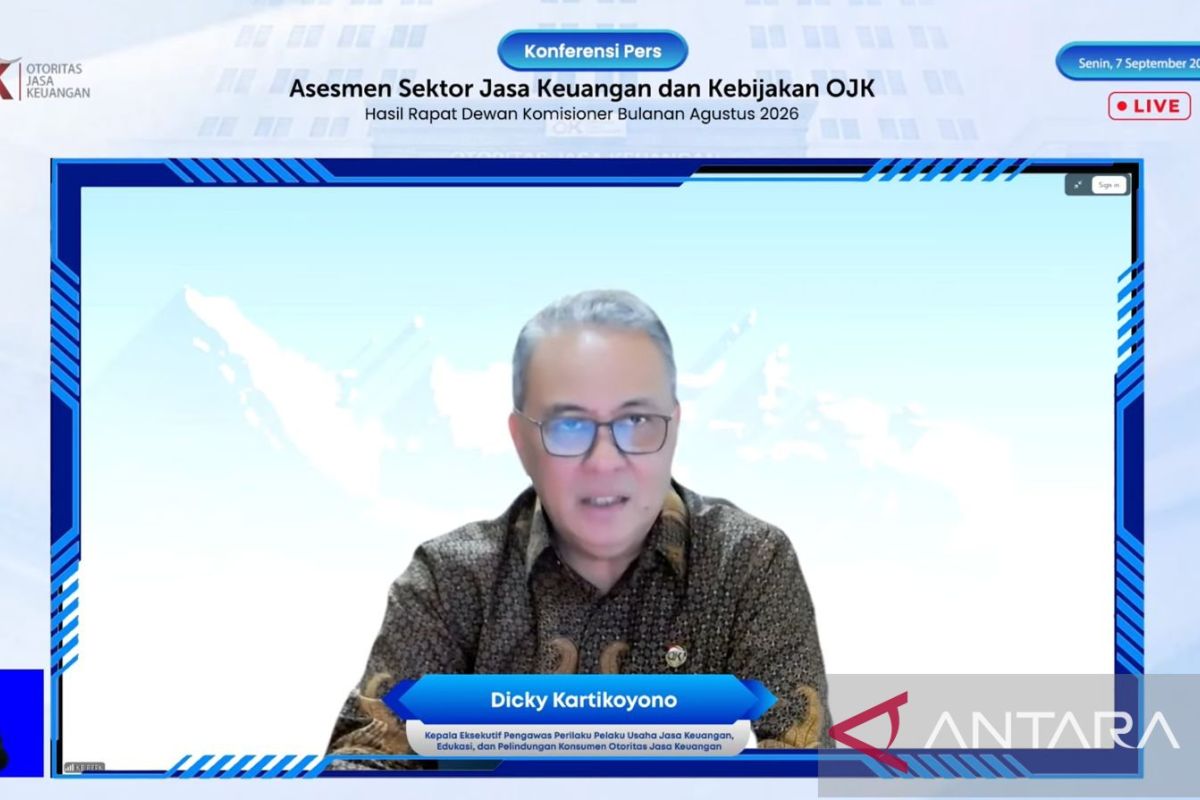
“We will continue to strengthen the eradication of illegal financial activities, including through the use of technology when the time comes,” said Dicky Kartikoyono, Executive Head of Behavioural Supervision of Financial Services Business Actors, Education, and Consumer Protection at OJK, at a press conference on the results of the August 2026 Board of Commissioners Meeting (RDKB) in Jakarta on Monday.
The number of complaints regarding illegal entities received by OJK over the same period reached 30,328. Of that total, 26,729 complaints concerned illegal online lending, 3,399 related to illegal investments, and 200 related to illegal pawnshops.
Meanwhile, regarding financial scams, OJK and Satgas PASTI through the Indonesia Anti-Scam Centre (IASC) have received 668,441 reports since the IASC began operating on 22 November 2024 up to 31 August 2026.
That figure comprises 321,715 reports submitted by victims through financial sector businesses, such as banks and payment system providers, which were subsequently entered into the IASC system, whilst 346,726 reports were lodged directly by victims into the IASC system.
The number of reported and verified accounts reached 1,276,688, of which 659,419 accounts have been blocked.
OJK recorded that, to date, a total of Rp771.2 billion in victims’ funds has been blocked. Meanwhile, the total funds returned to victims stand at Rp206 billion, drawn from accounts at 19 banks used by perpetrators of fraud.
Dicky urged the public to remain increasingly vigilant against various forms of financial transaction fraud, in step with the misuse of ever more advanced technology by criminals operating across borders.
This includes the misuse of artificial intelligence (AI) for fake or fictitious identities. Up to June 2026, the IASC had received 1,379 fraud reports suspected of involving AI.
“This means the activities of fraudsters, scammers, and hackers using this technology are becoming increasingly complex. We can even see that voice cloning and face cloning are being widely used,” said Dicky.
In response to these recent developments, Dicky said OJK and Satgas PASTI are deepening synergy and collaboration to carry out prevention and early detection, and are even urging the industry to continue developing various technological innovations.
“Of course, the foremost measure is education and public awareness. Satgas PASTI continuously and consistently reminds the public to be truly vigilant about fraud methods through the national campaign to eradicate scams and illegal financial activities,” he said.
In addition, OJK is strengthening risk-based customer due diligence and enhanced due diligence. For their part, industry players must continue to bolster their capacity to develop fraud detection systems.
“We are also gradually building a blacklist covering the entire digital financial ecosystem. We then conduct real-time transaction monitoring so that every suspicious activity can be identified and acted upon more quickly,” said Dicky.
He added that OJK and Satgas PASTI will not cease strengthening cyber patrols. OJK is also cooperating with social media platforms and telecommunications companies to eradicate illegal entities and financial fraud.
“Going forward, OJK will strengthen comprehensive scam handling through the development of anti-scam apps or channel 157 via apps, the integration of related data and systems, strengthened regulation, and the obligation of industry players to meet minimum standards for their fraud detection systems,” said Dicky.