
Sanad in the Instant Age
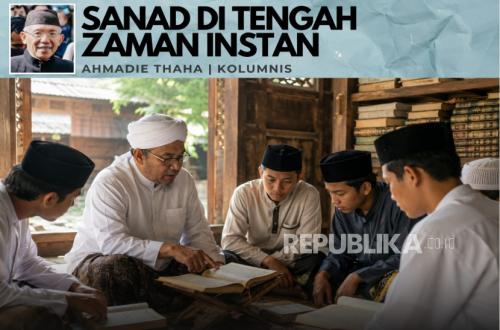
In a country where it’s now easier to find a “viral ustaz” than a tyre repairman, a new phenomenon has emerged: sanad-based training for reciting Al-Fatihah. Some people are puzzled. “What, even reciting Al-Fatihah requires a sanad?” They may be accustomed to living in an era of everything instant: instant coffee, instant noodles, even wanting instant religious conclusions. Just open a three-minute short video, and they feel they’ve reached the level of Imam Ghazali. Yet, in Islamic tradition, knowledge is not street-side fried snacks that can be grabbed from just anyone. Knowledge is inherited. It is guarded. Its purity is ensured. There is a path. There is a teacher. There is a sanad. Now, certificates for sanad are even being issued. Complete ones. Ready to be framed and hung in the living room, alongside graduation photos. Not just for Al-Fatihah, but also for sanad-based Qur’an memorisation. Amid a world noisy with social media algorithms, it’s quite intriguing that one public figure consistently speaking about sanad is an active minister: Nusron Wahid. He appears like an academic who doesn’t settle for just citing texts. He speaks about sanad not once or twice. Most recently, he appeared at the Pengajian Majlisul Ilmi of the Persatuan Ummat Islam (PUI) in Jakarta. There, among other things, he emphasised that “religion is advice, but the question is: from where do we take its sanad?” He reminded that sanad is the key to preserving the purity of knowledge. Before that, at the Haul Guru Tua Alkhairaat in Palu, Central Sulawesi, he warned of the dangers of learning religion without sanad, for example, only from social media like unclear ustadz lectures on YouTube. Even at the Tarawih Study at Masjid Ukhuwah Islamiyah UI in Depok, he linked sanad to the ethics of public leadership: that decisions without clear references are as dangerous as fatwas without sanad. This is intriguing. Because usually, officials at the level of a minister, when speaking from the podium, are busy discussing downstreaming, digitalisation, industrialisation, or at least revitalisation. But Nusron discusses sanad. As if he is a minister expert in sanad. That may be because he was born from pesantren culture, a tradition that from the outset has lived on chains of knowledge. In pesantren tradition, a kiai is not just someone who is good at speaking. He must clearly state “from whom he learned.” Which book, learned from whom. It must be clear. Even prayers and wirid, their ijazah must be clear from whom. Because in the tradition of scholars, knowledge without sanad is like billions of rupiah in cash without serial numbers: it looks convincing, but it’s not necessarily genuine. So it’s no wonder if in pesantren, sanad can be more important than academic degrees. Doctorates can be plentiful. Professors can line up. But sanad is about the continuity of the soul of knowledge. In classical pesantren tradition, a person’s scholarship is hard to accept if their knowledge path is unclear. Because sanad is not just a list of names. It is a mechanism for verifying Islamic civilisation for centuries. Imam Abdullah bin al-Mubarak from Turkmenistan even said: “Al-isnādu minad-dīn. Lawlā al-isnādu la qāla man syā’a mā syā’a.” Sanad is part of religion. If there were no sanad, people would say whatever they please. And indeed, today people do say whatever they please. After reading just one social media thread, they immediately feel like mujtahids. After memorising two hadiths, they’re bold enough to declare bid’ah on the neighbouring village. After learning Arabic from an app, they feel qualified to correct Imam Nawawi. This is the era when Google is considered more magical than a teacher. Yet Google is a warehouse of data, not a warehouse of wisdom. It can give quick answers, but it can’t impart adab. Search engines can display thousands of fatwas, but they can’t instil spiritual caution. Therefore, the sanad tradition was born as a fortress of knowledge civilisation. In Islam, according to Nusron, sanad has several important forms. First, sanad nasab (dam) or lineage sanad. This mainly applies to the line of Ahlul Bait, descendants of the Prophet Muhammad (peace be upon him). In classical Islamic tradition, nasab is not just biological pride, but also moral and spiritual responsibility. Therefore, the Prophet’s lineage is guarded very strictly through the science of nasab. There are even many special books that trace the genealogy of Ahlul Bait back to the Prophet Muhammad (peace be upon him). Not for blood feudalism, but to safeguard historical trust. Second, sanad talaqqī, especially in the Qur’an. This is what’s currently popular in training for reciting Al-Fatihah or sanad-based Qur’an memorisation. A qari learns directly from a teacher, that teacher learned from their teacher, and so on, connecting back to the Prophet Muhammad (peace be upon him). So when someone recites “Māliki yaumid-dīn” with a certain length, there is a chain of transmission for their recitation. There is verification of makhraj, tajwid, even the rhythm of recitation. Not just any recitation, because one is aware that the recitation of Al-Fatihah determines the validity of prayer. The Qur’an from the beginning was revealed through the talaqqī method: read directly, heard directly, corrected directly. Not just a PDF downloaded and read alone while lounging. Third, sanad of knowledge. This encompasses fiqh, tafsir, hadith, usul fiqh, to various Islamic disciplines. A student learns a book from a teacher who has a clear chain of knowledge transmission to the great imams, then to the companions, then to the Prophet Muhammad (peace be upon him). Thus, when a scholar speaks, behind them stands thousands of other scholars as the chain of knowledge. That’s why the authority of classical scholars was so strong. They didn’t speak alone. They carried a long history of knowledge. Fourth, sanad of awrād and Sufism. In tariqa tradition, wirid cannot be taken just anywhere like marketplace discounts. There is ijazah. There is adab. There is spiritual readiness. Because dhikr is not just repeating sounds, but a process of soul purification. Therefore, awrād are passed from mursyid to murid in stages. From one generation to the next. Many great tariqas like Qadiriyah, Naqsyabandiyah, Syadziliyah, Tijaniyah, all live through spiritual sanad connected back to the Prophet Muhammad (peace be upon him). Fifth, sanad mushāfahah.