
Samuel Sekuritas: Interest Rates and Rupiah are Key to JCI Recovery
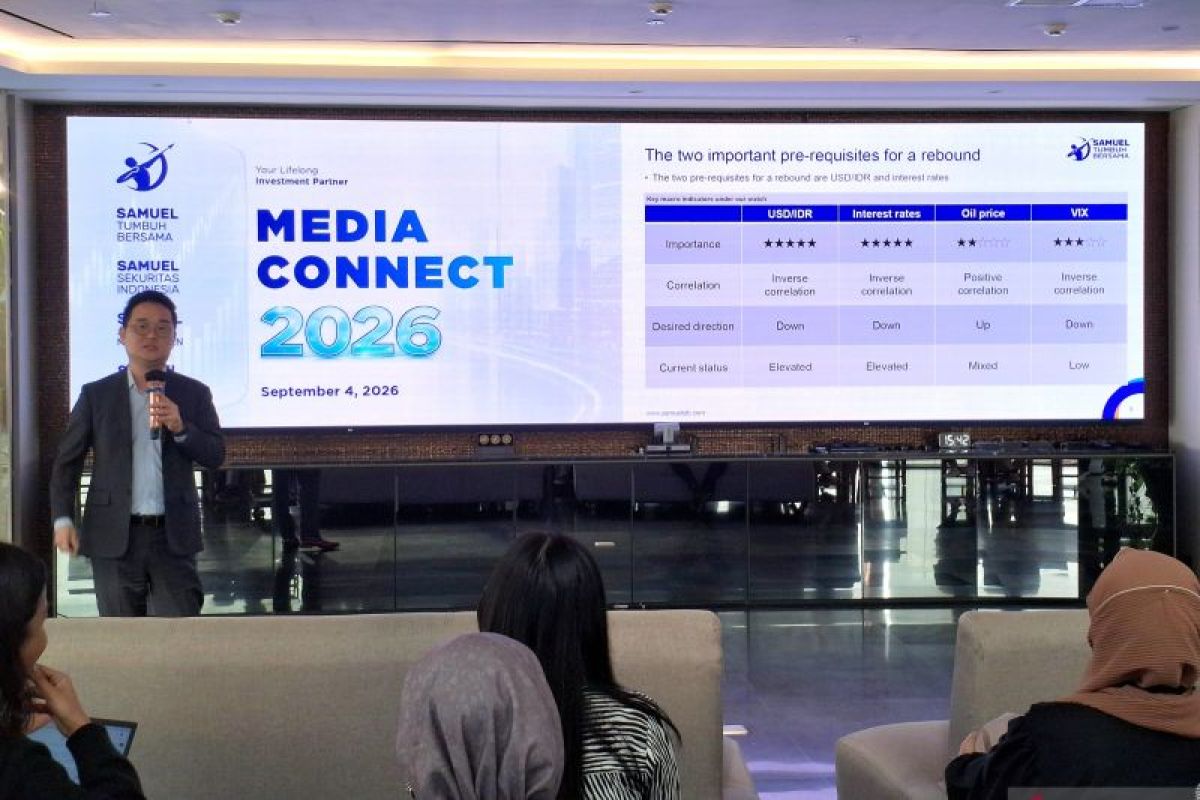
PT Samuel Sekuritas Indonesia believes that expectations regarding benchmark interest rates and the rupiah exchange rate will be the key to the recovery of the Jakarta Composite Index (JCI) during the final third of 2026.
Managing Director of PT Samuel Tumbuh Bersama, Tae Yong Shim, noted that investors are currently questioning when the JCI can return to an uptrend after facing pressure throughout the year.
“The main question for investors right now is when the JCI can rebound. Looking at history, the JCI has shown V-shaped recoveries several times after sharp declines. However, such a recovery requires clear prerequisites, particularly regarding the direction of the rupiah and interest rates,” Shim stated during the Samuel Sekuritas Indonesia Media Connect in Jakarta on Friday.
In a presentation titled ‘September Market Navigation: Victory is Just Around the Corner’, Shim explained that the rupiah exchange rate and 10-year Indonesian Government bond yields have a strong negative correlation with the JCI. This means that a weakening rupiah and rising bond yields tend to exert pressure on the stock market. Conversely, a stabilised rupiah and falling yields have the potential to create space for a JCI recovery.
Shim estimates that the pressure on the rupiah has reached its peak in the first half of 2026. “If the rupiah’s weakness has passed its worst point, then the rationale for maintaining high interest rates also becomes increasingly weak. This is crucial for the market, as the rupiah and interest rates are the two primary prerequisites for paving the way for a JCI recovery,” said Shim.
Regarding interest rates, Shim noted that market participants are beginning to anticipate that Bank Indonesia (BI) will not continue interest rate hikes through the fourth quarter of 2026 and 2027. However, he emphasised that the direction of this policy remains heavily dependent on developments in the rupiah exchange rate.
He assessed that the 10-year Indonesian Government bond yield, currently at around 7 per cent, is still comparable to BBB-rated countries. “Theoretically, that yield has the potential to reach the 6 per cent range, considering the inflation rates of peer countries,” Shim added.
Furthermore, he identified domestic liquidity as another factor supporting market recovery, with Indonesia’s money supply (M2) recorded at Rp10,371 trillion, representing an 8 per cent year-on-year growth. “We see that investors still possess significant liquidity. When sentiment begins to shift and funds start moving back into the stock market, price movements can occur quite rapidly,” said Shim.
On the international front, he mentioned that foreign fund flows are showing signs of improvement, with foreign investors recorded as returning to buy Indonesian bonds and stocks since June 2026. A weakening US dollar is viewed as a potential driver for fund rotation into emerging market assets, including Indonesia.
Since June 2026, Samuel Tumbuh Bersama observed that domestic stock valuations are becoming attractive, with the JCI having a trailing price-to-earnings (P/E) ratio of approximately 14.2x, approaching its 10-year low of 12.5x and sitting below the 10-year average of approximately 20.6x.
With lower valuations, solid corporate fundamentals, and the potential for rupiah and interest rate stabilisation, Shim believes the opportunities for market gains are now greater than the risks of decline. “With current market valuations at a more attractive level and Indonesia’s corporate fundamentals remaining solid, combined with a more stable rupiah, easing interest rate expectations, large domestic liquidity, and the return of foreign inflows, we see the opportunity for market recovery opening up,” said Shim.
In conjunction with this view, Samuel Tumbuh Bersama recommends that investors begin reducing cash positions and rebalancing allocations towards risky assets, with a composition of 40 per cent stocks, 40 per cent fixed income, 5 per cent gold, 10 per cent crypto, and 5 per cent cash. For preferred stocks, the focus is directed towards non-MSCI blue chips, while for fixed-income instruments, the preference remains on short-term bonds.
Source: jawawa.id (https://jawawa.id/newsitem/samuel-sekuritas-interest-rates-and-rupiah-are-key-to-jci-recovery-1788534206)
Originally published by Antara (Indonesian) (https://www.antaranews.com/berita/5726657/samuel-sekuritas-suku-bunga-dan-rupiah-jadi-kunci-pemulihan-ihsg), translated from Indonesian