
Salvage of KM Virgo Transport 8: Waiting for Godot?
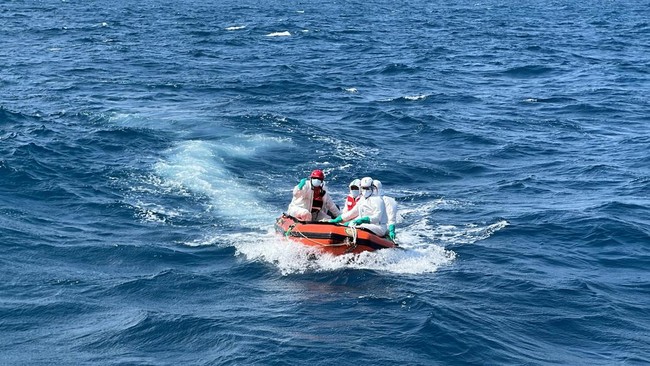
When this article was written, 49 days had passed since the tragedy involving KM Virgo Transport 8. News about the disaster was gradually fading from public attention, replaced by coverage of politics and the economy, and even a report of a ferry fire near Merak Port in Banten.
Before long, perhaps, the accident will be forgotten by the public, including the government. Everything will go on as usual — business as usual. But that is not the case for the victims’ families, especially those whose relatives’ bodies have still not been recovered from the wreck.
Their grief is exceptionally difficult to bear. Their relatives — perhaps a younger or older sibling, an aunt, an uncle or someone else — may never be brought up from the seabed in the waters around Masalembo in the Java Sea.
The wreck of KM Virgo Transport 8, which holds around 50 bodies, has not entirely sunk; part of the vessel remains just above the water’s surface. So near, yet out of reach. Tragic. The inability to recover the wreck appears to stem from protracted negotiations between Virgo Karya Shipping, the company that operated Virgo Transport 8, and the parties that would refloat the vessel through a salvage operation.
According to reports in the media, the company is negotiating and preparing the administrative requirements for salvage following the sinking of KM Virgo Transport 8. PT VKS says it is in intensive communication with an international protection and indemnity (P&I) insurer, which is assessing the technical aspects of the recovery.
The insurer has reportedly narrowed down the candidates to carry out the work and brought in international experts to devise a recovery method that would not damage the bodies inside the vessel. PT VKS’s lawyer said salvage administration had been held up because investigators had seized several important vessel documents as evidence.
PT VKS has submitted a request to borrow those documents so the insurance paperwork can be completed. Whatever the company’s explanation, the fact remains that physical recovery work has not begun at all, and this situation has continued for 49 days.
In response to what it considers a slow process while dozens of victims remain missing, the Ministry of Transportation, through the Banjarmasin Harbourmaster and Port Authority (KSOP), has sent a strongly worded letter to PT VKS and the P&I insurer urging them to speed up work on the ground. The question now is why the company’s salvage operation is taking so long. Is this normal in the shipping business?
In my view, the answer is fairly simple. PT VKS appears not to have wreck-removal insurance. It may not even have hull and machinery insurance covering the vessel’s hull and engines.
It is worth noting that these two types of insurance serve different purposes. Wreck-removal cover — often associated with P&I — concerns the raising, removal or destruction of a wreck, including third-party liability or pollution risks unrelated to navigation.
It is provided through P&I clubs. Hull and machinery insurance, meanwhile, covers losses arising from physical damage to or the loss of a vessel’s hull, engines and equipment as a result of perils of the sea or other risks of navigation.
Wreck-removal insurance is a relative newcomer to maritime accident cover. The Nairobi International Convention on the Removal of Wrecks, adopted by the International Maritime Organization (IMO) in 2007 and entering into force internationally in 2015, is only 11 years old. Hull and machinery insurance, by contrast, has a history spanning hundreds of years — if not thousands, when traced back to ancient Babylon.
Returning to the suggestion that PT VKS has no wreck-removal insurance, this is based on the following reasoning. Insurance premiums are paid in advance, after the level of risk has been assessed. If the insured property is high-risk, the premium will be very expensive — or the request for cover may be rejected altogether.
No insurance is arranged after property — in this case, a vessel — has suffered an accident; no insurer would pay out in those circumstances. Statements by the ferry company’s representatives in the media that they are negotiating with an insurer reinforce this suspicion. What, after all, is there to negotiate? If there is insurance, the vessel can simply be raised. It does take time, of course.
I asked people in the marine insurance industry why the salvage effort for KM Virgo Transport 8 was moving so slowly. One of them, who works at a firm regarded as a leading authority on wreck removal in Indonesia, said the vessel was not listed as covered by the country’s wreck-removal insurance consortium.
Well, there you have it. It seems the ferry operator is buying time. It is not clear for how long. Will this become a case of waiting for Godot?
Source: jawawa.id (https://jawawa.id/newsitem/salvage-of-km-virgo-transport-8-waiting-for-godot-1793584274)
Originally published by CNBC Indonesia (https://www.cnbcindonesia.com/opini/20261102081935-14-781365/salvage-km-virgo-transport-8-bak-menunggu-godot), translated from Indonesian