
Said Iqbal Urges Ban on Foreign Workers, Criticises Omnibus Law
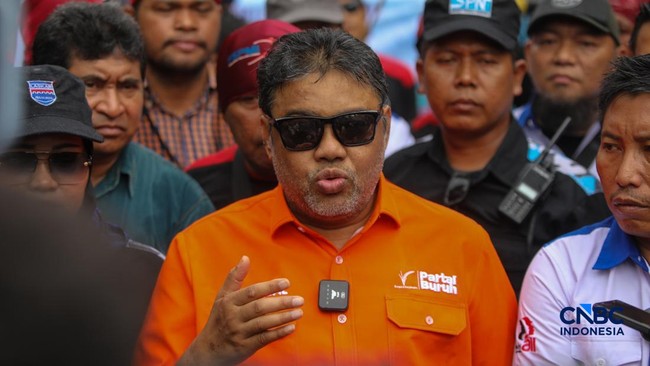
The President of the KSPI and the Labour Party, Said Iqbal, has urged for the restriction, or even a ban, on foreign workers (TKA) in Indonesia. Additionally, he has requested that redundancies (PHK) be made more difficult to execute.
These are two of ten points that must be implemented to ensure the protection of workers and labourers in Indonesia. He stated that these ten points should be incorporated as clusters within the articles of the proposed Labour Protection Bill. He also requested that the Bill be passed no later than October 2026.
This, he added, is in accordance with the mandate of the Constitutional Court Decision Number 168/PUU-XXI/2023. However, Said Iqbal warned that the deadline should not serve as an excuse for rushed legislation that sacrifices the substance of worker protection.
Furthermore, Said Iqbal highlighted the use of the term “protection” within the Bill.
“If the title is the Labour Protection Bill, then its contents must reflect the presence of the state and a bias towards labourers. Protection must apply before working, during work, and after work,” said Said Iqbal in a statement, quoted on Monday (30/8/2026).
“There should be at least ten clusters of articles determining labour protection,” he asserted.
First, Said Iqbal continued, the Bill must guarantee a decent wage and move away from the principle of the lowest possible wages. “Wage provisions already accepted by workers and employers, including the substance of Government Regulation Number 49 of 2026 regarding the minimum wage, can serve as a reference,” he said.
Second, regarding redundancies (PHK), he insisted that dismissals must be made more difficult and treated as a last resort through fair procedures, rather than being made easier for employers.
Third, the Labour Union-Party Coalition (KSP-PB) and the Indonesian Trade Union Confederation (KSPI) reject severance pay of only 0.5 times the stipulated amount, as currently permitted under Government Regulation Number 35 of 2021. “Severance pay must be at least one time the stipulated amount and must not be paid in instalments, as it serves as a replacement for income when a worker loses their job,” he noted.
Fourth, he urged that outsourcing be abolished or at least strictly limited in accordance with Constitutional Court Decision Number 1s68/PUU-XXI/2023. “The KSP-PB proposal is to limit it to only four types of supporting jobs: drivers, security officers, cleaning services, and catering. Supporting services in the oil sector and arrangements in State-Owned Enterprises (BUMN) should be placed under special provisions by forming subsidiaries,” he said.
Fifth, regarding fixed-term contracts (PKWT), Said Iqbal stated that contract durations must be clearly limited and not left indefinite to the discretion of employers. “The Constitutional Court decision must be the reference, including a total PKWT limit of a maximum of five years. The practice of very short, repetitive, or even continuous contracts throughout the period of employment must be prevented.”
Sixth, foreign workers (TKA) should be limited to skilled labour, with a maximum working period of three years and an obligation to transfer knowledge, technology, and jobs to Indonesian workers. Foreign workers for jobs that do not require special skills should be prohibited.
Seventh, Said Iqbal highlighted working hours and rest periods. He believes the principle of a 40-hour work week must be maintained, with eight hours per day for a five-day week or seven hours per day for a six-day week, so that work beyond these limits is counted as overtime. “Flexible working arrangements that undermine the certainty of rest periods must be rejected. The right to long-term rest for workers who have served six years also needs to be restored and guaranteed.”
Eighth, the cluster regarding work protection, according to Said Iqbal, concerns criminal sanctions. “Violations of normative rights related to workers’ wages must face strict sanctions. Employers who do not pay the minimum wage or do not pay severance must be subject to criminal penalties; these good provisions must not be abolished.”
Ninth, regarding the Job Loss Guarantee (JKP), the scope of JKP must be expanded to include workers who are not yet participants in BPJS Ketenagakerjaan. JKP, he added, should be developed into a stronger unemployment insurance, with employer contributions and benefits that truly support workers after redundancy.
Tenth, the focus is on the protection of contract and outsourcing workers after redundancy. “Contract and outsourcing workers must receive compensation equivalent to the function of severance pay. That is, one year of service is worth one month’s wage, with a benefit scale of up to nine months’ wage for eight years of service or more.”
He also stressed the need for transparency. Said Iqbal warned that the passing of the Labour Protection Bill must not repeat the process of the formation of Law No. 13/2003 concerning Labour, which took years. He also criticised the Omnibus Law, which he described as reflecting the dangers of rapid legislation and a lack of openness.
“Do not repeat the method of forming the Omnibus Law, which was discussed in haste, even until midnight and moving from hotel to hotel. This Bill concerns the lives of tens of millions of workers and their families. The discussion must be open, participatory, and must not become an arena for competing interests that sacrifice labourers,” he stated.
“In principle, KSP-PB and KSPI are asking the DPR (Parliament) and the government to find a constitutional way forward if substantive discussions cannot be properly resolved within two months,” he said.
Source: jawawa.id (https://jawawa.id/newsitem/said-iqbal-urges-ban-on-foreign-workers-criticises-omnibus-law-1788155761)
Originally published by CNBC Indonesia (https://www.cnbcindonesia.com/news/20260831111421-4-763579/said-iqbal-desak-tenaga-kerja-asing-dilarang-sindir-habis-omnibus-law), translated from Indonesian