
Said Abdullah Reviews 2027 Economic Growth Target in KEM PPKF 2027
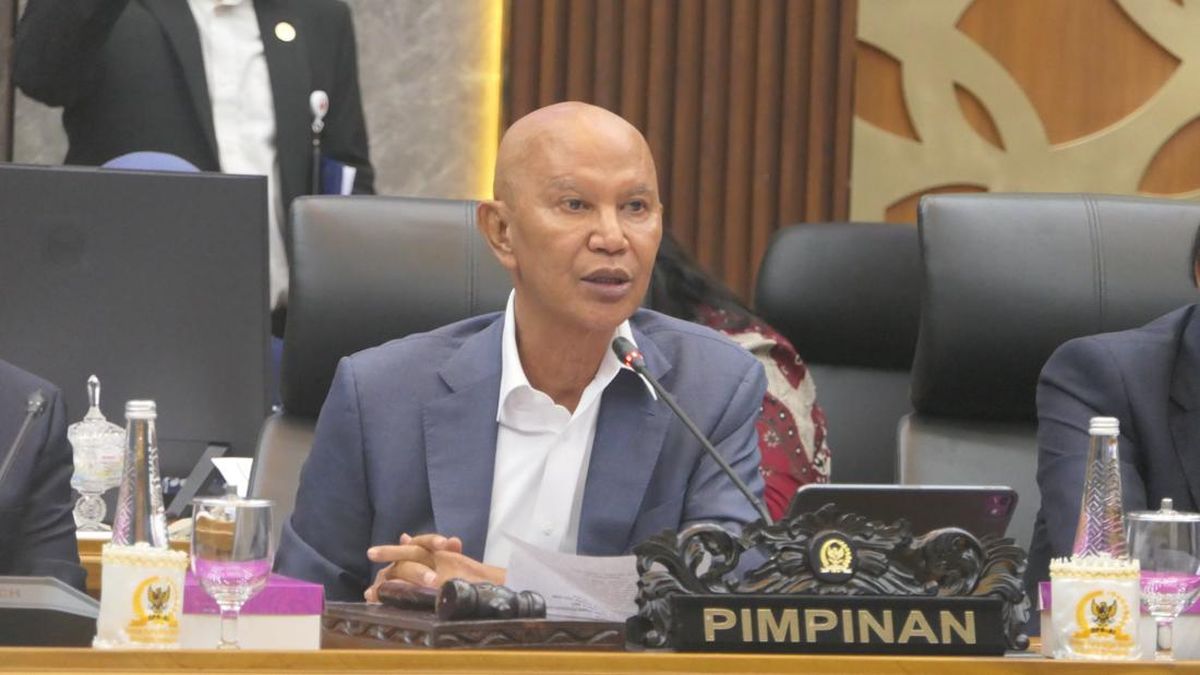
The House of Representatives’ Budget Committee (Banggar), together with the government, discussed the 2027 Macroeconomic Framework and Fiscal Policy Principles (KEM PPKF) during a working meeting on Monday (9/6). During the discussion, House Budget Committee Chair Said Abdullah scrutinised each of the government’s KEM PPKF 2027 proposals one by one. Said also appreciated President Prabowo Subianto’s move, which he assessed as building a new state tradition by directly delivering the introduction to the KEM PPKF 2027 during a House plenary session. According to Said, this step becomes a positive new tradition in constitutional practice while strengthening communication between the government and parliament in formulating the direction of national economic policy. “We scrutinised each of the government’s KEM PPKF 2027 proposals one by one. We appreciate that President Prabowo created a new state tradition by speaking directly at the House’s Plenary Session to deliver the Introduction to the KEM PPKF 2027,” said Said. In the KEM PPKF 2027 document, the government proposed several basic macroeconomic assumptions, including economic growth of 5.8-6.5 percent, inflation of 1.5-3.5 percent, the rupiah exchange rate in the range of Rp16,800-Rp17,500 per US dollar, and a Government Securities (SBN) yield of 6.5-7.3 percent. The government also targeted oil lifting of 602-615 thousand barrels per day and gas lifting of 934-977 thousand barrels of oil equivalent. Said assessed that the government’s economic growth target demonstrates optimism as well as seriousness in pushing Indonesia towards becoming a high-income country. According to him, efforts to achieve higher growth need the support of all national economic policy instruments. “High and sustainable economic growth is very important as a national strategy towards becoming a high-income country. We have asked Bank Indonesia to participate in supporting economic growth. It is also fitting that Danantara, which has assets worth tens of thousands of trillions, shares the task of driving economic growth,” he stated. He added that the government’s economic growth strategy must also continue to pay attention to the aspect of equity so that the benefits of development can be felt by all levels of society. Therefore, fiscal policy is expected to orchestrate economic growth, poverty reduction, unemployment reduction, and the reduction of social inequality simultaneously. On the other hand, Said reminded the government to be wary of pressure on the rupiah exchange rate, rising SBN yields, and the weakening of the domestic capital market. According to him, these conditions must be responded to with measured policies capable of restoring business confidence. “Currently, we are facing serious pressure on the exchange rate and SBN interest rates. Meanwhile, on the stock exchange floor, the Jakarta Composite Index (IHSG) graph is increasingly declining. What we must prepare is how to overcome a strong dollar, expensive SBN yields, and a declining IHSG,” he said. To restore market confidence, Said assessed that the government needs to maintain policy consistency and avoid announcing premature policies. In addition, productive dialogue with various stakeholders also needs to be strengthened to minimise business uncertainty. He also appreciated the government’s proposal setting the 2027 Draft State Budget deficit target in the range of 1.8-2.4 percent of gross domestic product (GDP). According to him, this target can provide a positive signal to the market if accompanied by a lower deficit realisation in the current year’s state budget. “This is good news. Hopefully, it will further convince the market. Especially if this year the deficit realisation can be lower, at least 2.58% from the 2026 State Budget target of 2.68%, and the 2025 realisation, which reached 2.81%. This shows a positive trend,” he said. Furthermore, Said encouraged governance reform for various government priority programmes, including the Free Nutritious Meals programme (MBG) and the Merah Putih Village Cooperatives (KDMP), through increasing implementer capacity, strengthening supply chains, and preventing conflicts of interest. Regarding state financing, Said reminded that in 2027 the government still faces a large principal and interest debt payment burden. At the same time, the government also needs to seek new financing sources through debt issuance. According to him, the increase in SBN yields can indeed attract investor interest, but on the other hand, it has the potential to increase the interest burden that must be borne by the state. Therefore, the government must pay attention to various factors that influence investor perception, from fiscal stability and exchange rate volatility to regulatory certainty. “Even if SBN yields must be higher, we hope it can be redeemed with productive spending that brings increased income because it aligns with economic growth,” he said. In the KEM PPKF 2027, the government established eight National Priority Programmes, namely food sovereignty, energy and water sovereignty, education, health, downstreaming and industrialisation, infrastructure-housing-disaster resilience, the people’s economy and villages, and poverty reduction. Said assessed that all these programmes constitute important stages in Indonesia’s medium and long-term development. However, he reminded of the threat of climate change that could potentially disrupt target achievement, especially in the food and water sectors. “The Meteorology, Climatology and Geophysics Agency (BMKG) warns that we must prepare to face El Niño Godzilla, or a long dry season. This situation could threaten the food and water sovereignty programmes. Therefore, mitigation must be carried out as early as possible,” he said. In the energy sector, Said requested the government to immediately carry out fundamental reform. One of them is by aligning national energy production and consumption so as not to continue depending on fuel oil imports. “We export coal to support the world, but domestic energy consumption comes from fuel imports. This asynchrony makes energy policy budget costly,” he said.