
Safeguarding the State's Mandate from State Capture
President Prabowo Subianto’s speech at the opening of the KSTI 2026 national symposium on 26 June 2026 deserves a deeper reading beyond a mere call to build economic independence and prosperity for Indonesia. Before an academic audience of 2,600 rectors, deans, professors, researchers, and industry players, the message of national self-reliance actually touches on a more fundamental issue: how to ensure the state continues to work for the people, not for narrow interests that hijack public policy.
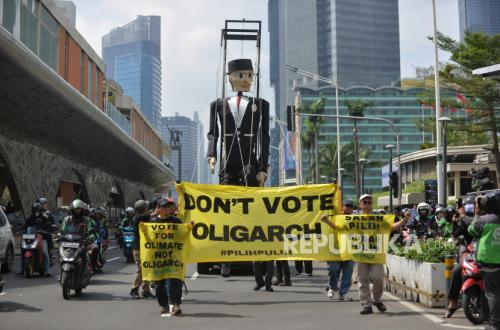
At this point, the term state capture becomes crucial. Simply put, state capture is a condition where the direction of policy, regulation, licensing, budgeting, and even law enforcement is unduly influenced by certain groups. The state still appears to be functioning. Meetings still take place. Laws are still passed. Projects are still inaugurated. Yet, behind seemingly legitimate procedures, the public interest can be slowly displaced by the interests of political elites, economic oligarchs, bureaucratic networks, or specific business groups.
The danger of state capture lies in its subtle nature. It does not always manifest as visible bribery. It can appear as closeness, privileged access, influence in drafting regulations, or the placement of certain people in strategic positions. If ordinary corruption breaks the rules, state capture can work by shaping the rules to benefit certain parties. This is the most dangerous form of hijacking the state: when wrongdoing is made to look legal.
From an Islamic perspective, power is a sacred trust. Allah SWT says in Surah An-Nisa, verse 58: ‘Indeed, Allah commands you to render trusts to whom they are due and when you judge between people to judge with justice.’ This verse provides a very strong moral foundation for state governance. The trust must not be misused. The law must not be bent. Policy must not become a tool to enrich a handful of people.
From a social psychology standpoint, state capture can also be understood as a process of forming deviant group norms. In groupthink theory, a group that is too closed, too loyal to the leader, and too afraid of criticism can lose the ability to judge clearly. They feel they are always right because they live in the same echo chamber. Criticism is considered a threat. Obedience is considered loyalty. Ultimately, public decisions are no longer tested based on their benefit to the people, but on whether they benefit the group itself.
There is also the symptom of moral disengagement, where a person or group deactivates their moral considerations to justify wrongful actions. They do not feel they are harming the people because they use language that sounds noble: stability, acceleration, investment, efficiency, or national interest. In fact, behind these terms can lie rent-seeking, conflicts of interest, and injustice. Social psychology reminds us that public evil often begins not with an overt malicious intent, but with small justifications that are repeated until they are considered normal.
Therefore, the economic independence agenda presented at KSTI 2026 must be accompanied by an agenda to safeguard the integrity of the state. Independence must not only mean the ability to produce goods, build industries, master technology, or manage natural resources. Independence also means the state is sovereign over its own policies. The state must not be held hostage by cartels, oligarchs, political sponsors, or rent-seeking networks hiding behind the name of development.
The first step to preventing state capture is to open the policy process to the public. Every major regulation, especially those concerning natural resources, food, energy, health, education, taxation, subsidies, and strategic projects, must be open to public scrutiny. The public has the right to know who proposed it, who drafted it, who provided input, who stands to benefit, and whether there is a potential conflict of interest within it. Transparency is not an obstacle to development. Transparency is a fence to ensure development is not hijacked.
Second, conflict-of-interest rules must be strengthened. It is not enough to merely prohibit public officials from accepting bribes. They must also be prevented from making decisions that benefit their families, business networks, political cronies, or parties that financed their political activities. Many deviations are not born from an envelope under the table, but from relationships considered ordinary, access that is too close, and compromises that are allowed to repeat.
Third, political financing must be made more transparent. As long as the cost of politics is high and the sources of political funding are opaque, there is always a risk that state policy becomes a tool to repay debts to financiers. Democracy must not stop at the ballot box. Democracy must ensure that after the people vote, policy is not taken over by those with large capital and closed access.
Fourth, oversight institutions must be kept independent. The Corruption Eradication Commission (KPK), the Audit Board (BPK), the Ombudsman, the Business Competition Supervisory Commission (KPPU), the courts, the prosecutor’s office, the police, the inspectorate, the media, universities, and civil society are the moral fences of the republic. A strong state is not afraid of oversight. A confident government is not afraid of criticism. Indeed, oversight is proof that power understands itself as a trust, not a possession.
Fifth, universities must play a prophetic-intellectual role. KSTI 2026 has placed universities in a strategic position. However, universities must not merely become providers of scientific legitimacy for the state or industry’s agenda. Universities must dare to be guardians of common sense, testing policies with data, reading social risks, exposing conflicts of interest, and reminding those in power when the direction of development begins to stray from justice.
Safeguarding the state from state capture is not merely a legal agenda. It is a moral, political, and cultural agenda. It is a test of whether the republic is truly independent or merely changing masters. President Prabowo’s speech at KSTI 2026 should be a starting point to build a state that is not only economically self-reliant but also sovereign over its own decisions.