
Safeguarding Mineral Sovereignty: Gold Governance Key to Unlocking Value
Indonesia possesses substantial gold reserves and ranks fourth in the world according to the central bank. This strategic position can serve as a cornerstone of national mineral sovereignty with optimal governance.
The Coordinating Ministry for Economic Affairs records domestic gold demand at approximately 190–200 tonnes per year. However, the large potential of gold reserves is not yet fully matched by gold supply entering through formal channels. Formal gold supply currently stands at only around 53.5–86.2 tonnes per year.
This gap shows there remains considerable room to strengthen governance and integrate the national gold supply chain into a formal, transparent and standardised system.
Director General of Mineral and Coal at the Ministry of Energy and Mineral Resources (ESDM) Tri Winarno said one of the problems still found in national gold governance is the existence of gold sales indicated to be illegal.
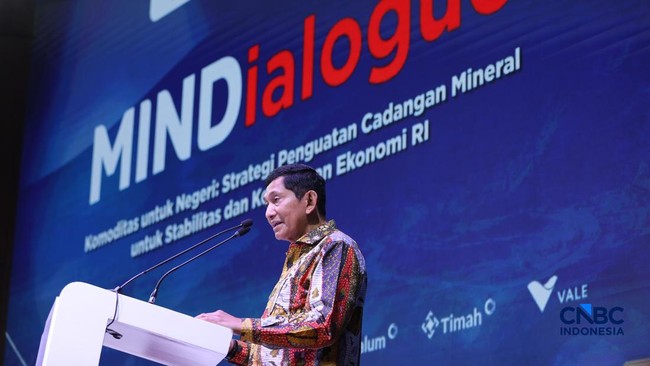
“Indeed, there are several notes on gold where some sales have been identified as, in quotation marks, illegal,” Tri said at the MINDialogue forum: Commodities for the Nation, Strategy for Strengthening Mineral Reserves for Stability and Economic Sovereignty of the Republic of Indonesia, in Jakarta, Wednesday (12/8/2026).
On the other hand, the Small-Scale Gold Mining (PESK) sector and artisanal mining make a fairly large contribution to national gold supply. Production from this sector is estimated to reach 50–120 tonnes per year, or close to the volume of supply coming from formal channels.
Tri said the government is working to improve artisanal mining governance by facilitating miners who have so far been identified as illegal miners to obtain permits through the People’s Mining Permit (IPR) mechanism.
“So, going forward, for governance improvements and so on, the Ministry of ESDM is actually trying to facilitate miners identified as illegal miners to be granted permits through the IPR mechanism,” Tri added.
Deputy Minister of Investment and Downstreaming as well as Deputy Head of BKPM Todotua Pasaribu said Indonesia’s challenge is not only pursuing economic growth, but also ensuring that natural resource wealth can provide the greatest possible added value for the nation.
“We have almost all resource diversification, natural resources. We have gas, we have oil, in the maritime sector, agriculture, almost the entire range is there and we also have very capable reserve stock strength. But the problem is how we can create greater value from the natural resource strength we possess,” Todotua said.
In line with this, President Director of MIND ID Maroef Sjamsoeddin assessed that the management of mineral reserves, particularly gold, is not merely an economic matter. According to him, mineral management is also linked to the national interest in maintaining security, sovereignty, economic resilience and public welfare.
“Mineral resources must be managed strategically, sustainably, and provide the greatest possible added value for the Unitary State of the Republic of Indonesia (NKRI) as mandated in the Preamble to the 1945 Constitution, namely for the independence and sovereignty of their management,” Maroef explained.
According to Maroef, there are still a number of aspects that need to be strengthened in national gold governance. These include the management of artisanal mining, traceability of the ore supply chain, and strengthening the trading ecosystem for mining products so that it is connected to formal channels.
MIND ID assesses that these improvements need to be carried out comprehensively by involving cross-institutional synergy, from the government and businesses to the public. The transformation of mineral reserve governance, Maroef said, needs to be carried out at every main node of the mining business process, from the upstream, midstream, to downstream sectors.
In the upstream sector, MIND ID is encouraging the formalisation of artisanal mining through IPR supported by regulatory harmonisation and continuous technical guidance. This step is expected to make artisanal mining activities more orderly and safe while providing greater economic benefits for the community.
Meanwhile, in the midstream sector, ore processing needs to be strengthened through the presence of a legally incorporated aggregator institution capable of guaranteeing supply chain traceability towards the formal system. Through this scheme, the appointed company can act as a technical mentor as well as a standby buyer (offtaker) to ensure mining products meet the required standards.
Strengthening governance from upstream to midstream is further expected to increase the supply of raw materials entering the formal supply chain. This will strengthen the productivity of the national gold processing and refining industry, expand public access to standardised gold products, and support the strengthening of the national bullion ecosystem.
MIND ID believes that improving gold governance will not only increase added value and supply chain efficiency, but also ensure that Indonesia’s gold wealth provides greater benefits for the state and society.
Ultimately, strengthening national gold governance is part of efforts to build sustainable economic sovereignty. With a legally connected, transparent and integrated supply chain from upstream to downstream, Indonesia can increase economic activity while strengthening its ability to safeguard the strategic value of natural wealth for the greatest prosperity of the people and the sovereignty of the state.