
Safeguarding Educational Sovereignty Behind Foreign Aid Programmes
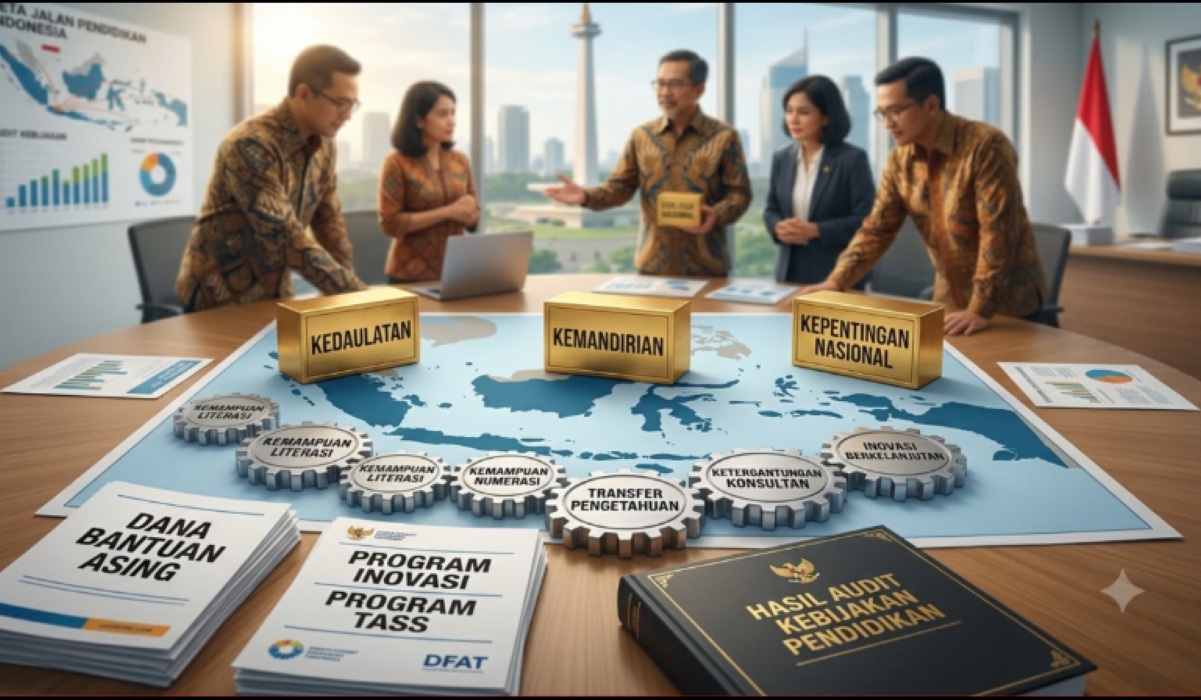
In the midst of increasingly complex global geopolitical dynamics, education is no longer viewed merely as a public service sector. Education has become a strategic instrument for human resource development, national character building, and even a component of international diplomacy. It is unsurprising that many developed nations utilise educational cooperation as one of their foreign policy instruments.
Indonesia is one of the countries that has received various forms of development assistance in the education sector for over two decades. One of the most prominent is the cooperation between the Indonesian Government and the Australian Government through the Department of Foreign Affairs and Trade (DFAT).
Through various programmes such as Technical Assistance for Education System Strengthening (TASS) and Innovation for Indonesia’s School Children (INOVASI), managed by Palladium, Australia has become one of the largest development partners in Indonesia’s primary education sector.
The INOVASI programme itself began in January 2016, entered its second phase in 2020 by integrating the TASS programme, and has continued through subsequent phases to the present. The funding value from DFAT for the second phase alone reached approximately A$54.6 million, demonstrating the scale of Australia’s investment in Indonesia’s education reform.
It is undeniable that these programmes have produced several best practices. Local governments have received assistance, teachers have undergone capacity building, various learning models have been tested, and the government has received various research-based inputs. In fact, several learning approaches developed through these programmes have subsequently become references for national education reform. This fact deserves appreciation.
However, precisely because these programmes have been running for almost a decade, it is time for the Indonesian government to conduct a thorough policy audit of all foreign aid in the field of education. The intended audit is not to find fault or build anti-foreign sentiment, but to ensure that all forms of cooperation truly provide strategic benefits for Indonesia’s national interests.
The fundamental question is simple. After almost ten years of various donor programmes running, has the quality of Indonesian education increased significantly? Have the literacy and numeracy skills of Indonesian children experienced a real leap? Has the capacity of local governments truly become more independent? Do the introduced innovations remain alive after donor funding ends? Or does most innovation actually cease when the project concludes?
These questions deserve to be answered through an independent national evaluation.
In international relations, no aid is truly free from interest. Development assistance is a legitimate part of diplomacy conducted by every nation. Therefore, the Indonesian government must place every donor programme within the framework of national interest. The direction of Indonesia’s educational development must not gradually be influenced more by the development priorities of donor countries than by the nation’s own strategic needs.
This vigilance should not only be directed at the presence of foreign experts. A more complex challenge arises when programme implementation fully utilises Indonesian professionals, but the programme design, success indicators, research methodology, and policy recommendations are all constructed based on the thinking framework of donor agencies. In such a situation, the face of the programme appears entirely ‘Indonesian’, but its substantive orientation may reflect the interests of the financier.
This assertion is not a form of suspicion towards Indonesian professionals working in various international programmes. Many of them are the nation’s best academics, researchers, and practitioners possessing high integrity. However, the state still needs to have mechanisms to ensure that every policy product arising from international aid programmes has truly undergone a screening process based on national interest. Loyalty to the nation must always take precedence over loyalty to a project.
The government also needs to evaluate all policy recommendations generated during almost ten years of programme implementation. How many recommendations have been adopted by the government? Which ones proved effective? Which ones failed? Which ones produced long-term impacts? And no less importantly, were there policies that turned out to be less suitable with the social, cultural, and educational characteristics of Indonesia?
Such an audit is a practice of healthy governance. A sovereign nation does not merely receive aid, but also possesses the ability to evaluate the benefits of every aid it receives.
Evaluation must also cover institutional aspects. So far, various donor programmes have heavily involved international consultancy firms, non-governmental organisations, universities, and national consultants. The government needs to map whether this pattern has resulted in knowledge transfer to state apparatus or has instead created a new dependency on external consultants.
The success of a programme should be measured by the increasing capacity of ministries, local governments, and schools to work independently, rather than an increasing reliance on project assistance.
Another equally important matter is the governance of educational data. In the digital era, data is a strategic national asset. Data regarding students, teachers, assessments, schools, and learning achievements holds immense value for policy formulation.