
Safe Weekend on Railway Lines: KAI Urges Driver Discipline at Crossings and Residents to Stay Away from Tracks
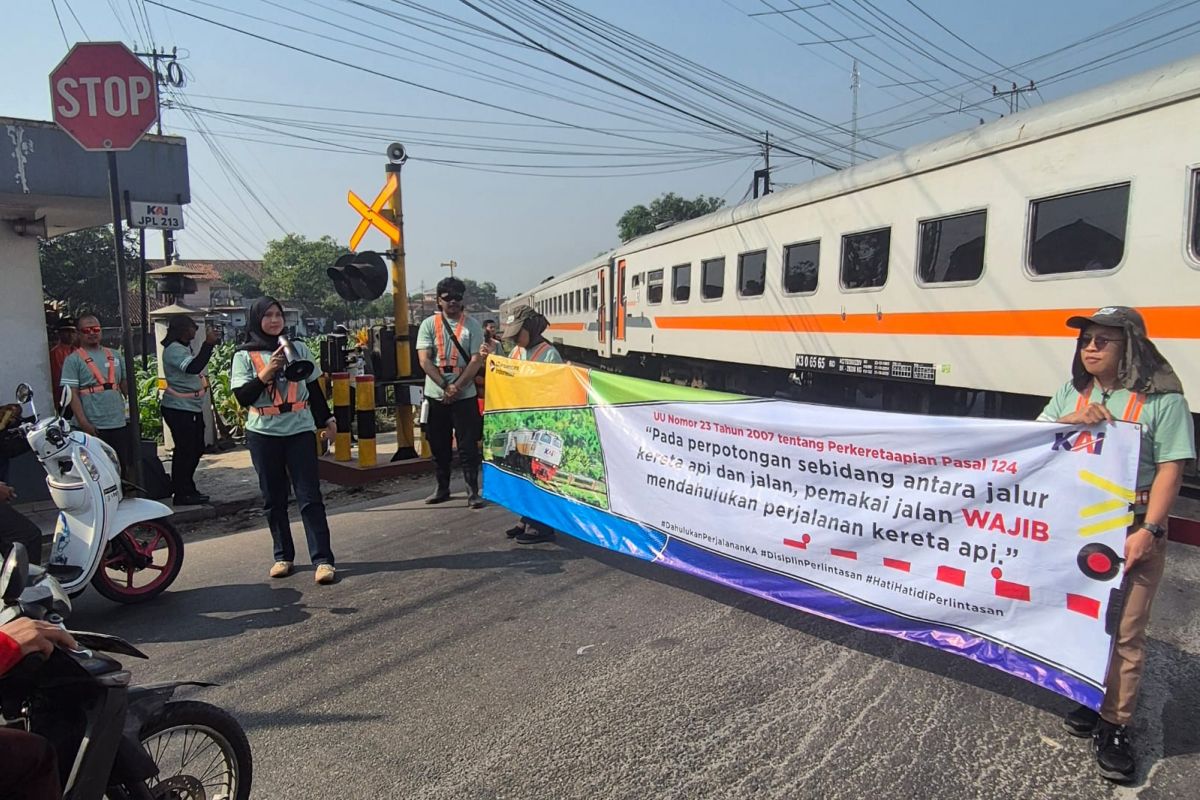
Weekends are a time when many people travel, gather, go on outings, and engage in activities around their neighbourhoods. During such moments, PT Kereta Api Indonesia (Persero) is urging the public to maintain collective safety by being disciplined when crossing level crossings and by not playing, taking selfies, sitting, fishing, vending, or conducting any activities along railway lines.
Vice President of Corporate Communication at KAI, Anne Purba, stated that the safety of train journeys depends heavily on the discipline of all parties. Trains operate on dedicated tracks and cannot stop suddenly like road vehicles.
“Waiting a few minutes at a crossing is far safer than taking the risk of trespassing. We invite the public, especially this weekend, to stop, look right and left, ensure it is safe, and give priority to trains. Railway tracks are also not a place for playing or gathering. One step into a restricted area can endanger oneself, passengers, and railway staff,” Anne said.
KAI recorded 128 accidents at level crossings up to 14 June 2026, resulting in 105 casualties, comprising 44 fatalities, 27 serious injuries, and 34 minor injuries. In terms of causes, 113 incidents, or 88 per cent, were due to vehicles trespassing; 9 incidents, or 7 per cent, were caused by vehicles stalling; and 6 incidents, or 5 per cent, were related to late or unclosed crossing barriers. The vehicles involved included 74 motorcycles, or 58 per cent, and 54 cars, or 42 per cent. By type of crossing, 59 incidents, or 46 per cent, occurred at guarded crossings and 69 incidents, or 54 per cent, at unguarded crossings.
Beyond crossing accidents, KAI also recorded 252 trespassing incidents on railway tracks outside of crossings up to 14 June 2026. Of these, 235 incidents, or 93 per cent, involved people, while 17 incidents, or 7 per cent, involved vehicles. Among the incidents involving people, 183 fatalities, 44 serious injuries, and 19 minor injuries were recorded. This data serves as a reminder that being on railway track areas without authorisation is an extremely dangerous act.
Anne emphasised that safety regulations at crossings are stipulated in Law Number 22 of 2009 on Road Traffic and Transport, Article 114. At level crossings between railway tracks and roads, drivers are required to stop when signals sound, barriers begin to close, or other warnings are given; to give priority to trains; and to grant the right of way to vehicles that arrived first. Violations of these obligations are regulated under Article 296.
Regarding activities on railway tracks, Law Number 23 of 2007 on Railways, Article 181 paragraph (1), prohibits any person from being within the railway track utility zone, placing or moving objects on the rails, crossing railway tracks without authorisation, or using railway tracks for other purposes. The criminal provisions are set out in Article 199, with adjustments following the latest applicable provisions in Law Number 1 of 2026 on Criminal Adjustments.
In terms of crossing management, KAI records a total of 3,674 level crossings. The breakdown includes 2,771 registered crossings and 903 unregistered and unguarded crossings. Of the registered crossings, 1,864 points are guarded and 907 points are registered but unguarded. Consequently, there are 1,810 unguarded level crossings that are the focus of management, consisting of 907 registered but unguarded points and 903 unregistered and unguarded points.
KAI, together with Danantara, BP BUMN, the Directorate General of Railways of the Ministry of Transportation, and the National Transportation Safety Committee (KNKT), has also coordinated the handling of level crossings. For the priority closure programme, of the 172 designated level crossings, 150 points have been closed as of 18 June 2026, reaching 87 per cent. There remain 22 points whose resolution is being continuously coordinated with relevant stakeholders.
The details of the closure realisation for the 150 points include: Operational Area 1 Jakarta, 20 out of 31 points; Operational Area 2 Bandung, 1 out of 1 point; Operational Area 3 Cirebon, 1 out of 1 point; Operational Area 4 Semarang, 11 out of 11 points; Operational Area 5 Purwokerto, 6 out of 6 points; Operational Area 6 Yogyakarta, 2 out of 2 points; Operational Area 7 Madiun, 1 out of 1 point; Operational Area 8 Surabaya, 4 points from a target of 2 points; Operational Area 9 Jember, 7 out of 7 points; Regional Division I North Sumatra, 39 out of 39 points; Regional Division II West Sumatra, 26 out of 35 points; Regional Division III Palembang, 6 out of 6 points; and Regional Division IV Tanjungkarang, 26 out of 30 points.
In addition to closures, KAI has also prepared a safety improvement programme for crossings that still require upgrading. From an initial quota of 1,638 level crossings, 1,404 have been verified as targets for safety enhancement. Based on the verification recap, the distribution of road widths consists of 732 crossings with a width of less than 4 metres, 589 crossings with a width of 4 to 6 metres, and 83 crossings with a width of more than 6 metres.
From the 1,404 verified points, KAI has designated 190 priority points to be commenced in 2026 through the provision of guard posts without barriers, communication tools, and watchmen. The remaining 1,214 points will be handled in stages during the 2027 to 2030 period, taking into account priority scales, field conditions, and coordination with Railway Engineering Centres (BTP) and local transportation agencies.
Today, KAI together with communities in the Operational Area 2 Bandung region conducted a socialisation campaign on level crossing safety and disciplined activity around railway tracks. The activity involved 30 participants from various communities, including railfans, through safety education sessions and a Safety Hunting Photo & Video activity directed to ensure that train documentation is carried out from safe locations and in accordance with regulations.
“We appreciate the railfan communities who have been helping to convey safety messages. We currently foster 56 communities,” Anne added.