
Sadang children raft first, then go to school
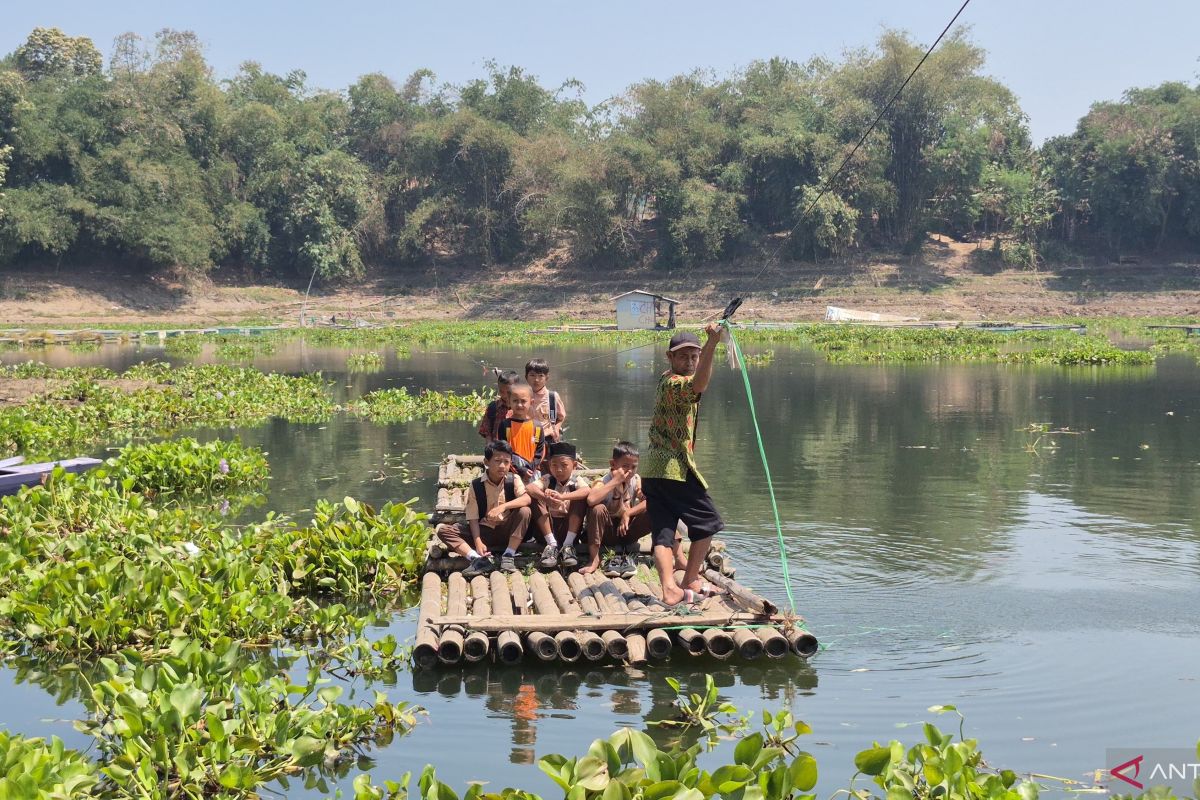
The clock was approaching 6 a.m. Western Indonesia Time when a number of children in Kampung Sadang, Budiharja Village, Cililin District, West Bandung Regency, West Java, began preparing to go to school.
Dressed in their white-and-red uniforms with school bags slung over their backs, they walked together towards the edge of the Saguling Reservoir, where a bamboo raft was waiting to carry them to the other side.
One by one, the children climbed onto the raft. They sat close together, keeping their bags and school equipment safe. A resident then helped guide the raft using a rope stretched across the surface of the reservoir.
Slowly, the raft moved away from the Kampung Sadang shore towards Kampung Gombong, where SD Negeri Budiharja primary school is located.
For these children, travelling by raft is not an occasional experience. Every school day, they cross the Saguling Reservoir by raft to reach their classrooms.
The sight may seem unusual to those seeing it for the first time. But for the residents of Kampung Sadang, crossing the reservoir on a bamboo raft has been part of daily life for decades.
Kampung Sadang and the school are actually not very far apart when viewed from the crossing point.
However, the absence of a bridge means the children must either use the raft or walk along a much longer land route.
Taufik, head of SD Negeri Budiharja, said the distance via the land route from Kampung Sadang to the school is nearly four kilometres.
On foot, the children’s journey can take around half an hour. The situation is made worse by the fact that pupils must now be in class by 6.30 a.m.
“So to shorten the children’s journey and support their enthusiasm for school, I would ask for a pedestrian bridge so that the trip from there to here could take just 10 minutes or even 5 minutes. The bridge is very much needed,” said Taufik.
There are currently 16 pupils at SD Negeri Budiharja who still use the raft to travel to and from school.
They consist of three first-year pupils, four second-year pupils, three third-year pupils, three fifth-year pupils, and three sixth-year pupils.
For the school, the issue is not only about travel distance, but also about the children’s comfort and access to education.